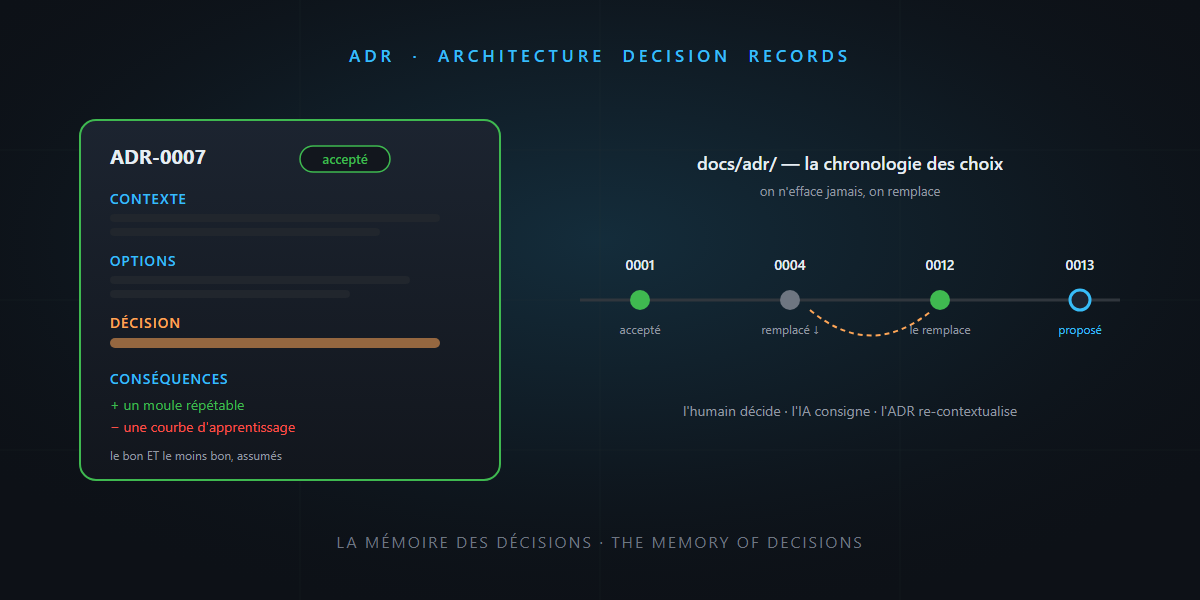
Sprint 23. A new developer joins the team and asks the fatal question: “Why MongoDB, here? Everything else is SQL Server.” Silence. The person who made that choice left a year ago. Was it a good reason? A constraint of the time? A lost bet? Nobody knows. So nobody dares touch it.
In the vibe engineering article, I slipped in one instruction: a docs folder with ADRs. Today, let’s unfold it. It’s the documentation tool with the best effort-to-value ratio I know — and in the age of AI agents, it’s worth double. You’ll see: it’s not rocket science.
Chesterton’s fence
An old engineering parable: you find a fence in the middle of a path. Naive reflex: “it serves no purpose, let’s remove it.” Wise reflex: “as long as I don’t know why it’s there, I don’t touch it.”
All legacy code is full of Chesterton’s fences: that weird cache, that three-attempt retry, that isolated MongoDB. Without the reason, every past decision becomes untouchable — or worse, gets demolished by someone unaware of the constraint it solved. The problem isn’t the decision; it’s the memory of the decision.
The ADR: one record per decision
An ADR (Architecture Decision Record) is a small Markdown file that captures one structural decision. Not a forty-page architecture binder: a record, numbered, dated, that fits on one screen. The classic format (Michael Nygard’s) has five sections:
| Section | The question it answers |
|---|---|
| Title + number | what is this about? (0007-cqrs-with-carter.md) |
| Status | proposed, accepted, superseded by…? |
| Context | what was the situation, the constraints, the options? |
| Decision | what did we choose, stated affirmatively? |
| Consequences | what does it imply — the good and the less good? |
A concrete example, in full
# ADR-0007: CQRS with Minimal API + Carter instead of MVC controllers

## Status
Accepted — 2026-07-12

## Context
The application exposes an API where reads (catalogs, searches) are
20 times more frequent than writes, with different performance needs.
The team (3 devs) knows MVC; nobody has practiced CQRS yet. Part of
the code will be AI-generated: we need a structure the agent can
reproduce without drifting.

Options considered:
1. Classic MVC controllers — familiar, but everything mixes into
   ever-growing controllers.
2. Full CQRS with event sourcing — oversized for the need.
3. "Light" CQRS: Minimal API + Carter + one handler per use case.

## Decision
Option 3. Each feature = one command OR one query, with its dedicated
handler. Carter modules group endpoints by domain.

## Consequences
+ A clear, repeatable mold — including for AI-generated code.
+ Handlers testable in isolation (target: 80% coverage).
- Learning curve for the team (~1 sprint).
- More files; navigation takes getting used to.
- Event sourcing remains possible later; this choice doesn't block it.
Notice the owned negative consequences: that’s what separates an ADR from a marketing document. Eighteen months from now, “why Carter?” will have a complete answer — context, discarded alternatives, accepted price.
When to write an ADR (and when not to)
The three-question test — one yes is enough:
- Will the decision be expensive to reverse? (framework, database, service boundaries)
- Does it constrain future development? (conventions, imposed patterns)
- Did it spark debate in the team? (if we discussed it for an hour, the conclusion deserves ten minutes of writing)
A variable name, a utility lib replaceable in an hour: no ADR. Otherwise the tool dies under its own weight — ten important records beat a hundred bureaucratic ones.
The lifecycle: never erase, supersede
Golden rule: an accepted ADR is immutable. If the decision changes, you don’t edit history — you write a new ADR that supersedes the old one, and the old one moves to “Superseded by ADR-0019”. The docs/adr/ folder thus becomes the chronology of the project’s choices: you can replay the film, understand what was true at the time, and why it no longer is.
Practically: the records live in the repository (docs/adr/NNNN-title.md), versioned with the code, reviewed in pull requests like everything else. An architecture decision going through code review — that’s exactly where it belongs.
Why it’s worth double in the age of AI agents
Three reasons, and the third one is new:
- The AI re-contextualizes with it. A conversation is forgotten by the next session; a
docs/adr/folder gets re-read. The sprint-24 agent that reads ADR-0007 reproduces the CQRS pattern instead of reinventing controllers — it’s the documentation side of the formula from the vibe engineering post: the prompt expresses the decisions, the repo remembers them. - The AI drafts it. The alignment discussion happened in the chat? Ask the agent: “write the ADR for what we just decided”. The ideal division of labor: the human decides, the AI records, the human reviews.
- The ADR protects against overzealous agents. An agent that “cleans up” code without knowing its reason is Chesterton’s fence torn down at LLM speed. The record is the sign saying “this fence is here because…” — readable by humans and by machines.
In summary
- The problem isn’t making decisions, it’s losing their reason — Chesterton’s fence.
- An ADR = one Markdown record per structural decision: status, context, options, decision, consequences (negative ones included).
- Write one for what’s expensive to reverse, constraining, or debated — and never edit: supersede.
- In the repo, reviewed in PRs — and in the agent era: the human decides, the AI records, the ADR re-contextualizes future sessions.
Ten minutes of writing per decision, and never again “we don’t know why, so we don’t touch it”. And that, honestly… is not rocket science.