Ask an AI model a question about the history of Rome: brilliant answer. Ask it about your internal expense reimbursement procedure: it makes things up, politely. Fair enough — it has never read your documents. They’re private, recent, or both.
The solution is called RAG (Retrieval-Augmented Generation), and it rests on a delightful idea: embeddings, or how to turn text into points on a map. Two barbaric words, one crystal-clear mechanism. Let’s take it apart. You’ll see: it’s not rocket science.
The problem: a cultured expert who never read your files
An LLM knows what it saw during training: a lot of things, up to a certain date, and none of your private data. Two tempting-but-wrong ideas to fill the gap:
Wrong solution 1: paste everything into the prompt. Your 400 pages of documentation in every message? Remember the tokens article: everything you send is paid on every turn, the context window has a ceiling, and a model drowned in 400 pages answers worse, not better. The right context size is the smallest one that does the job.
Wrong solution 2: retrain the model (fine-tuning). Expensive, slow, and above all frozen: your documentation changes tomorrow, and your custom model is already stale. Fine-tuning teaches a style or a behavior — not fresh knowledge.
The real solution fits in one sentence: give the model only the three relevant pages, at the moment it needs them. But then you have to find those three pages. Enter embeddings.
The embedding: text becomes a point on a map
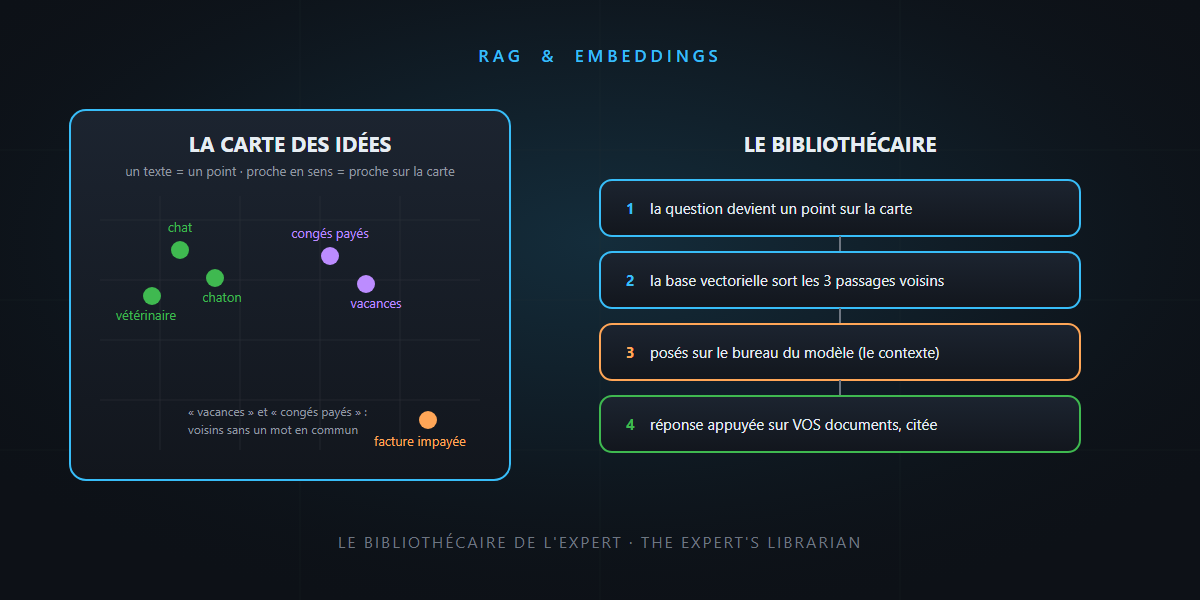
An embedding is a transformation: you give a text to a specialized model, and it returns a list of numbers (a vector — often several hundred). You can think of those numbers as coordinates on a giant map of ideas.
And here’s the magic property: two texts with similar meaning land at nearby coordinates.
- “kitten” ends up right next to “cat”, not far from “veterinarian”…
- …and very far from “unpaid invoice”.
- Better: “paid leave” and “vacation” are neighbors without sharing a single word.
That’s the quality leap over good old Ctrl+F: keyword search finds words, embeddings find meaning. Someone searches for “remote work”? The paragraph about “working from home” comes up anyway.
The vector database: the library sorted by meaning
Once your documents are turned into points, you need to store them and be able to ask: “give me the points closest to this one”. That’s the job of a vector database — a library sorted not alphabetically, but by proximity of ideas: the shelves group together what talks about the same thing.
A detail that matters: you don’t index whole documents, but chunks of a few paragraphs. Too big, and the chunk drowns the information in noise; too small, and it loses its context. This slicing — chunking — is a discreet but decisive tuning knob of any RAG system.
RAG assembled: the librarian and the expert
Everything is in place. Here’s the full film, for every question:
- The question comes in: “what’s the reimbursement deadline for business travel expenses?”
- It’s turned into a point on the same map (embedding of the question).
- Retrieval: the vector database returns the 3 to 5 closest chunks — the “professional expenses” section of your policy, an HR FAQ…
- Augmentation: those chunks are pasted into the context, with the question and an instruction: “answer from these excerpts, cite your sources”.
- Generation: the model writes — grounded in your documents.
The image to remember: the model is a brilliant expert who never read your files; RAG gives it a librarian who, before every answer, lays the three right documents on its desk. The expert doesn’t become more knowledgeable — it becomes documented.
Readers of the Agent Framework article will recognize the librarian: it’s exactly the role of context providers — information proactively placed in front of the agent, without it having to think of asking.
The word of honesty: what RAG doesn’t fix
- The answer is only as good as what the search found. If the right passages don’t come up (bad chunking, ambiguous question, missing document), the model answers off-target — with the same confidence. A RAG system gets evaluated and tuned: it’s plumbing, not magic.
- Hallucination doesn’t disappear. It recedes a lot — the model has the facts in front of it — but it can still embroider between the excerpts. Demand citations: an answer that points to its sources can be checked in one click. (Why does the model embroider, deep down? See you tomorrow — that’s the next post’s topic.)
- Freshness is a process. New document = re-indexing. It’s a pipeline to maintain, not a one-off.
In summary
| Notion | The image | What to remember |
|---|---|---|
| Embedding | coordinates on the map of ideas | close in meaning = close on the map, even with no shared words |
| Vector database | the library sorted by meaning | finds the chunks closest to a question |
| Chunking | slicing books into passages | too big = noise, too small = out of context |
| RAG | the expert’s librarian | the 3 right excerpts on the desk, for every question |
- Neither everything-in-the-prompt (expensive, capped) nor fine-tuning (frozen): the right information, at the right time, in small quantity.
- The quality of a RAG system lives in the search (embeddings, chunking) more than in the model.
- Demand citations — RAG documents the expert; it doesn’t make it infallible.
Next time someone tells you “we plugged the AI into our documents”, you’ll know exactly what’s running behind: a map, a librarian, three excerpts on a desk. And that, honestly… is not rocket science.