In the tokens article, one line of the price table was intriguing: cached tokens, billed at a fraction of the normal price. And in the tool calling loop, one detail should have alarmed you: on every round-trip, the entire context is resent and re-billed. An agent chaining thirty tool calls re-reads the same instructions thirty times.
The remedy is called prompt caching, and it’s probably the best-yield optimization in all of AI engineering: used well, it divides the bill several-fold — provided you understand one single rule. You’ll see: it’s not rocket science.
Why it exists: re-reading isn’t free
A quick mechanical reminder: before generating a single token, the model must “digest” your whole context — a heavy computation, proportional to prompt size. Yet in a conversation or an agent loop, the overwhelming majority of the prompt doesn’t change from turn to turn: same system instructions, same tool catalog, same beginning of history. Redoing that computation every turn means paying for a full re-read of a file where only the last page is new.
The cache’s idea: the provider keeps in memory the result of digesting a prompt prefix. On the next turn, if the same prefix comes back, it resumes the computation where it left off — and bills the re-read at a reduced rate (depending on the provider, 2 to 10 times cheaper than normal input; some slightly surcharge the first cache write). Latency drops along with the bill: less to digest, faster answers.
THE rule: everything hinges on the prefix
Engrave this one, everything else follows: the cache only reuses the longest strictly identical prefix of the prompt. Identical byte for byte, from the very first character. The slightest change at position N invalidates everything after N — even if 99% of the rest is unchanged.
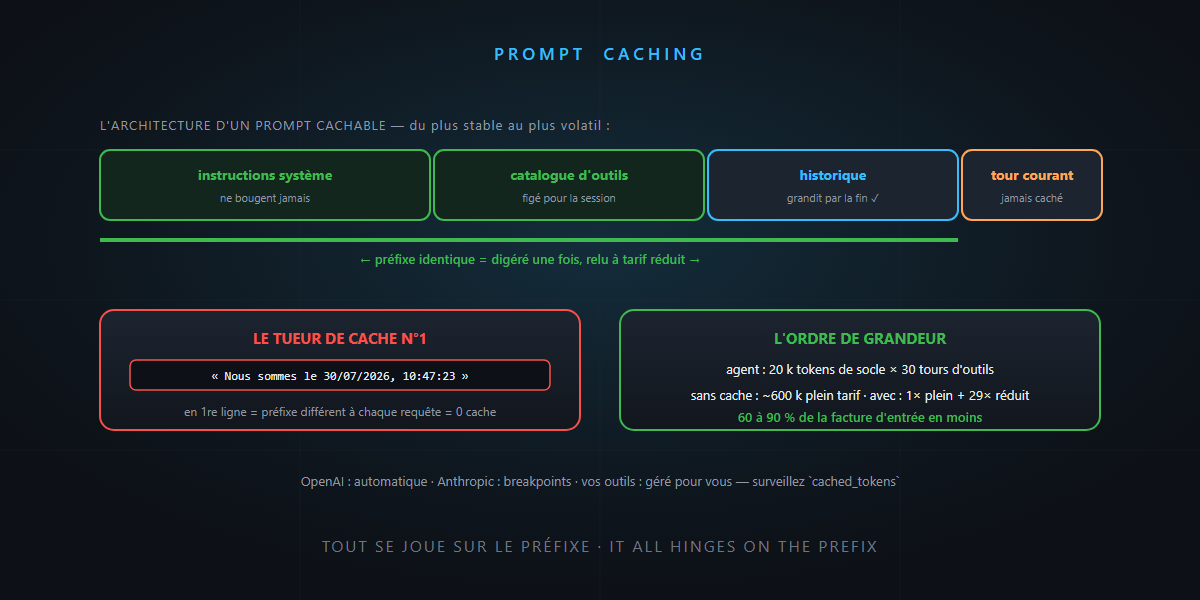
Hence the canonical architecture of a cacheable prompt — from most stable to most volatile:
- System instructions (your base prompt, the rules) — never move.
- The tool catalog (yesterday’s JSON Schemas) — never moves mid-session.
- Conversation history — only grows at the end (perfect: the prefix stays stable).
- The current turn — new every time, never cached, that’s normal.
A well-structured conversation is thus cached by construction: each turn pays full price only for what’s new.
The mistakes that ruin the cache (seen in the wild)
- The timestamp in the system prompt. “It is 07/30/2026, 10:47:23” on the first line = a different prefix on every request = zero cache, forever. Classic mistake number one. If you need the date, it goes at the end of the prompt — or rounded to the day.
- An unstable tool catalog. Reordering tools, enabling/disabling them dynamically, rewording a description on the fly: everything before the history must be frozen for the session.
- The badly placed session identifier. A GUID or username inserted early in the prompt fragments the cache per request. Variable data goes as late as possible.
- And compaction! The link with the context window article: summarizing history rewrites the prefix — and thus invalidates the cache. It’s a real trade-off: compaction shrinks the context durably, but the next turn repays everything at full price. One more reason to compact at the right moments (between tasks), not in the middle of a tool loop.
One last mechanical detail: the cache has a short TTL — typically a few sliding minutes (refreshed on each reuse), extendable with some providers. An agent chaining its turns stays warm; a conversation resumed an hour later repays the first digestion.
Who handles it: often not you — but verify
Good news: in everyday tools — Copilot, Claude Code, agent harnesses — caching is handled for you, and it’s one reason their prompts are so rigidly structured. On the API side:
- OpenAI: automatic beyond a prompt-size threshold — nothing to do, everything to structure well.
- Anthropic (Claude): explicit — you set cache breakpoints (typically after instructions and tools) and the SDK does the rest.
- In all cases, the API response tells you what was cached (
cached_tokensand equivalents): that’s THE metric to watch. A low cache rate on a conversational app = an unstable prefix somewhere — go find the timestamp.
The order of magnitude that motivates
Take a realistic agent: 20,000 tokens of base (instructions + tools), 30 tool turns in the session. Without cache: ~600,000 full-price input tokens just to re-read the base. With cache: the base is paid once at full price, then ~29 re-reads at the reduced rate — depending on the provider, that’s 60 to 90% of the input bill evaporating, plus noticeably faster responses. No other optimization in this series has that effort-to-gain ratio: here, “the effort” is moving a timestamp.
In summary
- Every turn re-digests and re-bills the whole context — the cache lets you pay for digestion once and re-read at a reduced rate.
- The single rule: only the longest byte-for-byte identical prefix is reused — structure from most stable to most volatile: instructions → tools → history → current turn.
- The cache killers: leading timestamp, unstable tool catalog, early identifiers — and compaction, to be triggered between tasks.
- OpenAI caches automatically, Anthropic via breakpoints, your daily tools do it for you — but watch
cached_tokens: it’s the thermometer.
Pay to read the file once, then pay only for the new pages: prompt caching is AI engineering’s photocopier — spectacularly profitable, as long as you don’t scribble on the first page. And that, honestly… is not rocket science.