This whole blog rests on one little phrase repeated everywhere: “the agent calls a tool”. Copilot runs your tests, your MCP server answers the model, Agent Framework executes your function tools… But concretely, how does a model that can only produce text “call” a C# function?
Short answer, and it’s today’s revelation: it doesn’t. It asks politely. Let’s take the mechanism apart — the missing link of the whole series. You’ll see: it’s not rocket science.
The revelation: the model executes nothing
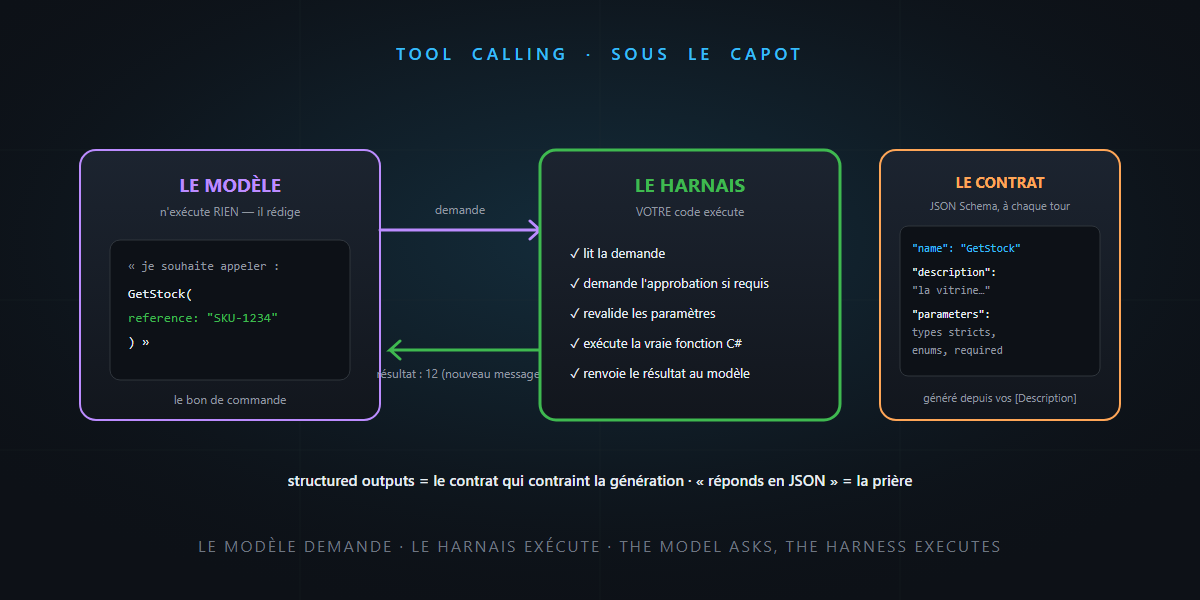
An LLM produces tokens, nothing else. When we say it “calls GetStock”, here’s what actually happens:
- The model writes a special, structured message: “I would like to call
GetStockwith{"reference": "SKU-1234"}“. - Your code (the harness, the SDK, Copilot…) reads that message, executes the real function, and collects the result.
- The result is sent back to the model as a new message, and the conversation continues.
The series’ employee never had the workshop keys: he fills in purchase orders, and the harness delivers. The entire security of the system lives in that separation — it’s your code that executes, so it’s your code that can ask for approval, refuse, or validate.
The contract: a JSON Schema (you’re already writing it)
How does the model know which tools exist and how to fill them in? With every request, it receives the catalog: for each tool, a name, a description, and a JSON Schema describing the parameters. You already write these without knowing it:
[McpServerTool, Description("Returns the stock level of a product from its reference.")]
public static int GetStock(
    [Description("The product reference, for example SKU-1234.")] string reference)
…becomes, on the wire:
{
  "name": "GetStock",
  "description": "Returns the stock level of a product from its reference.",
  "parameters": {
    "type": "object",
    "properties": { "reference": { "type": "string", "description": "The product reference…" } },
    "required": ["reference"]
  }
}
Hence two truths we’ve already met, which now make full sense: the [Description]s are the shop window (it’s literally what the model reads to choose), and the catalog is paid in tokens on every turn — forty verbose tools is thousands of tokens before your question even starts. MCP, function tools, Copilot: they all speak this same language under the hood.
The full loop
A question like “what’s the stock for SKU-1234, and order 50 if we’re under the threshold” unrolls the mechanism in a loop:
model → call GetStock(SKU-1234) → harness executes → result: 12 → model → call GetThreshold(SKU-1234) → harness executes → result: 20 → model → call CreateOrder(SKU-1234, 50) → human approval → execution → model → final written answer.
Every arrow is a message round-trip. It’s the harness, under the microscope — and that’s why an agent “thinks” in steps: it can do nothing but read results and write what comes next.
Why it goes wrong (and the remedies)
Hallucinated parameters. The model writes its purchase orders the way it writes everything: plausibly. An invented reference, an approximate enum ("Urgent" instead of "High"), a date in the wrong format. Remedies: strict types in the schema (enums, formats, bounds — the SDK generates them from your typed C# signatures), and a tool that revalidates everything at execution (rule already set).
The obese catalog. Forty tools, and the model chooses badly — Agent Framework’s docs say it bluntly: tool selection degrades as the count grows. Remedies: fewer, better-described tools, and specialized subagents that each carry only their own kit.
The mute error. The tool fails with Exception of type 'System.Exception' was thrown — and the model, which reads results, can do nothing with it. Return errors written for a reader: “unknown reference; valid references look like SKU-1234” — and the model corrects itself on the next turn. A useful error is a steering instrument.
“Answer in JSON” vs structured outputs: the prayer and the contract
Last floor, often confused with tool calling: getting structured output from the model (for your screens, imports, pipelines).
- The prayer: writing “answer only in JSON” in the prompt. It works… often. And one day, a wrapping ` ```json `, a trailing comma, a renamed field — and your parser breaks.
- The contract: structured outputs. You provide the schema, and the provider constrains generation itself: at each token, only tokens compatible with the schema are allowed. It’s no longer an instruction, it’s a grammar — the JSON is valid by construction.
In .NET, that’s the response-format parameter of the SDKs (and GetResponseAsync<T> in Microsoft.Extensions.AI, which deserializes straight into your type). The rule: the shape by contract, the substance by evals — the schema guarantees valid JSON, not true JSON.
In summary
- The model never executes anything: it writes call requests, your harness executes — all the security lives in that separation.
- The contract is a JSON Schema generated from your signatures: the
[Description]s are read by the model, and the catalog is paid on every turn. - The classic failures: plausible-but-wrong parameters (strict types + revalidation), obese catalog (fewer tools, better described), mute errors (write them for a reader).
- For structured output: the contract (structured outputs) rather than the prayer (“answer in JSON”) — valid by construction, true only after verification.
The employee fills in purchase orders, the harness delivers, and the schema acts as the pre-printed form: that’s all of tool calling. The missing link is in place. And that, honestly… is not rocket science.