A team spends weeks polishing its .instructions.md files for GitHub Copilot — pixel-perfect applyTo globs, per-directory rules, the whole nine yards. Then it tries Claude Code on the same repository… and the agent ignores everything. Not a bug: Claude Code expects CLAUDE.md files scoped by directory hierarchy, not globs in .github/instructions/. Same concept, incompatible syntax. The team’s verdict: “AI is useless.” The handbook’s verdict: you just discovered that “the AI” doesn’t exist — there are four parts, and you only changed one of them.
After the vibe coding cliff, we pop the hood with chapter 11 of Daniel Meppiel’s Agentic SDLC Handbook: the agentic runtime machine. Four independent, replaceable components — and a vocabulary that turns “it stopped working” into a precise diagnosis. Not rocket science, promise.
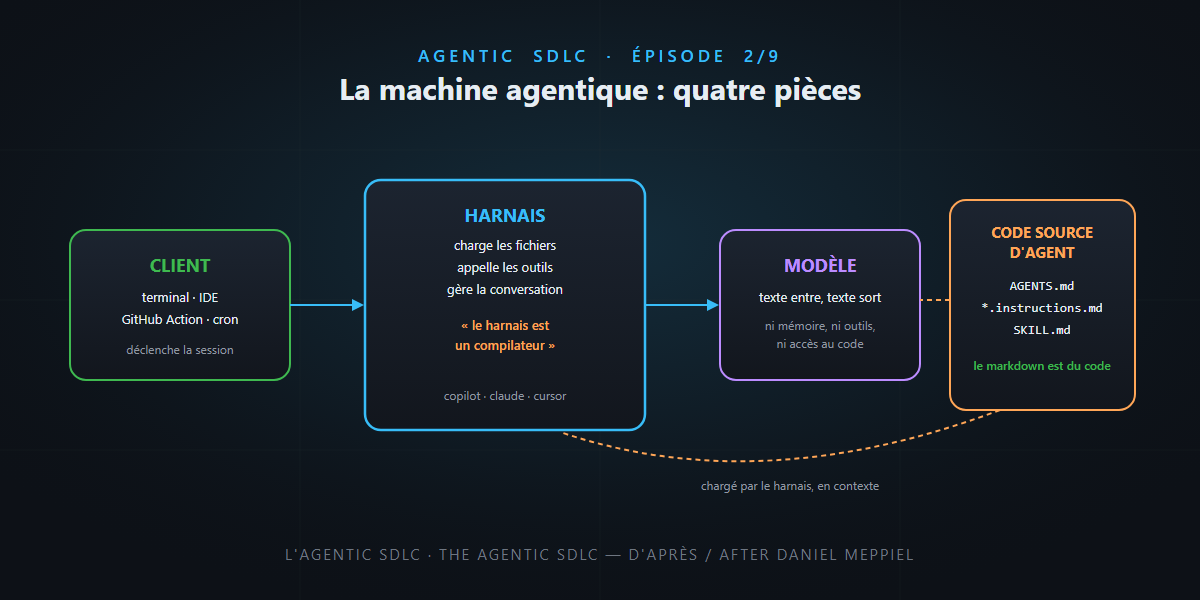
The four parts
| Part | What it is | What we forget |
|---|---|---|
| The model | the inference engine (Claude, GPT, Gemini…): text in, text out | it has no memory, no tools, no access to your code — everything is brought to it |
| The harness | the program driving the model: what runs when you type claude, copilot or open Cursor |
it is what loads files, invokes tools, manages the conversation |
| Agent source code | your AGENTS.md, .instructions.md, SKILL.md… |
this is not documentation: it is executable configuration |
| The client | whatever triggers the session: terminal, IDE, GitHub Action, cron | it injects the bootstrap context that trickles down through everything else |
Most complaints aimed “at the model” actually target one of the other three parts. We had already sketched the harness in the AI harness; the handbook pushes the idea one notch further.
The harness is a compiler
The opening story is not an anecdote, it’s a law. Copilot and Claude Code implement the same concept — scoped rules injected automatically — with incompatible syntaxes:
| Aspect | GitHub Copilot | Claude Code |
|---|---|---|
| File | api.instructions.md |
CLAUDE.md |
| Location | .github/instructions/ |
nested in the relevant subtree |
| Scoping | applyTo frontmatter (glob) |
directory hierarchy |
| References | Markdown links | @path directive |
The handbook’s conclusion: switching harnesses is porting code, not ticking a box. The clean move is to keep canonical primitives and write a small shim file at the entry point the new harness expects — exactly like keeping a portable core with per-platform adapters.
Markdown is code
Your instruction files have all the properties of executable code:
- parsed: malformed YAML frontmatter fails silently;
- linked: cross-file references form a dependency graph;
- loaded: their content enters context at deterministic moments, observable in verbose mode;
- executed: wording precision matters — “never use X” prevents a regression, “avoid X” leaves room to negotiate.
So: version them, review them in PRs, lint them, test them. It is the direct continuation of what we wrote about AGENTS.md — with one extra watchword: write these files with the rigor of code, not the looseness of docs.
The asymmetry that rules everything: inference is per-thread, the filesystem is shared
This is THE load-bearing principle of the book, the one every pattern in the next episodes hangs from. Each inference session is amnesiac: a private window that dies with the session and passes nothing on. The filesystem is the only persistent, shared memory.
Very concrete consequences:
- two parallel agents cannot talk to each other: they coordinate exclusively through files;
- a child agent inherits nothing — it only reads what its parent wrote to disk;
- long sessions demand the plan-write-then-reload pattern: write the plan to a file along the way, re-read it at decision points, to survive inference boundaries.
Recognize the mechanics of our Copilot subagents? That’s it — generalized into an architectural principle.
What this changes on Monday morning
- A diagnostic vocabulary. Different behavior between two machines, two tools, two days? Ask which of the four parts changed before blaming “the AI”.
- A context budget to watch. A skill that never triggers is often a parent file that ate the budget before it — the transitive closure of your primitives is measurable.
- Engineering discipline on primitives. Review, lint, CI: your agent files are production code.
A word of honesty
- The four-part breakdown is the handbook’s vocabulary, not an industry standard — every vendor renames everything their own way. That’s exactly what makes it useful: it survives the renamings.
- Portability is improving (the handbook points to emerging standards on the skills side), but today, porting between harnesses is real work. Budget it as such.
In short
- “The AI” = model + harness + agent source code + client. Four independent, replaceable parts — and four distinct suspects when things go wrong.
- The harness is a compiler: same concepts, incompatible syntaxes; switching tools is a port.
- Markdown is code: parsed, linked, loaded, executed — treat it with the same rigor.
- Inference is per-thread, the filesystem is shared: all multi-agent coordination goes through files; hence the plan-write-then-reload pattern.
Tomorrow we equip the repository: the seven primitives of the instrumented codebase — instructions, agents, skills, prompts, memory, specs, hooks — and how they snap together. And that, honestly… is not rocket science.