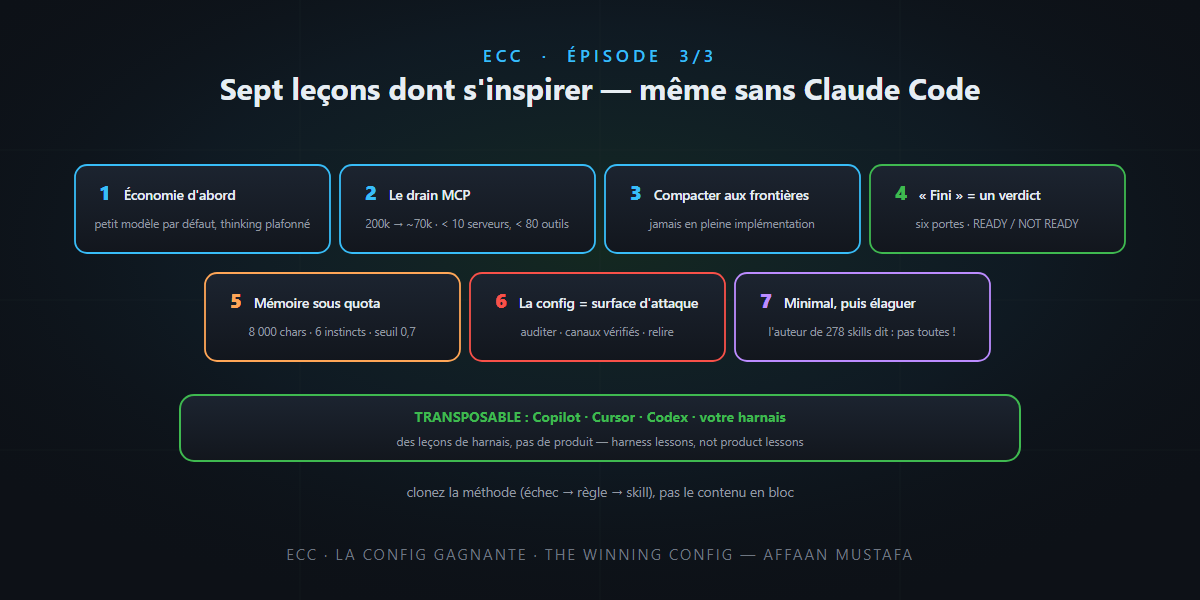
Not a Claude Code user? Doesn’t matter. The best ideas in ECC are not Claude Code ideas: they are harness ideas — and your Copilot, your Cursor or your Codex obey the same laws. To close this mini-series, here are the seven lessons I take away from the winning config, each verifiable in the repo, each transferable by Monday morning.
Grab a notebook. Not rocket science — and it’s lived experience, not theory.
Lesson 1 — Economy first, heroics second
The README’s most counter-intuitive advice: don’t make the biggest model your default. ECC’s recommended setup: Sonnet as the base model (≈ −60% cost, enough for most coding tasks), a thinking tokens cap at 10,000 instead of 31,999 (≈ −70% on the hidden reasoning cost), and the big model on demand for problems that deserve it. The winner of an Anthropic hackathon doesn’t burn Opus on variable renames — meditate on that, and re-read the economics of inference.
Lesson 2 — Your MCPs are eating your window
The number that stings, as the README puts it: every MCP tool description consumes tokens from your 200k window — potentially shrinking it to ~70k of useful space. The ECC discipline: fewer than 10 active MCP servers, fewer than 80 tools, and runtime deactivation of anything the current project doesn’t need. We announced it in our attention economy episode: the bind isn’t free. Take inventory of your MCP servers today — you’ll be surprised.
Lesson 3 — Compact at boundaries, never mid-flight
The strategic-compact skill flips the default reflex: don’t let compaction fire at 95% full, in a panic, in the middle of an implementation — it takes the variable names and file paths you need most with it. Compact deliberately at logical boundaries: after research, after a milestone, after a closed debugging session. ECC even lowers the auto-compact threshold to 50% to stay in control. It’s the operational cousin of the handbook’s plan-write-then-reload pattern.
Lesson 4 — “Done” is a verdict, not a sentence
The verification-loop we saw yesterday deserves to be stolen as-is: six gates (build, types, lint, tests, security, diff), a binary READY / NOT READY verdict, and a ban on continuing over a broken build. Whatever your harness: write that checklist into your instructions and demand the report. It’s the tooled-up antidote to the nineteen ways to sabotage your agents — the trust fall first among them.
Lesson 5 — Memory gets a budget like everything else
ECC’s memory isn’t an attic, it’s an airlock with a quota: at most 8,000 characters injected at startup, six instincts maximum, a 0.7 confidence threshold — and a global kill-switch for small-context setups. Unlimited memory is an anti-feature: it recreates the very context dumping it claimed to solve. If you keep a logbook for your AI, give it a cap and value-based triage — not an infinite scroll.
Lesson 6 — Your config is an attack surface
AgentShield exists because ECC’s creator spotted the blind spot: we scan our dependencies, never our agent files. Yet a hook can exfiltrate, an MCP server can lie, a skill copied from a gist can carry an injection — and the author himself warns that malicious mirrors of his own config circulate. Three reflexes: audit your configs (secrets, permissions, hooks), install from verified channels only, and review any model-generated config before persisting it. The logical sequel to securing GitHub Copilot and defense in depth.
Lesson 7 — Start minimal, prune often
The author of 278 skills tells you himself not to install them all: installation profiles (minimal, core, full), rules copied only for your stack, and the #1 documented pitfall — stacking install methods into conflict. It’s word for word the instrumented codebase roadmap: 3 to 5 files first, growth driven by real failures, monthly pruning. The perfect config isn’t the biggest one; it’s the one where every line has earned its place.
Bringing it home: the Copilot table
| ECC idea | GitHub Copilot equivalent |
|---|---|
| Lazy skills | skills and scoped instructions (applyTo) |
| Specialized agents | subagents and custom agents |
| GateGuard hooks | branch protections, CI, linters, org policies |
| Instincts / memory | AGENTS.md + a versioned journal, curated by hand |
| Model economy | picking your model per task |
| MCP budget | same servers, same drain — inventory and deactivate |
One honest absence: an equivalent of event hooks doesn’t exist everywhere — hence the fallback to CI and repo protections, which do the same job one step later.
A word of honesty
- A winning config is winning for its author: ten months of his failures, his stacks, his opinions (tmux, 80% coverage). Clone the method — the failure → rule → skill loop — not the content wholesale.
- The quoted numbers (−60%, −70%, 200k→70k) are ECC’s README numbers: operating orders of magnitude observed by the author, not controlled benchmarks. Verify against your own bills.
In short — the mini-series in one idea
- Economize first: small model by default, capped thinking, deliberate compaction, inventoried MCPs.
- Prove next: six gates, one verdict, never “done” on someone’s word.
- Capitalize last: memory under quota, rules born from failures, regular pruning — and a config audited like code, because it is code.
- ECC is the life-size demonstration of what the Agentic SDLC series theorized: the winning repo is an instrumented, bounded, measured repo.
Thanks for following this deep dive — Affaan Mustafa’s repo is right here, free, readable, and honestly more instructive than many paid trainings. Steal, adapt, prune. And that, honestly… is not rocket science.