Ask your team where it is written that “middleware decorators go in middleware.py” or that “the old HTTP client has been deprecated since March”. Answer: nowhere. It’s known, not written. For a new colleague, the coffee machine fixes that; for an agent that shows up amnesiac at every session, it’s a landmine. Chapter 12 of Daniel Meppiel’s Agentic SDLC Handbook attacks exactly that seam: the instrumented codebase, or how to convert tacit knowledge into files the agent loads as context.
If you followed our series “the repo that talks”, you are on familiar ground — and you are about to see how Meppiel systematizes the idea into a small programming language with seven primitives. Not rocket science.
The seven primitives
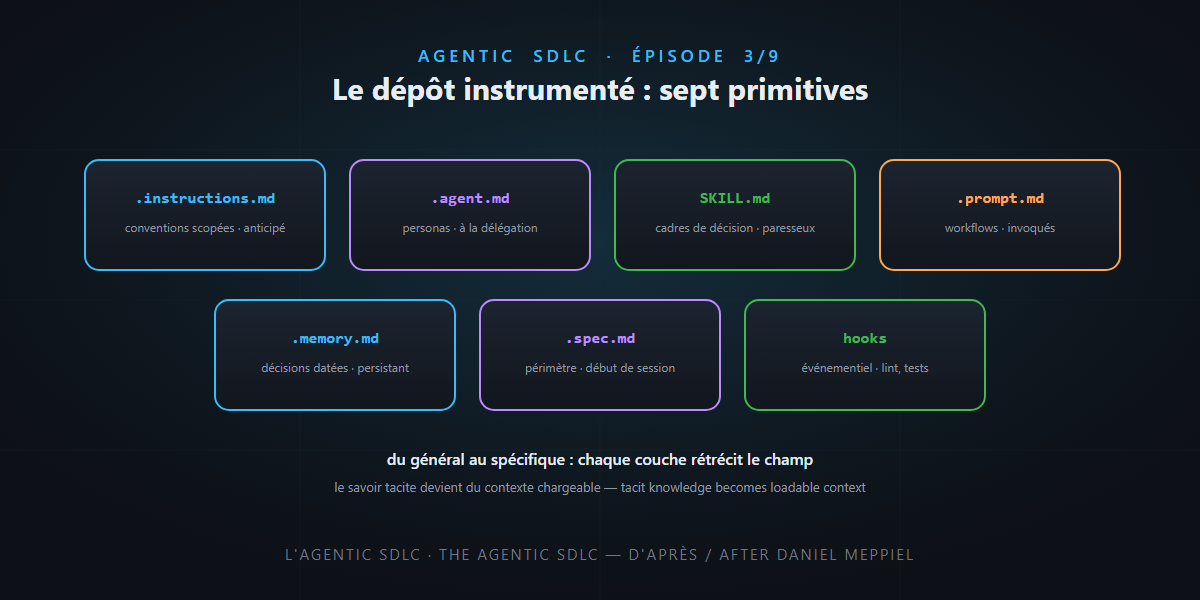
Each primitive fills one specific knowledge gap and loads at one specific moment — that pairing (what + when) is what makes the system:
| Primitive | Loading | Role |
|---|---|---|
Instructions (.instructions.md) |
eager, glob-scoped | the conventions of a file domain (“all middleware goes through X”) |
Agents (.agent.md) |
on delegation | specialist personas: expertise, named patterns, allowed tools |
Skills (SKILL.md) |
lazy, on demand | reusable decision frameworks, not mere rules |
Prompts (.prompt.md) |
invoked by the human | repeatable workflows — the repo’s makefile targets |
Memory (.memory.md) |
eager, persistent | dated decisions, trade-offs, project history |
Specs (.spec.md) |
invoked at session start | a feature’s scope: components, contracts, criteria |
| Hooks | event-driven | automatic reactions: lint on save, tests on new file |
Three design rules run through the chapter: keep files short (under 40-50 lines, otherwise split), give patterns names (agents cite what has a name), and include the anti-patterns (“never do X” encodes institutional memory).
Assembly: a hierarchy, not a pile
For a given task, effective context assembles in layers, general to specific: global instructions → scoped instructions → activated skills → agent persona → prompt or spec → memory → hooks across the board. Each layer narrows the field and adds precision. A conflict between layers is not bad luck: it’s a design bug to fix.
You can hear the echo of AGENTS.md and Copilot’s skills, instructions and agents: the bricks already exist in your tools. What the handbook adds is the grammar for composing them.
The instrumentation audit: where to start
The chapter’s how-to fits in five steps, and it makes an excellent team workshop:
- List your conventions — expect 30 to 60 items from one team discussion.
- Classify them: already in the code? in the docs? only in heads? (focus on the heads)
- Rank by cost of failure: security first, style last.
- Map each item to one of the seven primitives.
- Write 3 to 5 files covering the critical ones — and iterate on feedback.
Then the feedback loop takes over. For every failed agent output, a diagnosis: violated convention → scoped instruction; output too generic → enrich the persona; no decision framework → extract a skill; missing historical context → update memory. Every correction becomes a permanent prevention — compound interest applied to context.
What it pays back
The handbook offers field-observed orders of magnitude: convention violations dropping from 40-60% of output to under 10%, reviews emptied of style nitpicks to keep only substance, code needing rewrite cut in half. And a realistic roadmap: week 1, global instructions + one scoped file + one persona; week 2, test on real work and update memory; week 3, first skill and first prompt; then monthly review and deletion of dead rules.
A word of honesty
- The handbook’s before/after numbers are field estimates, not a controlled study — the author presents them as such. Take the trend, not the decimal.
- The classic trap: generating fifty primitive files in a week. That is the surest way to produce dead documentation — the chapter’s rule is clear: add only in response to an observed failure, and prune monthly.
- Artifacts and primitives don’t duplicate each other: the artifacts of the repo that talks (ADRs, glossary, tests…) document the system for humans and agents; primitives configure agent behavior. The latter point to the former — it’s a marriage, not a rivalry.
In short
- The instrumented codebase converts tacit knowledge into loadable files: the direct answer to episode 1’s “dual knowledge problem”.
- Seven primitives, each with its loading moment: instructions, agents, skills, prompts, memory, specs, hooks.
- Assembly is a hierarchy from general to specific — a conflict is a design bug.
- Start with the instrumentation audit (5 steps, 3-5 files), then let the feedback loop grow the system in response to real failures.
- Short files, named patterns, included anti-patterns — and monthly pruning.
Tomorrow, the handbook’s centerpiece: PROSE, the five architectural constraints that hold the whole edifice together — with their openly claimed lineage from REST. And that, honestly… is not rocket science.