Try the experiment: give the same prompt to two AI agents, one in a bare repository, the other in an equipped one — ADRs, a glossary, schemas, tests that tell the story of the behavior. The first one guesses; the second one knows. Same model, same prompt, two unrelated results. The difference doesn’t come from the AI: it comes from what the repository has to say to it.
Since this summer, this series has been exploring those artifacts one by one — ADRs, the glossary, diagrams as code, Git history. Today, let’s climb up for the view: here is the complete map of the repo that talks — and the next ten days to walk it. You’ll see: it’s not rocket science.
The thesis: value migrates from the code to its artifacts
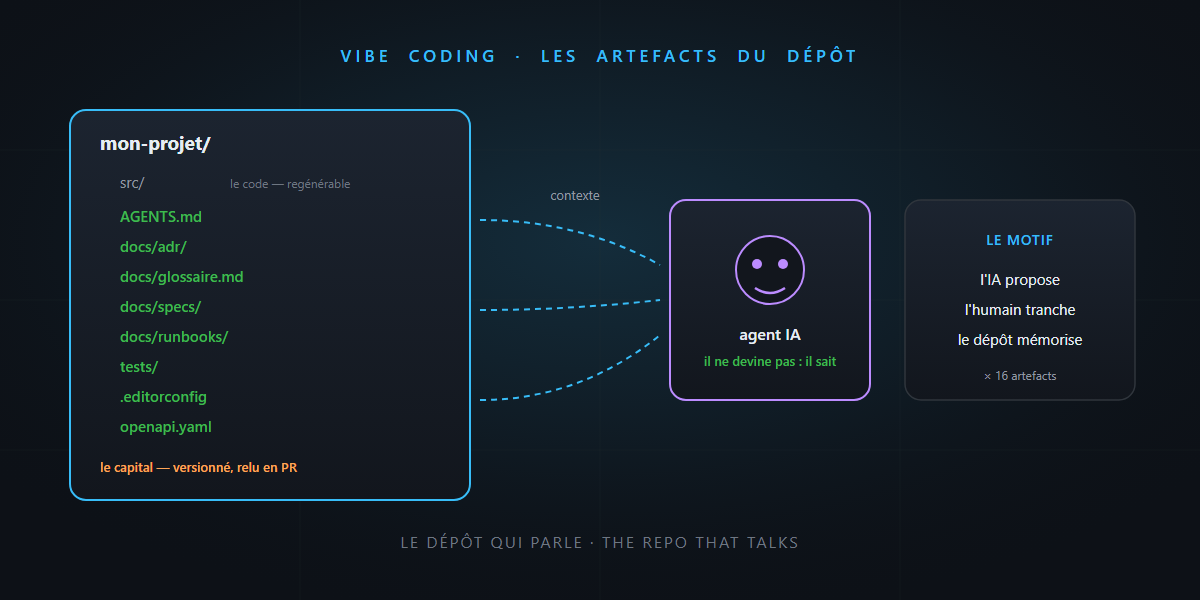
Vibe coding has a side effect few people spell out: code becomes regenerable. An implementation an agent can rewrite in twenty minutes is no longer the project’s capital. The capital is everything that constrains and explains that code: the decisions, the vocabulary, the contracts, the tests, the conventions. Lose the code, you regenerate it; lose the artifacts, you regenerate anything at all.
Hence the rule that structures the whole series: every artifact lives in the repository, versioned, reviewed in pull requests — because that’s where, and only where, your agent reads it on every session. An external wiki is invisible to it; a Markdown file next to the code is free context.
The map: four families
1. The memory of decisions — the why
| Artifact | What it captures | The article |
|---|---|---|
| ADR | a decision made, its options, its price | already published |
| RFC / design doc | a decision in progress — the organized debate | August 24 |
| Git history | the thousand small decisions, commit by commit | already published |
This family’s common thread: Chesterton’s fence. An agent that doesn’t know why something exists demolishes it with enthusiasm.
2. Intent — the what
| Artifact | What it captures | The article |
|---|---|---|
| Spec | the expected behavior, source of truth | August 23 |
| Issue template | a task’s brief, agent-ready | already published |
| Implementation plan | the how, approved before the code | August 25 |
| Tests | the executable spec — the one that cannot lie | August 26 |
This is the control family: in vibe coding, you don’t re-read a 2,000-line diff — you approve a spec, amend a plan, and demand green tests.
3. The guardrails — what enforces itself
| Artifact | What it captures | The article |
|---|---|---|
| Schemas and contracts (OpenAPI, JSON Schema, types) | machine-verifiable boundaries | August 27 |
| Linters and analyzers | self-enforcing conventions | August 28 |
| One branch per agent | the isolation that makes mistakes reversible | already published |
The agents’ favorite family: they don’t even read these artifacts, they bump into them — and correct themselves. Every automated rule is one instruction you don’t have to write and one review comment you don’t have to make.
4. Shared context — what everyone reads
| Artifact | What it captures | The article |
|---|---|---|
| AGENTS.md / instructions | the AI’s onboarding guide, re-read every session | August 22 |
| Domain glossary | the single vocabulary, business ↔ code | already published |
| Diagrams as code | the system map, editable by the agent | already published |
| Runbook | the manual for known outages | already published |
| Postmortem | the memory of incidents | August 29 |
| llms.txt | your published docs, written for other people’s agents | August 30 |
The pattern that shows up everywhere
Re-read any episode already published and you’ll find the same three rules — they hold for the entire map:
- The AI proposes, the human decides, the repo remembers. The agent excels at writing the draft (the ADR, the glossary, the postmortem, the diagram); the human keeps the decision; the repository keeps the record.
- Selectivity is the value. Ten living records beat a hundred bureaucratic ones — an artifact nobody maintains becomes a versioned lie.
- All of this was already worth gold before AI. None of these artifacts was invented for agents; they already served humans. Agents just make them pay twice: what helped the new colleague now helps a new colleague who shows up amnesiac every single session.
The honesty moment
- Don’t install all sixteen at once. A repository that goes from zero artifacts to the full arsenal in a week mostly produces dead documentation. Start where it bleeds: the agent names things wrong? Glossary. It undoes your choices? ADRs. It ignores your conventions? AGENTS.md and linters.
- Artifacts don’t replace conversation. A team that stopped talking because “it’s all in the docs” has a problem Markdown won’t fix.
In summary
- In vibe coding, code becomes regenerable; the capital is the artifacts that constrain and explain it — all of them in the repository, versioned, reviewed in PRs.
- Four families: the memory of decisions (ADRs, RFCs, Git), intent (specs, plans, tests), the guardrails (schemas, linters), and shared context (AGENTS.md, glossary, diagrams, runbooks, postmortems, llms.txt).
- Everywhere the same pattern: the AI proposes, the human decides, the repo remembers — and selectivity is the value.
- What’s next: one artifact per day until August 30. The map is drawn; let’s walk it.
A repo that talks is an agent that knows — and a human who sleeps well. See you tomorrow for the first stop: AGENTS.md. And that, honestly… it’s not rocket science.