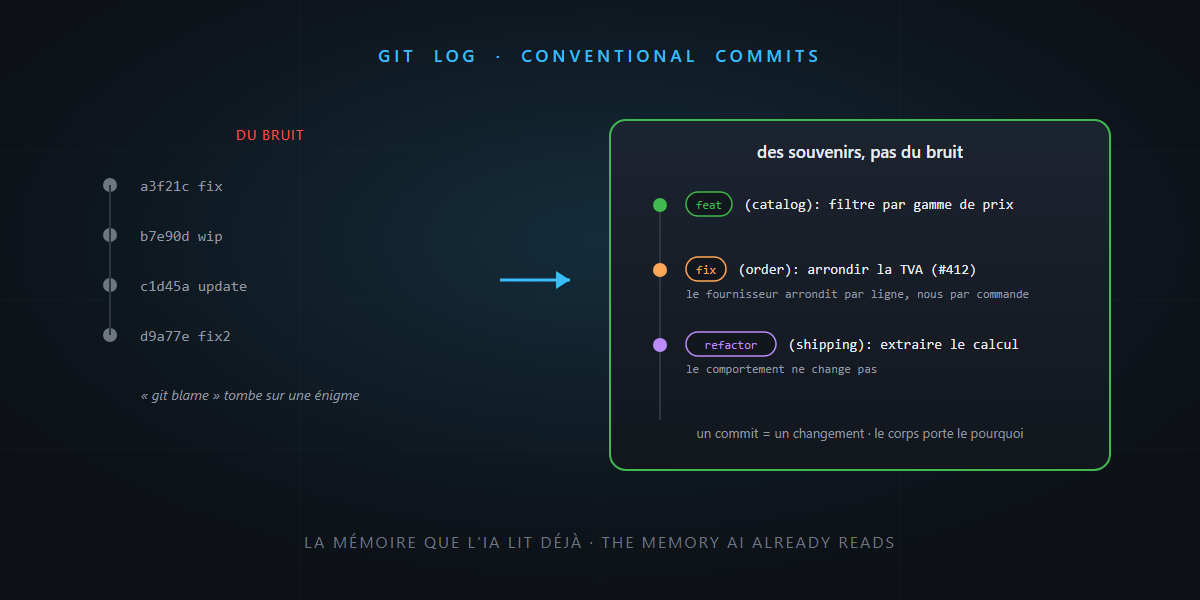
Watch an AI agent work on a tricky bug: at some point, almost always, it runs git log or git blame. It does exactly what a good dev would do: find out when that line changed, together with what, and why. And there, two worlds: either it finds fix(order): round VAT to the cent before totaling (#412) — or it finds fix, wip, update, fix2.
Yesterday we saw how AIs build themselves a memory. Today, the twist: your project already has a perfect memory — timestamped, tamper-proof — the Git history. The only question is whether you write memories into it, or noise. You’ll see: it’s not rocket science.
The history is a (free) knowledge base
Every commit can answer three questions that neither the code nor the comments can carry:
- What, together? The scope: which files moved in a single gesture. An atomic commit draws the invisible links between a handler, its migration and its test.
- When, and in what order? The chronology: did this bug appear before or after the EF migration?
git loganswers in seconds. - Why? The intent: the only piece of information that exists nowhere else. The diff says what changed; only the message says for what reason.
It’s the same thread as ADRs: losing the why makes code untouchable. The ADR captures the big decisions; the commit message captures the thousand small ones — the VAT rounding, the retry added after the incident, the workaround for the driver bug.
Conventional Commits: three minutes to learn
The Conventional Commits format won because it’s tiny: a prefix, an optional scope, a description.
feat(catalog): add price-range filter
fix(order): round VAT to the cent before totaling (#412)
refactor(shipping): extract delivery-time calculation to a dedicated service
| Prefix | It means | The reader (human or AI) deduces |
|---|---|---|
feat |
new capability | expected behavior has grown |
fix |
correction | there was a bug — the message says which |
refactor |
neither feat nor fix | behavior must not change |
test, docs, chore |
periphery | can often be skimmed |
The message body, optional, carries the why when it doesn’t fit on the line: “the supplier rounds per line, we round per order; one-cent discrepancy on baskets > 40 items”. Two sentences written once — re-read at every git blame for ten years.
The twin rule: the atomic commit. One commit = one logical change. The catch-all commit (“end of day”) destroys the history’s first treasure: scope. If you’d describe your commit with “and”, split it.
Why it’s worth double in the AI-agent era
- The agent reads the history unprompted.
git log --oneline -- path/to/file,git blame,git show: these are standard tools of any agent in autonomous mode. A clean history is quality context already injected into every session — without a single token from you. - The agent writes the history — brief it. One line in your instructions: “atomic commits, Conventional Commits format, the body explains the why”. Agents excel at this discipline — they don’t have the 6:45 pm laziness. Many teams discover their finest commit messages are now the machines’.
- The loop closes. The sprint-30 agent reading
fix(order): round VAT…written by the sprint-12 agent inherits the context without anyone writing a line of documentation. The history becomes a conversation between sessions — yesterday’s memory, repository edition.
And a mechanical bonus: Conventional Commits are parsable. Generated changelogs, automatic semantic versioning (GitVersion and friends), CI that reacts differently to a feat and a chore — prose becomes tooling.
The honest word
- Don’t rewrite ancient history. The rotten history of the last three years is unrecoverable — and that’s OK. The value builds from today; in six months, the recent layer (the one consulted most) will be clean.
- Squash merge is a choice, not a reflex. Crushing a PR of fifteen careful commits into a single “Add feature (#89)” throws away the reasoning’s detail. Squash the noise (“fix typo”, “oops”), keep the steps that tell the story — or demand PRs small enough that one commit is enough.
- A commit linter is useful, not sufficient. commitlint or a hook checks the format; no machine can check that the message says the why. That remains a matter of team culture — and review.
In summary
- Git history is the only project memory that is exhaustive, timestamped and free — provided you write memories into it (
fix(order): round VAT…) rather than noise (fix2). - Two tiny disciplines suffice: Conventional Commits (type, scope, description — the body for the why) and the atomic commit (one commit = one change; “and” = split).
- AI agents read this history spontaneously (
git log,git blame) and write it with perfect discipline if your instructions demand it — the ADR captures the big decisions, the commit captures the thousand small ones. - You don’t clean up the past: you write clean from today, and you think twice before squashing.
Next time someone — human or agent — runs git blame on your code, they’ll land on an explanation instead of a riddle. Ten seconds of care per commit, years of free context. And that, honestly… it’s not rocket science.