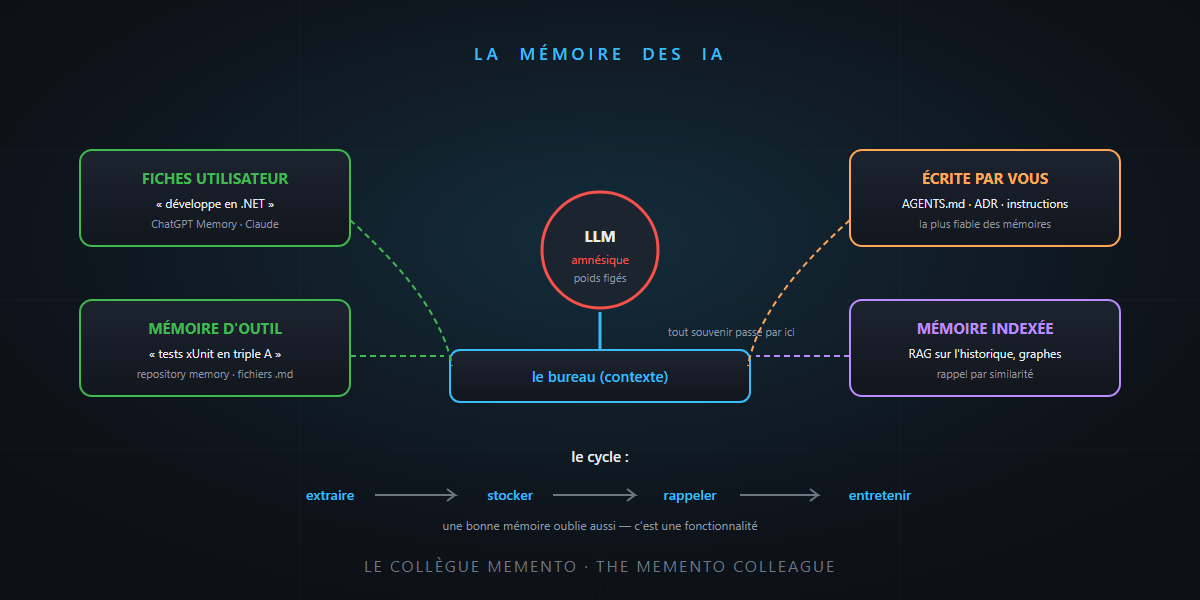
“I told you yesterday!” — and yet no: yesterday doesn’t exist for a language model. Its knowledge is frozen at training time, and its context window — yesterday’s desk — empties with every new conversation. An LLM is, by construction, a brilliant amnesiac.
And yet ChatGPT knows your preferences, Claude remembers your projects, Copilot CLI recalls your conventions. No magic: everything that looks like memory is an external system, built around the model. Today we take those systems apart — floor by floor. You’ll see: it’s not rocket science.
The Memento colleague
The right image is the hero of the film Memento: unable to form new memories, he copes through a system — tattoos for the essentials, annotated polaroids, notes everywhere. He remembers nothing; his system remembers for him.
An AI “with memory” is exactly that. The model stays amnesiac — its weights never change while you use it. Around it, a system extracts, stores, and lays the right notes back on the desk at the start of each session. Three immediate consequences:
- “Memory” is not learning: the model doesn’t get smarter, it gets better briefed (the fine-tuning vs context nuance, again).
- Every recalled memory occupies the desk: memory consumes context, bill included.
- What’s stored can be read, edited, deleted — and that’s excellent news.
Floor 1: working memory (already covered)
The context window: everything on the desk during the session. Volatile by nature — that was yesterday’s article, with its six compression patterns. Just remember it’s the mandatory gateway: wherever it comes from, a memory only acts once it lands on the desk.
Floor 2: user cards — ChatGPT’s and Claude’s memory
The system best known to the general public. During the conversation, a discreet process spots what’s worth keeping and writes it down as small cards:
“Develops in .NET and Blazor” · “Prefers concise answers” · “Preparing an Azure certification”
At each new session, the relevant cards are re-injected into the context — and that’s why ChatGPT “knows” what you do for a living. Two mechanisms coexist at OpenAI: explicit memories (the cards, viewable and deletable one by one in settings) and chat history reference (drawing from your past conversations). Claude plays a similar tune with its project-scoped memory, toggleable and inspectable — you can read what it retained, correct it, erase it.
The reflex to build: go read your cards. It’s your profile as seen by the machine — and sometimes one stale card (“works in Java”, since 2024…) biases all your answers. A memory needs maintenance.
Floor 3: tool memory — the repository that learns
The floor that concerns us most as developers — you met it in episode 2 of the CLI series:
- Copilot CLI maintains a repository memory: conventions discovered while working (“xUnit tests in triple A”, “endpoints via Carter”) are noted and reused — plus a cross-session memory to pick up last week’s thread.
- Claude Code keeps memory files in Markdown: dated, organized, versionable notes — the most inspectable form there is:
git diffon your AI’s memory.
Note the kinship with Memento: in both cases, these are text files the system re-reads at startup. No black box — notes.
Floor 4: human-written memory — your foundations
This article’s twist: you’ve been doing memory engineering since the beginning of this series. AGENTS.md, repository instructions, ADRs — what are they, if not memories written by you, injected into every session?
The difference with floor 3 is a difference of pen: here the human writes (reliable, intentional, reviewed in PRs), there the tool learns (automatic, but fallible). The two complement each other — the vibe engineering formula gets its final word: the prompt expresses, the repo remembers, the tooling enforces… and the tool learns the rest.
Floor 5: searchable memory — RAG on your own past
Last floor, for large volumes: when memories number in the thousands, you can’t re-inject everything. You index them — embeddings, vector database — and recall only the most relevant ones for the question at hand. The librarian, applied to your own history. That’s the mechanics of Agent Framework’s context providers, which push the idea all the way to knowledge graphs: memories that are connected (this customer → prefers → express delivery), not just stacked.
The full cycle (and its traps)
Every AI memory lives the same four-beat cycle: extract (what to keep? — after the response), store (card, file, vector), recall (lay it on the desk at the right time), maintain (deduplicate, update, expire). And each beat has its trap:
- Polluted memory: a wrong or stale card gets re-injected every session — a permanent bias. Hence the importance of inspectability (and the advantage of Markdown memories: they can be proofread).
- Privacy: what’s remembered travels in every prompt. In a company, “what does the tool retain, where, for whom?” belongs in the same folder as Copilot security — incognito/memory-off modes exist for good reasons.
- Overflow: remembering too much resurrects yesterday’s dilution. A good memory forgets — it’s a feature, not a flaw.
In summary
| Floor | Who writes | Lifespan | Example |
|---|---|---|---|
| Context window | the session | the conversation | yesterday’s desk |
| User cards | the tool (auto) | months | ChatGPT Memory, Claude memory |
| Tool memory | the tool (auto) | the project’s life | Copilot CLI repository memory |
| Written foundations | you | the project’s life | AGENTS.md, ADRs, instructions |
| Indexed memory | the tool | unlimited | RAG on history, knowledge graphs |
- An LLM is amnesiac by construction: any “memory” is an external system re-briefing the model each session.
- Remembering = extract, store, recall, maintain — and recall always goes through the desk (so it’s paid for).
- Read your cards: a memory gets inspected, corrected, pruned — and in a company, governed.
- The most reliable memory remains the one you write: your instructions and ADRs are first-class memories.
The Memento colleague copes very well — provided he keeps his notes up to date. Give your tools the same care: a few accurate cards beat a notebook bloated with dubious memories. And that, honestly… is not rocket science.