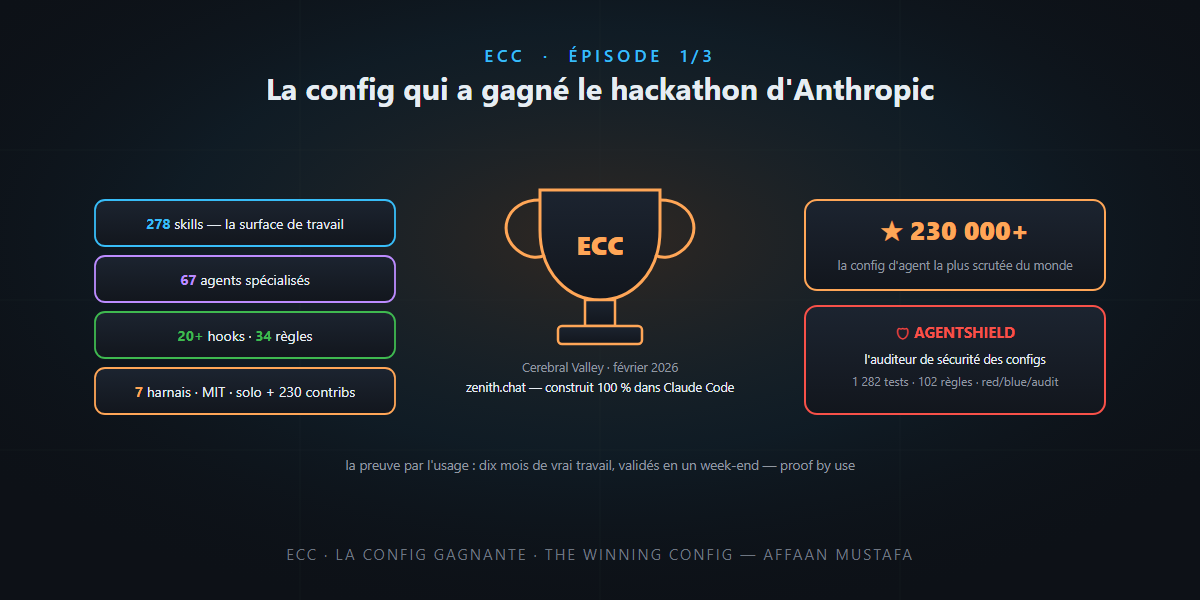
For nine episodes, our Agentic SDLC series defended one thesis: coding with agents demands a method — primitives, constraints, validation gates. What was missing was the exhibit. Here it is. February 2026, Anthropic × Forum Ventures hackathon at Cerebral Valley: Affaan Mustafa and his co-founder win by building zenith.chat entirely in Claude Code. And instead of keeping the recipe, the winner published his whole configuration under MIT: ECC, “the agent harness operating system”. More than 230,000 GitHub stars later, it is probably the most scrutinized agent config in the world.
This three-episode mini-series dissects it: today the story and the overview, tomorrow the technical anatomy, the day after the lessons to steal — even if you don’t use Claude Code. Not rocket science.
The identity card
ECC is not “a config file”: it’s a complete system, born — per its author — of more than ten months of intensive daily use building real products:
| Component | Volume | Role |
|---|---|---|
| Skills | 278 | the primary working surface: TDD, review, e2e, deployment, research… |
| Agents | 67 | delegable specialists: planner, architect, per-language reviewers |
| Rules | 34 (9 common + 25 per language) | the always-true: style, git, workflow |
| Hooks | 20+ scripts | event-driven automations: guardrails, formatting, secrets |
| MCP | 14 ready-made servers | GitHub, Supabase, Vercel, Railway… |
| Shims | 94 legacy commands | backward compatibility during the migration to skills |
All of it multi-harness — Claude Code, Cursor, Codex, OpenCode, Gemini, Copilot, Zed — maintained by a solo developer shipping weekly, backed by 230+ contributors. If you read our episode on the agentic runtime machine, you recognize the “agent source code” box — pushed here to industrial scale.
The hackathon as a crash test
The story fits in one line from the author: the win validated that the config was production-ready. Building a complete product in a weekend, driven entirely from the harness, is the ultimate crash test for a configuration — the opposite of a collection of theoretical prompts. It’s exactly the “handbook written with the method it teaches” principle we admired in Daniel Meppiel’s work: proof by use.
AgentShield: born the same weekend
Out of the same hackathon came AgentShield, a security auditor… for agent configurations. The tool scans CLAUDE.md, settings.json, MCP configs, hooks, agents and skills along five axes: secrets detection (14 patterns), permission auditing, hook injection analysis, MCP server risk profiling, agent config review. The spec sheet claims 1,282 tests, 98% coverage, 102 static analysis rules — and an adversarial pipeline of three Claude Opus agents: red team, blue team, auditor.
Take a second to appreciate the reversal: the agent config has become an attack surface that deserves its own scanner. It’s the logical continuation of what we wrote in prompt injection: defense in depth — more on this in episode 3.
Trying it without hurting yourself
Three installation paths, from simplest to finest:
- The plugin (recommended):
/plugin install ecc@eccfrom the Claude Code marketplace. - Selective install:
install.sh/install.ps1withminimal,coreorfullprofiles. - Manual copy: cherry-pick agents, rules and skills into
~/.claude/.
And pitfall #1, documented by the author himself: never stack the methods — plugin then install script = duplicate skills, duplicate hooks, conflicting context. The README even ships the uninstall --dry-run to dig yourself out.
One last point, and not the least: the author explicitly warns that unofficial third-party mirrors of his config circulate and may contain malware — install only from verified channels (the GitHub repo, the official npm packages, the ecc@ecc slug). An agent config deserves the same paranoia as a dependency.
The map of the mini-series
| # | Date | Episode |
|---|---|---|
| 1 | today | The config that won — you are here |
| 2 | September 15 | anatomy: skills-first, hooks, instincts and memory |
| 3 | September 16 | the lessons to steal — even without Claude Code |
A word of honesty
- 230,000 stars don’t mean “install everything”: ECC is a personal config turned ecosystem. Its first value, for us, is to be read — a free, annotated catalog of production-proven patterns.
- The project has a transparent commercial side (ECC Pro, sponsors) funding the shipping cadence; the core stays MIT “perpetually”. Worth keeping in mind while reading the README, as with any open source project with a paid tier.
In short
- ECC = the complete configuration of the Anthropic × Forum Ventures hackathon winner (Feb 2026, zenith.chat built entirely in Claude Code), published under MIT — 278 skills, 67 agents, 34 rules, 20+ hooks, multi-harness.
- Born of ten months of real use, validated by the win — proof by use, not theory.
- AgentShield, born the same weekend, scans… agent configs: the config is officially an attack surface.
- Install through one path (plugin or script or manual), from verified channels only.
Tomorrow we pop the hood: how 278 skills fit without melting the context window, what the hooks guard, and the “instincts” system that learns from your sessions. And that, honestly… is not rocket science.