How do you write a 68,000-word book with AI agents? Exactly the way you ship a 75-file PR: waves, checkpoints, and never two agents on the same file. Daniel Meppiel’s Agentic SDLC Handbook has a rare elegance: it is its own case study — eleven agents, four pods, a fleet orchestrated by its author with the very method the text teaches.
After the deterministic boundary, here are chapters 17 and 18: when to go multi-agent, how to partition, and the five-phase meta-process that turns a fleet into shipped software. We laid the groundwork with Copilot subagents; now we change scale. Not rocket science.
First: do you even need it?
Chapter 17 starts by cooling the enthusiasm:
| A single agent is enough if… | A fleet is justified if… |
|---|---|
| fewer than ~10 files | 15-20 files and up |
| a single concern | intersecting concerns (architecture + logging + security) |
| linear dependencies | parallelism that would actually save time |
| context fits comfortably in the window | distinct expertise domains to mobilize |
Three specialization patterns recur: writer/reviewer/tester (separate production from validation), domain teams (each carrying its specialized context), and audit/execute/validate (read-only agents explore, the human decides, read-write agents apply).
The golden rule and the shared truth
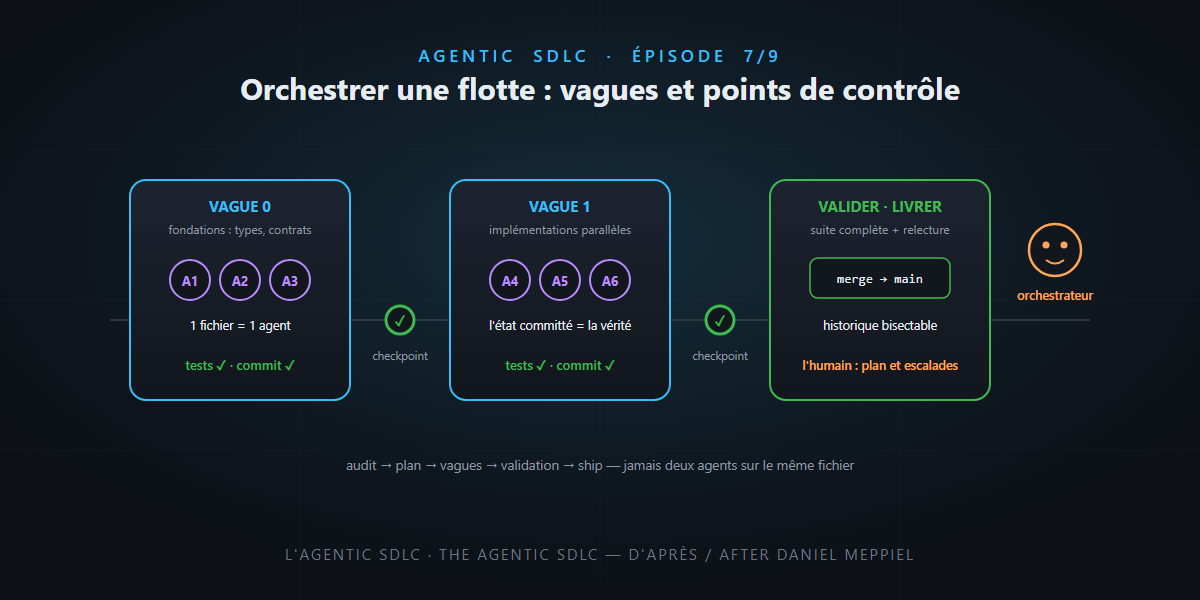
One parallelization constraint is non-negotiable: one file, one agent, per wave. Put two agents on the same file and the second one’s edits fail silently — its textual anchors have moved.
And remember episode 2: sessions are amnesiac and isolated — agent 1 sees neither agent 2’s conversation nor its reasoning. Coordination flows through committed state: between waves, the repository becomes the ground truth the next wave reads. Hence the imperative ordering: foundations before consumers — types, protocols and interfaces in wave 0, implementations after — to avoid semantic conflicts, those changes that are individually correct but mutually inconsistent.
The meta-process: five phases
Chapter 18 assembles it all into a universal flow, tool-independent:
- Audit — 2 to 4 read-only expert agents examine the code from distinct angles and return ranked findings, cited by file and line.
- Plan — the human turns findings into an executable spec: scope, teams, waves, principles. This is the highest-impact point: a mediocre plan perfectly executed yields mediocre software. Every task passes the self-sufficiency test — completable without questions? If not, re-slice. (A direct echo of our implementation plan.)
- Waves — parallel execution, one file per agent; every wave ends tested and committed.
- Validate — full suite + human inspection of critical changes.
- Ship — merge, changelog, and a bisectable history: one commit per wave, green tests at every step.
When a checkpoint breaks, the ADAPT loop takes over: diagnose, adjust the plan, re-execute — uncertainty is part of the contract with a probabilistic system. And the process scales both ways: under 10 files, compress everything (one audit, one wave); over 100, extend (4-6 experts, 6-10 waves).
Escalations and the coordination tax
The human orchestrator handles four escalation levels: L1 the agent self-heals (red tests), L2 human-refined retry, L3 design decision, L4 scope expansion. The handbook’s barometer: a healthy plan runs around 20% L3/L4; above 25%, it’s the plan that was underspecified, not the agents that are bad.
And the honest numbers from the reference PR (75 files): 45 minutes of human coordination for 24 minutes of agent compute. The win is not raw speed — it’s replacing the 30-45 minutes of debugging a degraded single-agent output with quality controlled upstream. Multi-agent pays off when files count in the dozens, concerns partition cleanly, and the pattern will repeat.
Proof by book
The handbook’s case study tells the story of its own writing: 11 agents in 4 pods (editorial, domain, review, audit), ~50 dispatches, 4 writing waves, 75 fact-check flags, 4 human escalations. Three delicious lessons: a single agent blew up mid-flight on the 15-chapter architecture (context is finite, always); three personas were created mid-project in response to real gaps; and the panel’s disagreement about how much space to give APM (the author’s own tool!) dissolved the moment the Chief Editor stated an explicit principle — the book must be useful without APM, which appears as proof, not prerequisite. One written principle is worth a thousand implicit arbitrations.
A word of honesty
- The coordination tax is real and the handbook prices it itself. A fleet for a 50-line change is an anti-pattern (chapter 27 says it bluntly) — start single-agent, go fleet on the criteria above.
- The orchestration described is still artisanal: the human paces the waves. Harnesses are progressively automating this — but the invariants (one file/one agent, commit per wave, foundations first) hold regardless of tooling.
In short
- Multi-agent only if: 15-20+ files, intersecting concerns, profitable parallelism, distinct expertises.
- Golden rule: one file, one agent, per wave — and committed state as the only shared truth between waves.
- The meta-process: audit → plan → waves → validate → ship, with the ADAPT loop when things break; the plan is the highest-impact human point.
- Escalations L1-L4: above 25% L3/L4, redo the plan.
- The existence proof: the handbook itself, written by 11 agents under human editorial direction.
Tomorrow, the gallery of horrors: nineteen anti-patterns — from the monolithic prompt to the agent that swears it modified files it never touched. You will recognize yourself (so did I). And that, honestly… is not rocket science.