Friday, 4:42 pm. The agent proudly announces: “Feature implemented — 47 files changed.” The diff is 2,000 lines. You scroll. By line 300, your eyes glaze over; by line 800, you approve “on trust”. Somewhere in the remaining 1,200, the agent rewrote your authentication middleware. You’ll find out on Monday.
Yesterday, we decided before coding with RFCs and design docs. Today, the next stop on the map of vibe coding artifacts: the implementation plan — the precise moment where the human keeps control over what the agent is about to do. You’ll see: it’s not rocket science.
The quote before the work
Nobody lets a contractor start the work without a quote. The quote reads in ten minutes: which walls, which materials, in what order, at what price. And above all: you negotiate on the quote. Once the wall is up, the negotiation changes name — it’s called demolition.
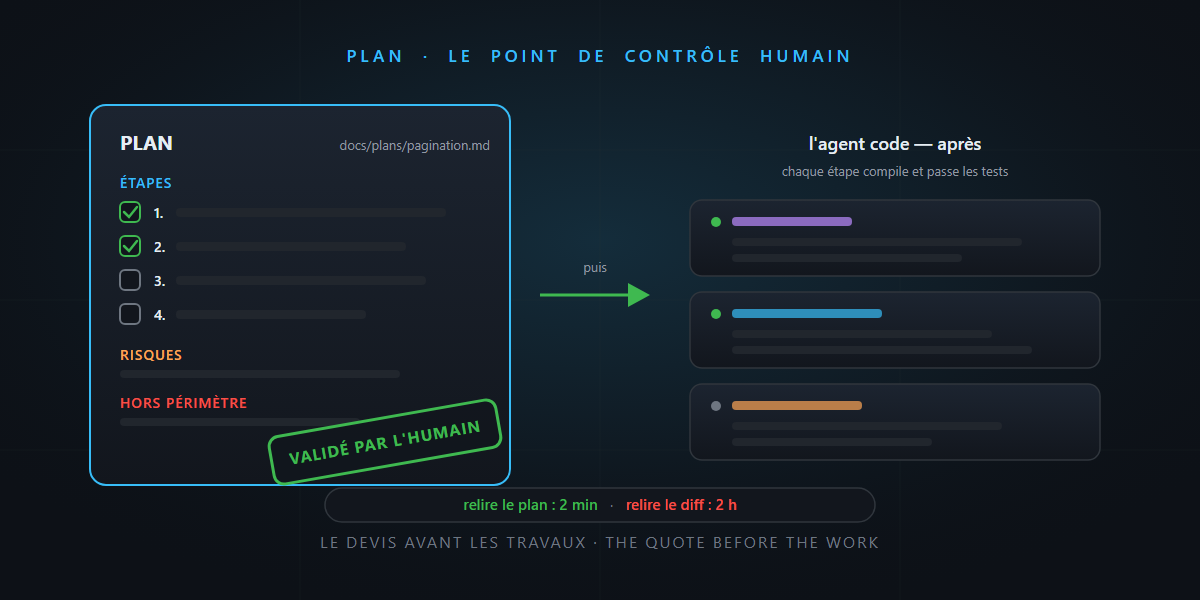
The 2,000-line diff is the wall, already built. The 40-line plan is the quote. Reviewing one takes two hours — when you actually review it; reviewing the other takes two minutes. A factor of 100, for the same decision power. The plan is where one minute of your attention has maximum leverage: it is THE human checkpoint of vibe coding.
Plan mode: read, propose, amend, code
The tools have baked the idea in. GitHub Copilot has its Plan mode — already covered in the article on modes — and Claude Code has its own. The mechanics are the same everywhere, in four beats:
- The agent reads. It explores the code read-only: nothing gets modified.
- The agent proposes a plan. Files, steps, approach — in plain text, before any line of code.
- The human amends. This is the step that matters: you strike out, you clarify, you redirect.
- Only then, the agent codes — following the approved plan.
All the value sits in step 3. Jumping from 2 to 4 by typing “ok go ahead” is signing the quote without reading it.
What a good plan contains
| Section | The question it answers |
|---|---|
| Goal | what are we trying to achieve, in one sentence? |
| Files touched | where will this happen — and thus, what’s the blast radius? |
| Ordered steps | in what order — each step compiles and passes the tests |
| Risks | what can go wrong, and what do we watch for? |
| Test strategy | how will we know it works? |
| Out of scope | what we are not doing — the golden section |
“Out of scope” is the reviewer’s best friend: it’s the fence that stops the agent from “improving” three neighboring modules on the way.
A concrete example, in full
# Plan: pagination on GET /api/policies

## Goal
Paginate the policy list (today: everything loaded in memory,
40,000 rows in production).

## Files touched
- Features/Policies/List/ListPoliciesQuery.cs      (page/pageSize parameters)
- Features/Policies/List/ListPoliciesHandler.cs    (Skip/Take on the SQL side)
- Features/Policies/List/ListPoliciesEndpoint.cs   (query string + headers)
- Tests/Policies/ListPoliciesTests.cs

## Steps (each one compiles and passes the tests)
1. Add page/pageSize to the query, defaults: 1 and 20, pageSize max 100.
2. Switch the handler to Skip/Take + CountAsync — check the SQL plan.
3. Expose X-Total-Count and prev/next links in the endpoint.
4. Tests: empty page, last page, pageSize out of bounds.

## Risks
- The mobile app calls this endpoint without parameters: the defaults
  must reproduce today's first-page behavior exactly.

## Test strategy
Integration tests against a real database (Testcontainers) — no EF mocks.

## Out of scope
- No cursor (keyset) pagination: an ADR to write if performance demands it.
- No configurable sorting — that's another ticket.
Forty lines, two minutes of reading. And on review, the line “the mobile app calls this endpoint without parameters” jumps out — exactly the kind of thing you know and the agent doesn’t. You amend one line; it codes for two hours.
Persist the plans in the repository
A non-trivial plan deserves to outlive the session: docs/plans/2026-08-25-pagination-policies.md, versioned with the code. Two benefits. In the pull request, the reviewer reads the plan before the diff — same leverage, a second time. And in the next session, the agent picking up the work re-reads the plan instead of re-guessing the intent: the repository re-contextualizes, just like with ADRs.
And the difference with the spec? Simple: the spec says what — the expected behavior, stable over time. The plan says how and in what order — and it’s disposable once executed. One spec outlives ten plans.
Why it’s worth double in the AI agent era
- The plan catches wrong directions before they cost anything. An agent heading the wrong way produces 2,000 wrong lines with the same confidence as 2,000 right ones. At the plan stage, the wrong direction fits in one line — “I’ll rewrite the auth middleware” — and gets fixed in one sentence.
- Amending the plan is steering without micro-managing. Between “I dictate every line” and “I let it run and pray”, the plan is the middle ground: you correct the trajectory once, upstream, then let the agent execute. The series formula, in action: the AI proposes, the human decides, the repository remembers.
- The plan slices the work into verifiable steps. “Each step compiles and passes the tests” turns one 2,000-line bet into four 500-line bets. At the first red light, you know which step lied — instead of digging through a monolithic diff.
The honesty moment
- Plans lie at the first obstacle. Step 2 will reveal a problem nobody had seen, and the plan will have to move. That’s normal: you replan. The value is in the planning — the exploration, the risks flushed out — not in the document itself.
- Over-planning a three-line change is theater. Demanding a plan to fix a typo is bureaucracy dressed up as rigor. A plan has to be earned: several files, a debatable direction, a real risk.
- An approved plan is not a contract. “But you approved the plan!” is not a defense. The human stays responsible for the final diff — the plan shrinks the surprise surface, it doesn’t replace the review.
In summary
- Reviewing a plan costs 100× less than reviewing the diff: negotiate on the quote, not on the wall already built.
- Plan mode: the agent reads and proposes, the human amends, then the agent codes — all the value is in the amendment.
- A good plan: files touched, ordered steps that compile and test one by one, risks, test strategy — and the out of scope.
- Non-trivial plans live in
docs/plans/: reviewed in PRs, re-read by the next agent. The spec says what; the plan says how.
Two minutes of attention at the right moment beat two hours of resigned scrolling at the wrong one. And that, honestly… it’s not rocket science.