Friday, 4 pm. The agent generated the “password reset” feature in twenty minutes. The code is clean, the tests pass. Monday, the product owner watches the demo: “The link was supposed to expire after 24 hours, not 7 days. And we never say ‘this email doesn’t exist’ — that’s an enumeration vulnerability.” Nobody had written it down. The agent guessed. It guessed fast, it guessed well-formatted, and it guessed wrong.
Yesterday we covered AGENTS.md — the guide that tells the AI how to work in your repository. Today, continuing the artifact map: spec-driven development, or how to tell the AI what to build — before it guesses on your behalf. You’ll see: it’s not rocket science.
The architect’s plan and the house
A house is built from a plan. And there’s a rule every architect knows: you don’t alter the house without updating the plan. Drill through a load-bearing wall without recording it, and the next project — the extension, the renovation — starts from a plan that’s wrong. The next builder will trust a document that lies.
For twenty years, our software “plans” suffered the opposite fate: the initial Word spec, never updated, dead by sprint 3. We eventually declared that the code is the source of truth — for lack of anything better. But something has changed: when an AI can regenerate the code for a feature in minutes, the code becomes the by-product. What remains, what holds the value, is the intent. The house can be rebuilt; the plan is the capital.
The chain: PRD → spec → plan → code
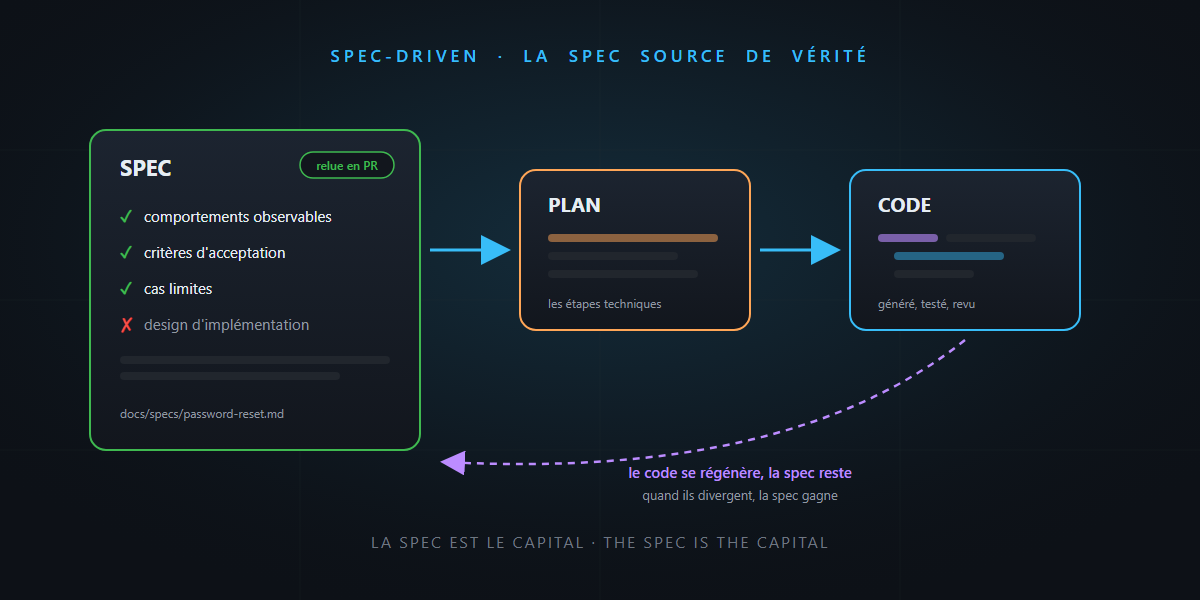
Spec-driven development puts the documents back in the right order, each at its own altitude:
| Level | Document | Answers | Who decides |
|---|---|---|---|
| Product | PRD | why this feature? for whom? | the product owner |
| Behavior | Spec | what must happen, observable from outside? | the team |
| Technical | Plan | how we implement it, in which steps? | the dev (+ AI) |
| Execution | Code | the implementation itself | the AI (+ human review) |
The spec is the pivot level: precise enough to be verifiable, abstract enough to survive three rewrites of the code. A good spec describes observable behaviors, acceptance criteria and edge cases — never implementation choices. “The link expires after 24 hours”: spec. “We store the token in Redis with a TTL”: plan.
A short spec, in full
Not a forty-page requirements binder. One Markdown file per feature, in docs/specs/, versioned and reviewed in PRs — like ADRs and the glossary:
# Spec: password reset

## Requirements (EARS style)
- WHEN a user requests a reset with a known email, the system
  SHALL send a single-use link valid for 24 hours.
- WHEN the email is unknown, the system SHALL display the same
  confirmation message (no email enumeration possible).
- WHEN the link has expired or was already used, the system SHALL
  display "link expired" and offer to send a new one.
- WHILE a reset is pending, previous links SHALL be invalidated.

## Acceptance criteria
- Given a link older than 24 hours, when the user clicks it,
  then the form is not displayed.
- Given two successive requests, when the first link is used,
  then it is rejected.

## Edge cases
- Deactivated account: same message as "unknown email".
- 3 requests within 10 minutes: rate limit, HTTP 429.

## Out of scope
- Email change, 2FA (separate specs).
Everything is verifiable from the outside: you can test every line without opening the code. And notice what’s not there: no Redis, no email library, no class names. That’s the plan — the level below.
The tools that popularized the approach
Two names keep coming up. GitHub Spec Kit, open source, structures the flow into three commands — /specify (the spec), /plan (the technical plan), /tasks (the task breakdown) — that the agent executes one after the other. Kiro, AWS’s IDE, put specs at the heart of its agent mode: every feature starts with a requirements file (in EARS style, precisely) that the AI maintains with you.
But remember the principle, not the tools: a Markdown file in docs/specs/, reviewed in PRs, already does 80% of the job. Spec-driven development will outlive Spec Kit the way ADRs outlived their generators.
Why it’s worth double in the AI agent era
- The agent implements against the spec instead of guessing. Without a spec, the AI fills the gaps with statistically plausible choices — a 7-day expiry, an error message that enumerates emails. With the spec in context, every requirement becomes a constraint, and your prompts shrink: “implement the
password-reset.mdspec” is enough. - The spec disambiguates everything downstream. The plan derives from it, the tests derive from it, code review leans on it — the reviewer (human or AI) compares the code to the spec, not to their intuition. The whole chain descends from the same document.
- When code and spec diverge, the spec wins — and the agent can detect the divergence. That’s the architect’s-plan rule, and it’s a task where AI excels: “compare this module to its spec and list the gaps”. Either the code is wrong (fix it — or regenerate it), or the spec has aged (update it in the same PR). The series formula applies as-is: the AI proposes, the human decides, the repository remembers.
The honesty moment
- This is not waterfall making a comeback. The waterfall spec described the whole system, up front, in one go. Here: one spec per feature, one page, written just before coding, amended along the way. It’s just-in-time, not Big Design Up Front.
- An unmaintained spec lies — and that’s worse than no spec. A wrong plan makes you drill through the wrong wall. The guardrail is the same as for the glossary: the code and its spec travel in the same PR, and an unjustified gap blocks the review.
- The overhead is real for small changes. A typo fix, a label, a style tweak: no spec. Save it for behaviors worth defending — ten living specs beat a hundred bureaucratic ones.
In summary
- When AI can regenerate the code, the code becomes a by-product — the spec is the capital, like the architect’s plan versus the house.
- The chain: PRD → spec → plan → code, and the spec describes observable behaviors, acceptance criteria, edge cases — never the implementation.
- A spec = one Markdown file per feature in
docs/specs/, versioned, reviewed in PRs — Spec Kit and Kiro tool the flow, the principle will outlive them. - With agents: the AI implements against the spec, detects divergences — and when code and spec diverge, the spec wins.
You don’t alter the house without updating the plan; you don’t merge the code without updating the spec. And that, honestly… is not rocket science.