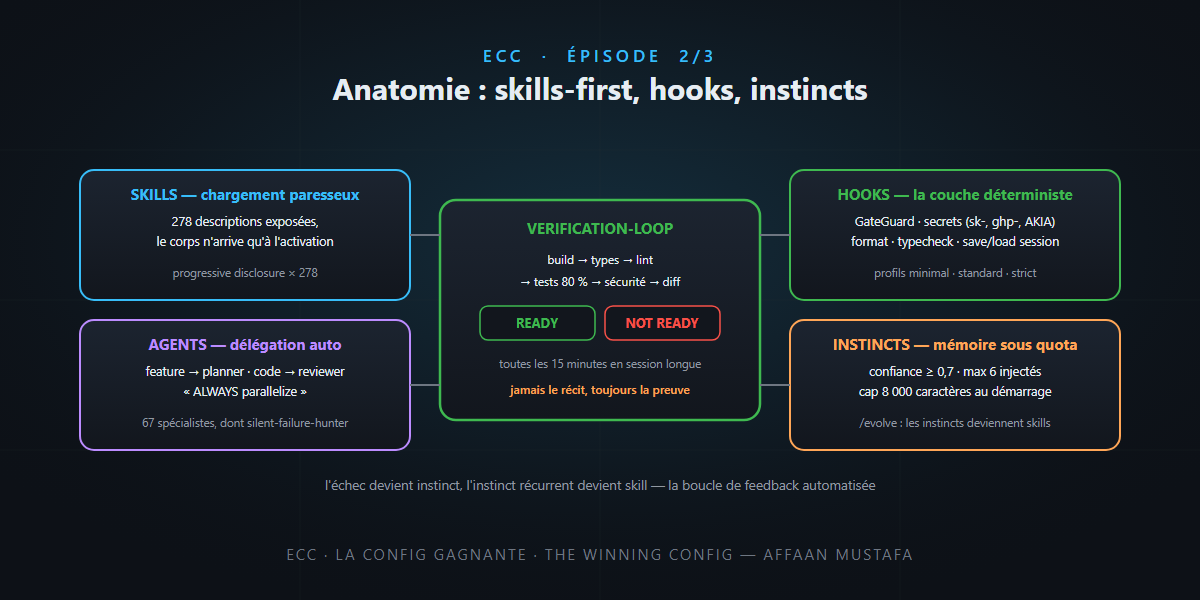
Trick question: how do you load 278 skills into an agent without pulverizing its context window? Answer: you don’t. You load their descriptions, and the body only arrives if the task calls for it. The whole architecture of ECC rests on that kind of trade-off — and if you followed our episode on the attention economy, you’ll spend this article ticking boxes: budgets, lazy loading, thresholds, gates. The handbook’s theory, embodied in a winning config.
Today we dissect ECC’s four organs: the skills-first surface, the agent fleet, the hooks, and the “instincts” memory system. Not rocket science.
Skills-first: commands are dead, long live skills
The most visible architectural choice: skills are the primary working surface, and the 94 historical slash-commands survive only as compatibility shims. The difference isn’t cosmetic — it’s budgetary. A command loads when invoked; a skill permanently exposes its description (a few lines) and only materializes its body on activation. It’s PROSE’s progressive disclosure, applied 278 times over.
Two skills set the house tone:
verification-loop— six gates before declaring work done: build → types → lint → tests (80% minimum coverage) → security (credentials, debug statements) → diff review. House rule: if the build breaks, STOP and fix before continuing. Output: a standardized READY / NOT READY report for the PR — and in long sessions, the loop returns every 15 minutes. It’s the tooled-up answer to the “trust fall” from our anti-patterns gallery: never the narrative, always the proof.search-first— research before code: documentation and sources first, implementation second. “Research-first development” turned into a reflex.
67 agents and one rule: parallelize
The agent fleet covers the expected roles (planner, architect, code-reviewer, security-reviewer, per-language build-resolvers) and a few gems — special mention for the silent-failure-hunter, whose name alone summarizes the deterministic/probabilistic boundary: agent failures are silent, so employ a bloodhound.
The most interesting part lies in the always-on rules that drive delegation: complex feature → planner, freshly written code → code-reviewer, bug → tdd-guide, architecture question → architect — without the user asking. And one all-caps instruction in the text: always parallelize independent tasks, never serialize unnecessarily. It’s fleet orchestration reduced to three-line rules.
Hooks: the deterministic layer
ECC’s 20+ hooks are the embodiment of what we preached in linters that enforce themselves: guardrails outside the model’s control.
| Moment | ECC examples |
|---|---|
| Pre-execution | block destructive git commands (GateGuard), console.log, shell outside tmux |
| Post-edit | auto-format, TypeScript verification |
| Pre-submission | secret detection by patterns (sk-, ghp-, AKIA…) |
| Session lifecycle | save context on Stop, reload on SessionStart |
Tuning happens at runtime through environment variables: ECC_HOOK_PROFILE=minimal|standard|strict for the enforcement level, ECC_DISABLED_HOOKS to switch off one specific hook without touching the config. An annoying hook gets disengaged, not deleted — the config stays shareable.
Instincts: the memory that learns (under quota)
The most original piece. ECC extracts patterns mid-session — your corrections, your preferences, your conventions — and stores them as “instincts” scored for confidence from 0 to 1. At the next session start, only instincts above the threshold (0.7 by default) get injected, six at most, within a context budget capped at 8,000 characters. The full memory lives on disk ($ECC_AGENT_DATA_HOME, isolated per harness so Claude Code and Cursor don’t overwrite each other); only the elite makes it into context.
Four commands drive the cycle: /instinct-status (see the scores), /instinct-export / /instinct-import (share your patterns — memory becomes transferable between humans), and the most beautiful one: /evolve, which clusters correlated instincts into a reusable skill. Re-read the instrumented codebase’s feedback loop: every corrected failure becomes a permanent prevention. ECC literally automates that loop — the failure becomes an instinct, the recurring instinct becomes a skill.
Multi-harness: porting, industrialized
Last organ: parity across seven harnesses, achieved through the adapter pattern (Cursor reuses Claude Code’s hook scripts), AGENTS.md as the universal format — we introduced it as your AI’s onboarding guide — and cross-platform Node scripts. Remember the diagnosis from the agentic runtime machine: “switching harnesses is porting code”. ECC is what porting looks like when you treat it as a product.
A word of honesty
- Self-learning writes model-generated configuration into your system: powerful, and exactly the kind of surface AgentShield exists to audit. Review your instincts the way you review a PR.
- Automatic delegation and parallelism cost tokens: ECC owns that and compensates with strict budget discipline — which is the whole subject of episode 3.
- Some choices are strong opinions (shell constrained to tmux, 80% coverage): author settings, not laws of physics.
In short
- Skills-first: 278 lazily-loaded skills, 94 commands reduced to shims — progressive disclosure at scale.
verification-loop: six gates and a READY/NOT READY verdict — proof before narrative, every 15 minutes.- 67 agents with rule-driven automatic delegation and mandatory parallelism on independent tasks.
- Hooks = the deterministic layer (GateGuard, secrets, formatting), runtime-tunable through profiles.
- Instincts: learned memory, confidence-scored, injected under quota (0.7 threshold, max 6, 8,000 characters) — and
/evolveturns recurring instincts into skills.
Tomorrow, the finale: the seven transferable lessons — token economics, MCP drain, strategic compaction, proof before “done”… — and how to apply them to your own harness, Copilot included. And that, honestly… is not rocket science.