The setting: an internal bot answering questions about order history. The documents — request, description, closing status — are in German, cut into 1,000-word chunks, indexed in Qdrant, and the bot always retrieves the top 5 before answering. The symptoms: confident answers built on irrelevant excerpts, and orders attributed to the wrong customer. If you built the RAG from the August article and it’s derailing on contact with reality, this episode is for you.
This scenario comes from a real conversation with a developer nursing their first bruises — classic growing pains, all solvable. To close the Microsoft.Extensions.AI series, we treat them one by one: six pitfalls, six fixes, code included. Not rocket science.
Pitfall 1 — the blind top-K
limit: 5 always returns five results — relevant or not. If nothing resembles the question, the model receives five mediocre excerpts and embroiders on them with aplomb: that’s hallucination served on a platter.
The fix fits in one parameter: the score threshold.
using Qdrant.Client;

var hits = await qdrant.SearchAsync("orders",
    queryVector,
    limit: 5,
    scoreThreshold: 0.75f);   // below this: we don't want to see it

if (hits.Count == 0)
    return "I found nothing reliable on this in the order history. "
         + "Could you give me an order number or a customer?";
The right to say “I don’t know” is something you program: zero results above the threshold beats five bad excerpts every time. The 0.75 isn’t magic — we calibrate it in pitfall 6.
Pitfall 2 — chunking by weight
1,000 words is a unit for scales, not for meaning. An order already has a structure: request, description, resolution. Cut along those seams — one chunk per field — and let identity travel as payload:
using Qdrant.Client.Grpc;

var points = order.Fields.Select(f => new PointStruct
{
    Id = Guid.NewGuid(),
    Vectors = embeddingsByField[f.Name],
    Payload =
    {
        ["order_id"]        = order.Id,
        ["customer_number"] = order.CustomerNumber,   // ← pitfall 3's filter
        ["field"]           = f.Name,                 // request | description | resolution
        ["date"]            = order.Date.ToString("yyyy-MM-dd"),
    }
});
await qdrant.UpsertAsync("orders", points.ToList());
An embedding should carry only one idea; metadata (numbers, dates, identifiers) has no business being inside the vectorized text — it’s there to filter, not to resemble. A direct continuation of the chunking rules from the .NET RAG.
Pitfall 3 — the entity drowned in the embedding
“Orders from customer Müller in March”: embed that sentence as-is and the customer name dilutes into the vector, and the search surfaces orders… from other customers. A proper noun isn’t a semantic notion, it’s an exact key.
The fix in two steps, and it’s pure episode 2: the model extracts the entity via tool calling, your code resolves it exactly:
[Description("Searches the orders of a specific customer")]
async Task<string> SearchCustomerOrders(
    [Description("The customer name as mentioned")] string customerName,
    [Description("The question to search within their orders")] string query)
{
    // 1. Exact resolution: fuzzy match against the customer table (SQL)
    var matches = await customers.FindClosestAsync(customerName);
    if (matches.Count != 1)
        return $"Several customers match: {string.Join(", ", matches)}. Which one?";

    // 2. Semantic search FILTERED to the right customer
    var vector = (await embedder.GenerateVectorAsync(query)).ToArray();
    var hits = await qdrant.SearchAsync("orders", vector,
        filter: MatchKeyword("customer_number", matches[0].Number),
        limit: 5, scoreThreshold: 0.75f);
    return FormatHits(hits);
}
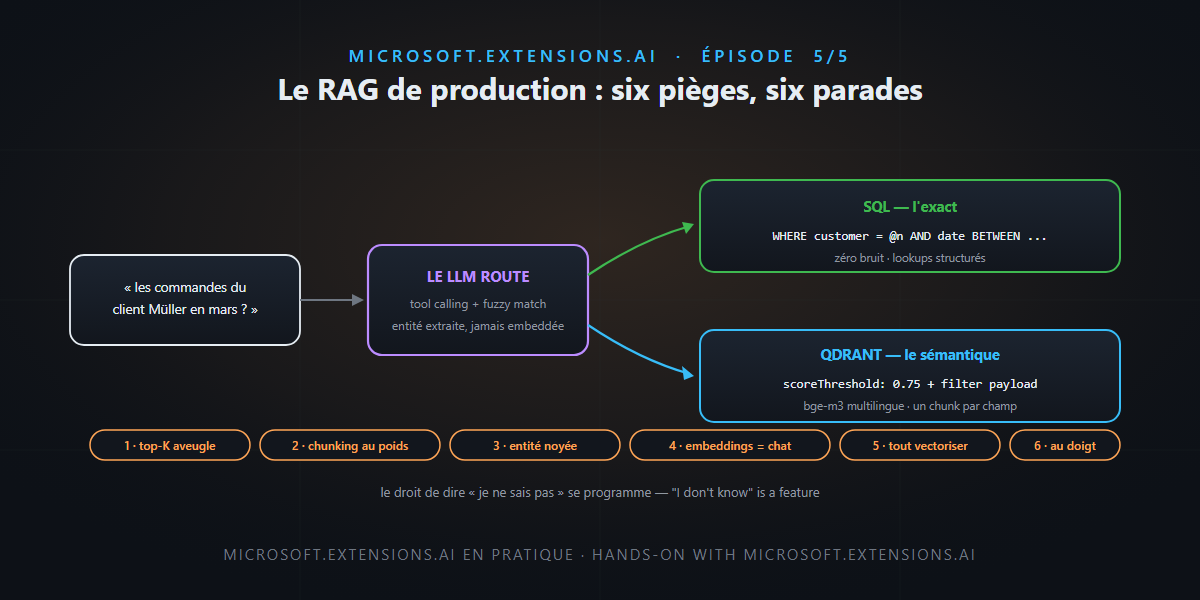
The division of labor is crisp: the LLM understands language (extracting “Müller”), the code guarantees exactness (fuzzy match against the reference table, ambiguity escalated to the user), and Qdrant only searches within the filtered scope. Never the neighbor’s orders again.
Pitfall 4 — embeddings and chat as a single choice
Two models, two jobs, two independent decisions — which is exactly why MEAI exposes two interfaces:
IEmbeddingGenerator: it must understand the language of your documents. German orders with an English-centric embedding model search poorly; a multilingual model likebge-m3(oneollama pullaway, episode 4) changes the game.IChatClient: it must excel at tool calling — it drives pitfalls 3 and 5. Locally: Qwen 2.5, Llama 3.1+; in the cloud: whatever you like (episode 3).
And the warning that saves a sleepless night: changing embeddings = re-indexing everything. Two embedding models share neither dimensions nor geometry — you can’t compare a bge-m3 vector against a text-embedding-3 index. Budget re-indexing like a schema migration.
Pitfall 5 — vectorizing everything
The costliest pitfall, and the most counter-intuitive when you’ve just discovered vectors: “orders from customer X in March” is not a semantic question. It’s a WHERE customer = X AND date BETWEEN … — exact results, zero noise, three milliseconds. Reserving Qdrant for the questions that deserve it (“have we ever had a gasket issue on this model?”) is the hybrid architecture:
var options = new ChatOptions
{
    Tools =
    [
        AIFunctionFactory.Create(QueryOrdersSql),        // exact filters: customer, date, status
        AIFunctionFactory.Create(SearchOrdersSemantic),  // open questions: Qdrant + threshold
    ]
};
// UseFunctionInvocation() does the rest: the model picks the right tool
The LLM becomes a router: SQL for the structured, vectors for the fuzzy, and both tools can combine within one conversation. It’s the application-level version of the hybrid search we covered infrastructure-side in vector search at scale.
Pitfall 6 — tuning without measuring
The 0.75 threshold, the chunk size, the bge-m3 choice: all hypotheses until the golden dataset has judged them. Twenty real questions, the expected chunk for each, and a measurement loop for every tweak. Add two production counters: the “I don’t know” rate (if it explodes, your threshold is too high) and the unsourced-answer rate (if it isn’t zero, your prompt leaks).
And the question to ask before all of this — the one that closed the original conversation: what do your users actually ask? If 80% of the questions are structured lookups, start with the SQL tool alone; vectors are earned by open questions, not by hype.
A word of honesty
- 0.75 is not a universal constant: the right threshold depends on the embedding model, the language and the domain. Calibrate it on your golden dataset — it’s a dial, not a dogma.
- Fuzzy matching has its own traps (homonyms, subsidiaries, typos): when in doubt, the tool must ask, never guess — pitfall 3’s example does that on purpose.
- Hybrid adds moving parts. If your usage is overwhelmingly lookups, a SQL-only bot with solid tool calling is an excellent v1 — add vectors when open questions actually arrive.
In short — the series in one lesson
- Score threshold over blind top-K — and a programmed “I don’t know”.
- Structural chunking (one field, one chunk) + metadata as payload, never inside the vectorized text.
- Entities get extracted (tool calling), resolved (fuzzy match in code) and filtered (payload) — they don’t get embedded.
- Embeddings and chat: two independent choices; multilingual for one, tool calling for the other; budget the re-indexing.
- Hybrid SQL + vector: the LLM routes, SQL answers the exact, Qdrant the semantic.
- And everything gets measured — thresholds included.
The series comes full circle: one interface (ep. 1), tools and types (ep. 2), three clouds (ep. 3), two local engines (ep. 4) — and a RAG that survives production. And that, honestly… is not rocket science.