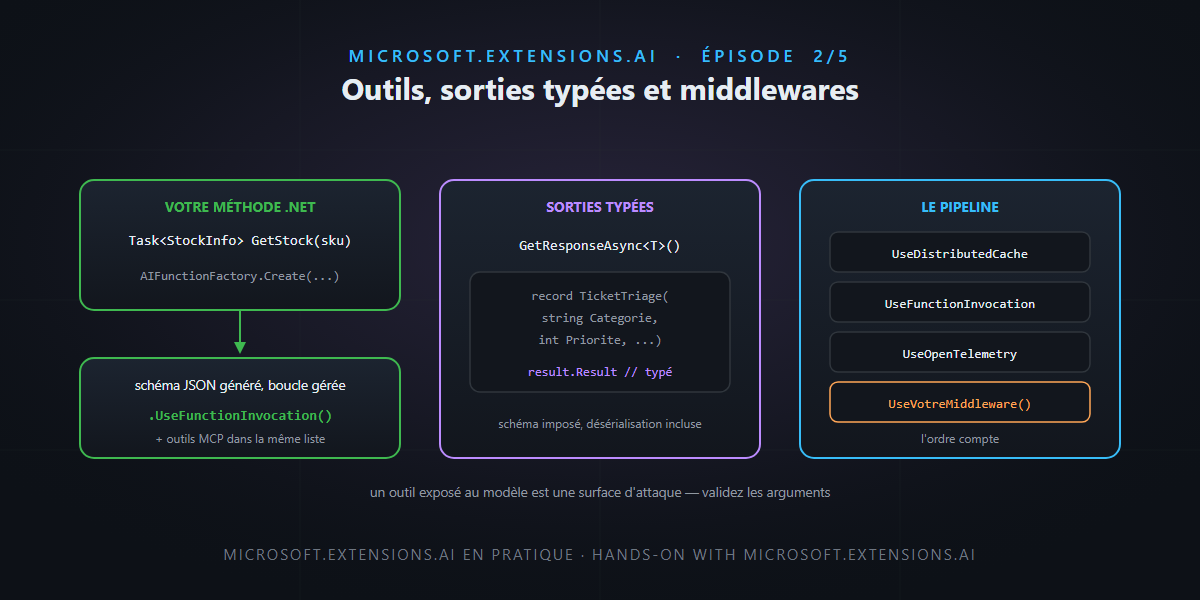
In tool calling: under the hood, we wrote the loop by hand: the model requests a function, we execute it, send the result back, call the model again… Instructive once, painful the second time. Today’s promise: with Microsoft.Extensions.AI, that loop becomes one line of pipeline — and along the way we pick up typed responses, caching and traces. The direct sequel to episode 1, and still not rocket science.
Giving the model arms: AIFunctionFactory
Any .NET method becomes a tool the model can call — the factory reads the signature, types and descriptions to generate the JSON schema automatically:
using Microsoft.Extensions.AI;
using System.ComponentModel;

[Description("Returns the stock status of an item")]
static async Task<StockInfo> GetStock(
    [Description("The item SKU, e.g. ART-1042")] string sku)
    => await inventory.LookupAsync(sku);

var options = new ChatOptions
{
    Tools = [AIFunctionFactory.Create(GetStock)]
};
And on the client side, the middleware that automates the whole loop:
IChatClient client = innerClient
    .AsBuilder()
    .UseFunctionInvocation()     // detects the call → executes → returns → loops
    .Build();

var response = await client.GetResponseAsync(
    "Do we still have ART-1042 in stock?", options);
FunctionInvokingChatClient handles multiple calls, chained calls and appending results to the history. What you used to write by hand in fifty lines fits in one Use.
MCP tools, for free
Remember our first MCP server? The MCP C# SDK exposes its tools as AIFunction instances. As a result, plugging an entire MCP server into your client takes three lines:
var mcp = await McpClient.CreateAsync(new HttpClientTransport(
    new() { Endpoint = new("https://learn.microsoft.com/api/mcp") }));

var options = new ChatOptions { Tools = [.. await mcp.ListToolsAsync()] };
Your homegrown tools and MCP tools coexist in the same list — the model doesn’t know the difference.
Typed outputs: GetResponseAsync<T>
No more “please answer in JSON” followed by a fingers-crossed JsonSerializer.Deserialize. MEAI generates the schema from your type, imposes it on the model and deserializes:
public record TicketTriage(string Category, int Priority, string[] Keywords);

var result = await client.GetResponseAsync<TicketTriage>(
    $"Analyze this support ticket and classify it: {ticket}");

TicketTriage triage = result.Result;   // typed, validated, ready to use
Under the hood, this is the constrained decoding we dissected in sampling and constrained decoding: the provider forces the output to respect the schema. For your ingestion pipelines, classifiers and extractors — this is the default tool.
The middleware pantry
| Middleware | What it does | The trap it avoids |
|---|---|---|
UseFunctionInvocation() |
the automatic tool loop | manual plumbing |
UseDistributedCache() |
exact-match response cache (IDistributedCache) | paying twice for the same question |
UseOpenTelemetry() |
standard GenAI traces and metrics | the black-box agent |
UseLogging() |
requests/responses into ILogger |
debugging blind |
Two clarifications worth gold:
UseDistributedCacheis an application-level exact-match cache — not to be confused with provider-side prompt caching, which discounts repeated prefixes. The two stack.- Order matters.
UseDistributedCachebeforeUseFunctionInvocation: you serve from cache before triggering tools; the reverse would cache intermediate conversations.
And if the middleware doesn’t exist, write it: inherit from DelegatingChatClient, override GetResponseAsync, and ship your own UseMyThing() — ten lines are enough for a homemade rate limiter built on System.Threading.RateLimiting.
A word of honesty
UseFunctionInvocationexecutes your code on the model’s command. A model that reads external content can be manipulated into calling your tools — re-read prompt injection: defense in depth before exposing anything beyond read-only. Validate arguments like any user input, and keep destructive tools behind a human confirmation.- Typed outputs and tool calling depend on model capabilities: big cloud models excel, small local models vary — we come back to this in episode 4, and it’s measurable with your evals.
In short
AIFunctionFactory.Create(myMethod)+UseFunctionInvocation(): industrialized tool calling — auto schema, auto loop, auto history.- MCP tools plug into the same
ChatOptions.Toolslist as your homegrown functions. GetResponseAsync<T>: typed responses validated by schema, no artisanal parsing.- Middleware (
cache,otel,logging) is cross-cutting and composable — and pipeline order is meaningful. - Security first: a tool exposed to the model is an attack surface.
Tomorrow, the splits: the same code on Azure AI Foundry, Anthropic and AWS Bedrock — three clouds, three official SDKs, one interface. And that, honestly… is not rocket science.