Level 400, episode 3. In the hallucinations article, we met temperature — “the dose of randomness”. And in tool calling, structured outputs — “the contract that constrains generation”. Two claims dropped without the mechanism. Today, we look at how a token is actually chosen.
On the menu: the probability distribution, how temperature/top-p/top-k sculpt it, why perfect determinism doesn’t exist even at temperature zero, and how a grammar forces valid JSON at the decoding level. You’ll see: it’s not rocket science.
What comes out of the model: a distribution, not a word
Let’s pick up where the KV cache left off. After digesting the context, the model doesn’t produce “a word”. It produces, for each possible token in the vocabulary (tens of thousands), a raw score — a logit. A function (softmax) turns these logits into a probability distribution: “‘Paris’ 82%, ‘the’ 6%, ‘Lyon’ 3%…” over the whole vocabulary.
The model stops there. Choosing the token from that distribution is a separate step — sampling — and it’s that which the parameters control. Crucial distinction: the model proposes a fixed distribution; the sampler draws a token from it. Changing the temperature doesn’t change what the model “thinks” — it changes how you draw from what it thinks.
Temperature: flatten or sharpen the distribution
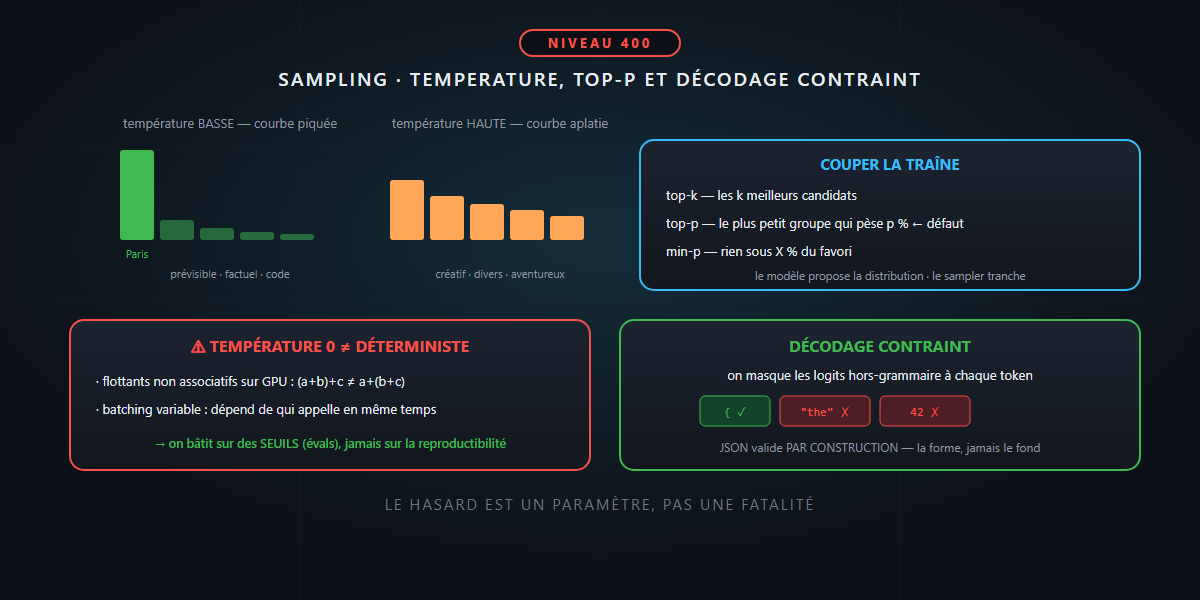
Temperature acts on the logits before the softmax. The right image: it reshapes the curve.
- Low temperature (→ 0): the curve sharpens. The gap between the favorite and the rest widens; the most probable token dominates. Predictable, repetitive, sober.
- High temperature (> 1): the curve flattens. The outsiders climb back up, the model dares improbable choices. Creative, diverse, adventurous.
Concretely: factual, code, extraction → low; brainstorm, writing variety → high. It’s not an “intelligence” knob, it’s a “width of the draw” knob. A high-temperature model isn’t more creative in the sense of better — it’s just allowed to leave the most probable paths.
Top-k, top-p, min-p: where you cut the tail
Temperature alone leaves a tiny chance to the absurd tokens of the long tail. So you bound it with filters — applied before the draw:
| Filter | What it does | The image |
|---|---|---|
| top-k | keeps only the k most probable tokens | “the top 40 candidates, bin the rest” |
| top-p (nucleus) | keeps tokens until cumulating p% of probability | “the smallest group that weighs 90%” |
| min-p | threshold relative to the best token | “nothing below 5% of the favorite” |
The most used is top-p (nucleus sampling): its selection size adapts to the context — wide when the model hesitates between a thousand plausible continuations, narrow when only one imposes itself. It’s the default fluidity/safety trade-off of most APIs. In practice you combine: top-p to cut the absurd tail, temperature to dose within what remains.
The bomb: temperature 0 is NOT deterministic
Here’s what separates level 300 from 400, and what costs hours of debugging to those who ignore it. “I set temperature 0, I always take the most probable token, so it’s reproducible.” False in production, and for physical reasons, not software ones:
- Floating-point arithmetic isn’t associative.
(a + b) + c ≠ a + (b + c)on a GPU. And the computations are spread across thousands of cores whose aggregation order varies from one run to another. Two near-tied logits can thus swap — and a token flips. - Non-deterministic batching. Your request is processed alongside others, in a batch whose composition changes on every call; the resulting GPU kernel optimizations alter the order of operations. The output thus depends on who else was calling at the same moment — which you don’t control.
Consequence for the architect: determinism isn’t a property to build on. That’s exactly what grounds the evals approach — you manage thresholds, not identical outputs — and the statistical eval engineering this blog will soon tackle. A fixed seed helps in development; it guarantees nothing across a GPU fleet.
Constrained decoding: how JSON becomes valid by construction
There remains the tool calling promise to honor: structured outputs. The mechanism is crystalline in its elegance and lodges exactly at the sampling step.
At each token, before drawing, you know the target grammar (your JSON Schema). You mask the logits of all tokens that would violate that grammar — their probability is forced to zero. If the schema expects { as the opening, every token other than { is eliminated before the draw. The model literally cannot produce invalid JSON: the grammar acts as a rail.
That’s the whole difference from “answer in JSON please”: the prayer hopes the distribution favors JSON; the constraint mechanically forbids off-grammar tokens. And it clarifies the final nuance: constrained decoding guarantees a valid shape (the JSON parses), never a correct substance (the values are true). The shape by grammar, the substance by evals — always.
In summary
- The model produces a probability distribution (logits → softmax); sampling draws a token from it — two distinct steps.
- Temperature reshapes the curve (low = sharp/sober, high = flat/creative); top-p cuts the tail adaptively — that’s the default duo.
- Temperature 0 ≠ deterministic: non-associative floats + variable batching on GPU. You build on thresholds (evals), never on exact reproducibility.
- Structured outputs mask off-grammar logits at each token: valid JSON by construction — the shape, never the substance.
The model thinks in probabilities, the sampler decides, and the grammar lays the rails: that’s how a word becomes the word. Randomness, here, is a parameter — not a fate. And that, honestly… is not rocket science.