Level 400, episode 2. Since the start of the series, we’ve laid down rules of thumb: the context is paid on every turn, the cache only reuses the identical prefix, the middle of the context is poorly retained. They work. But an architect wants the causal why — the mechanism under the abstractions.
So let’s open the hood and look at what happens physically in the few tens of milliseconds where the model produces one token. Three concepts — attention, quadratic cost, KV cache — and all your rules of thumb become theorems. You’ll see: it’s not rocket science.
Attention: every token looks at all the others
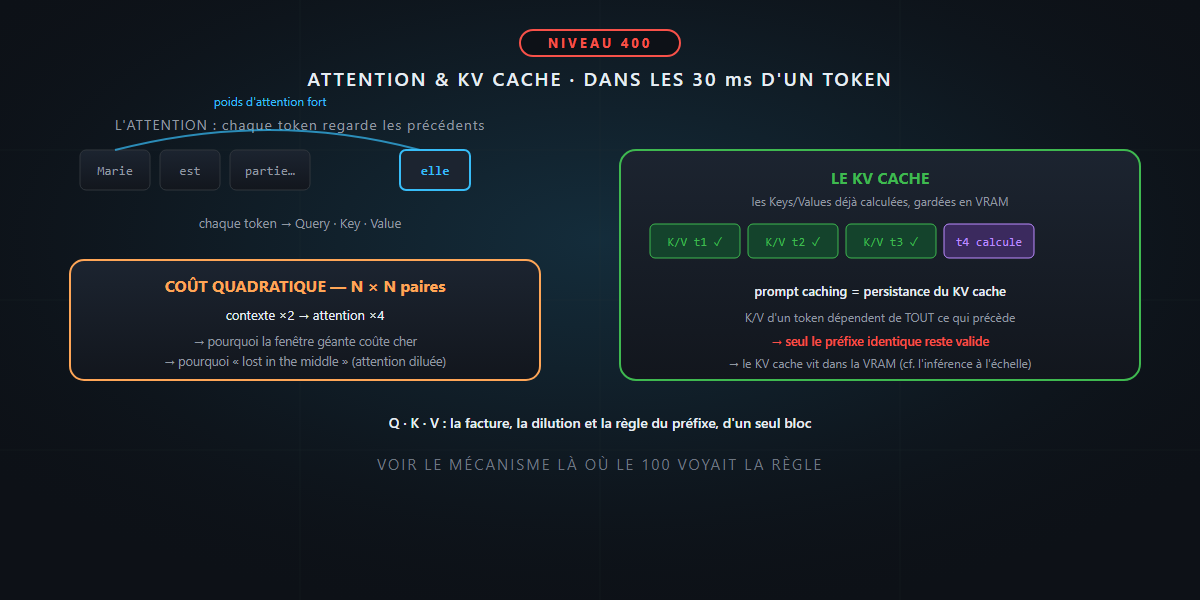
A language model is made of layers, and the heart of each layer is called attention. The idea, stripped of the math: to “understand” a token, the model lets it look at all the preceding tokens and weight their importance. The word “she” looks back, finds “Marie” ten tokens earlier, and gives her a strong weight. That’s attention — a mechanism for relating each position to all the others.
Technically, each token produces three vectors — a Query (what I’m looking for), a Key (what I offer as an anchor point), a Value (the information I carry). The attention weight between two tokens is the product of one’s Query and the other’s Key; the output is the sum of the Values, weighted by those weights. Remember the names Key and Value: they come back in two minutes, and they explain everything.
Quadratic cost: where dilution comes from
Here’s the consequence that hurts. If each token looks at all the others, then for a sequence of N tokens, there are N × N pairs to evaluate. Double the context, quadruple the attention computation. It’s the famous quadratic cost (O(N²)) — and it’s not incidental, it’s the central physical constraint of LLMs.
Two of your rules of thumb fall out of it, proven:
- Why the giant window costs so much — not linearly, but quadratically. A 200k-token context isn’t “twice” a 100k one, it’s four times the attention computation. The bill and the latency have their cause here.
- Why lost in the middle — the attention budget is finite and dilutes across N² pairs. The bigger N grows, the thinner the attention paid to each individual token — hence the degradation, and the middle, less anchored than the beginning (the instruction) and the end (the recent question), takes the biggest hit.
The well-kept desk of the context article wasn’t a comfort metaphor: it’s a quadratic necessity.
The KV cache: what prompt caching really caches
Now, the jewel — and the true nature of prompt caching. Generation happens token by token: to produce token 501, the model needs the Keys and Values of all tokens 1 through 500. Naively, it would recompute them for each new token — a colossal waste, since the Key and Value of token 12 never change once it’s written.
Hence the KV cache: you keep in memory (in the GPU’s VRAM) the already-computed Keys and Values, and each new token computes only its own. That’s what makes generation practical. And here’s the revelation that closes the series:
Prompt caching is the persistence of the KV cache between two requests. When the provider “caches your prefix”, it literally keeps the already-computed Keys/Values for those tokens. And now, THE prefix rule explains itself: a token’s Key/Value depends on everything that precedes it (attention looks backward). Change the token at position 3, and the K/V of positions 4, 5, 6… are invalidated — they were computed “looking at” the old token 3. The identical prefix isn’t an arbitrary convention: it’s the only portion whose Keys and Values remain mathematically valid. The cache-killing timestamp invalidates everything after it because it changes what each following token looked at.
What understanding this unlocks
- The KV cache lives in VRAM, and it grows with the context. It’s the memory item that limits the number of simultaneous conversations on a GPU — the thread the inference economics article will pull. “Long context” = “GPU memory consumed”, not just “tokens billed”.
- Attention optimizations (GQA, sliding window, MLA…) you see in model cards aren’t folklore: they’re direct attacks on the quadratic cost and the KV cache size. You now know which problem they solve.
- The first token is slow, the following ones fast. “Prefill” (digesting the whole prompt) is the big quadratic computation; “decode” (generating the continuation) benefits from the KV cache. TTFT vs tokens/second, two physically distinct regimes.
In summary
- Attention relates each token to all the previous ones via Query/Key/Value — the heart of each layer.
- The cost is quadratic (N²): the giant window costs four times, not two; and the dilution of the attention budget is the lost in the middle — two rules of thumb, now proven.
- The KV cache keeps the already-computed Keys/Values; prompt caching is its cross-request persistence, and that’s why only the identical prefix is reusable (K/V depend on everything before).
- And it opens what’s next: the KV cache in VRAM is the memory constraint of inference at scale.
Three letters — Q, K, V — and the whole series stands as one block: the bill, the dilution, the prefix rule, the slow first token. Level 400 is seeing the mechanism where level 100 saw the rule. And that, honestly… is not rocket science.