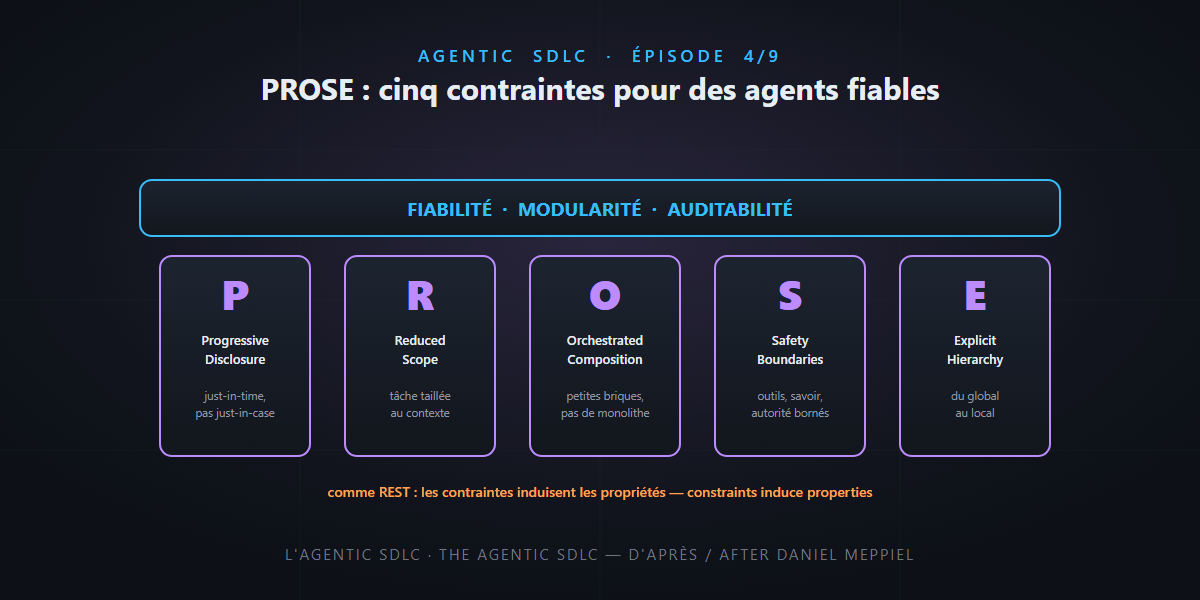
REST never prescribed a language, a framework or a format. It laid down constraints — statelessness, uniform interface, caching — and those constraints induced the properties we wanted: a web that scales and evolves piece by piece. The central bet of Daniel Meppiel’s Agentic SDLC Handbook is to repeat exactly that move for AI agents. It’s called PROSE, and it’s chapter 13 — the heart of the book.
After the agentic runtime machine and the seven primitives, here is the grammar that holds them together. Five constraints, five anti-patterns killed, one checklist. Not rocket science.
The five constraints in one table
| Letter | Constraint | The rule | The anti-pattern it kills |
|---|---|---|---|
| P | Progressive Disclosure | context arrives just-in-time, not just-in-case | context dumping |
| R | Reduced Scope | tasks sized to context capacity | scope creep |
| O | Orchestrated Composition | small, chainable primitives, no monolith | the monolithic prompt |
| S | Safety Boundaries | tools, knowledge and authority explicitly bounded | the unbounded agent |
| E | Explicit Hierarchy | rules in a tree, global to local | flat instructions |
Notice the correspondence with episode 1: each constraint answers a structural property of LLMs — finite context (P, R), probabilistic output (S), the need for composition and clear resolution (O, E).
A quick tour, with the concrete moves
- Progressive Disclosure. Attention degrades under load, so you optimize signal-to-noise, not volume. The move: Markdown links with descriptive labels instead of inlined content — the agent loads when relevant.
- Reduced Scope. The sizing heuristic is brilliantly simple: a well-sized task is one the agent finishes without asking a question. If you’re adding context mid-session, the scope was wrong from the start.
- Orchestrated Composition. The 3,000-word prompt covering role, standards, errors, tests and security is unpredictable: everything interacts with everything. The move: one file = one responsibility, and workflows that reference instead of copy-pasting.
- Safety Boundaries. Three boundaries per agent: capability (which tools), knowledge (which context), authority (what needs human approval). The chapter ships four standard roles — code writer, reviewer, test runner, deployer — each with its STOP gates. A direct echo of securing GitHub Copilot.
- Explicit Hierarchy. A root
AGENTS.mdfor the baseline, scoped files for domains: the agent resolves from most specific to most general — and you can add rules to a module without touching the parents.
Independent on paper, interdependent in practice
The most useful part of the chapter is its three failure stories — applying four constraints out of five is not enough:
- Hierarchy without Progressive Disclosure: a beautiful file tree… of self-contained, obese files. The agent gets everything at once and can no longer tell what applies to its task.
- Reduced Scope without Composition: well-sized tasks but guidance copy-pasted everywhere. The standard changes, and every service drifts with its stale copy.
- Safety Boundaries without Reduced Scope: strict gates drowned under 40,000 tokens of implementation detail — the agent has forgotten the constraints loaded at session start.
In the field: JWT in five sessions
The chapter’s worked example — adding JWT authentication to an Express app — shows the full system: an instruction hierarchy (root → backend → auth rules with STOP gates on token logic), a bounded persona (edits src/auth/ and tests/auth/, no deploy access), and a split into five fresh-context sessions (token schema, middleware, refresh endpoint, integration tests, frontend by a different agent). The delicious moment: in session 2, the backend agent tries to modify the frontend API client — its tool boundary stops it, it reports the suggestion, and the frontend specialist handles it in session 5 with the right context. The constraint didn’t cripple the system; it routed the information.
The compliance checklist
Eleven yes/no questions to audit your setup — here’s the skeleton: do your files link instead of inlining? does each task fit in one sentence? does each file have a single responsibility? does each agent have an explicit tool list and STOP gates? do your rules exist at three levels of specificity? Remediation priority per the handbook: safety gaps first (S), then hierarchy (E), then the rest by pain.
A word of honesty
- PROSE is an opinionated discipline, not a standard blessed by a committee — the author says so himself. The REST analogy is a goal, not a given: REST won because everyone adopted it, and that part of the game is still open.
- You recognized some old friends: single responsibility, least privilege, separation of concerns. That’s deliberate — and rather reassuring: PROSE applies to agents principles that forty years of software engineering have already stress-tested.
In short
- PROSE = Progressive Disclosure, Reduced Scope, Orchestrated Composition, Safety Boundaries, Explicit Hierarchy — five constraints that induce reliability, modularity and auditability, the way REST induced the web’s scalability.
- Each constraint kills one specific anti-pattern: context dumping, scope creep, the monolithic prompt, the unbounded agent, flat instructions.
- They are interdependent: four out of five, and the system leaks through the fifth.
- Test yourself with the eleven-question checklist — safety first.
Tomorrow we dive into the resource this whole system is economizing: attention. Window ≠ focus, the U-curve, and the full load lifecycle of your primitives. And that, honestly… is not rocket science.