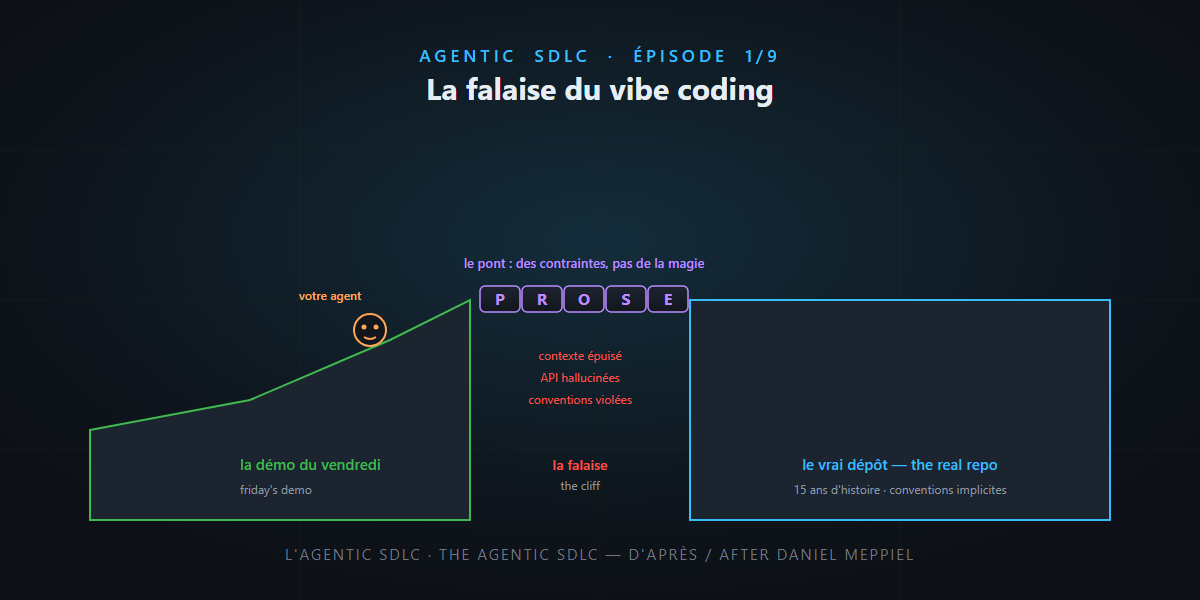
On Friday, the agent built your prototype in two hours and you applauded. On Monday, released onto the real repository — fifteen years of history, conventions nobody ever wrote down, a legacy module everyone tiptoes around — the same agent invents APIs, tramples your house rules and returns a diff nobody dares to merge. That moment has a name: the vibe coding cliff. And above all it has a remedy, which is not “wait for a better model”.
That is the thesis of the Agentic SDLC Handbook by Daniel Meppiel — Global Black Belt at Microsoft, creator of APM — a free, online book, written with the very method it teaches. Its opening line sums up the problem: every engineering organization is adopting AI coding agents, almost none of them has a methodology for it. This nine-episode series walks through his vision, from the developer’s desk to the CTO’s office. You’ll see: it’s not rocket science.
The cliff, up close
The handbook opens on something you have probably lived through: AI agents fail on real codebases in predictable ways. Three patterns keep coming back:
| Failure pattern | What happens |
|---|---|
| Context exhaustion | the whole system doesn’t fit in the window; the agent loses the thread mid-session |
| Hallucinated interfaces | the agent invents plausible APIs that don’t exist in your code |
| Violated conventions | team rules that were never written down are invisible to it — so it steamrolls them |
The trap is that these failures are silent. A weak model fails loudly: it can’t do the task, and you see it. A powerful model with poor context fails confidently: plausible code that passes review… and breaks in production.
It’s not the model, it’s what we feed it
The classic objection: “the next model will fix this.” The handbook compiles numbers that tell a different story. Context windows grew from 2,048 tokens (GPT-3, 2020) to over a million today — a factor of 500. If size were the problem, satisfaction would have followed. Yet the Stack Overflow 2024 survey shows 76% adoption but 45% of respondents rating AI as “bad” on complex tasks; the 2025 edition adds that 66% describe solutions that are “almost right, but not quite”. And GitClear’s analyses across 211 million lines measure churn (code rewritten shortly after being produced) exploding among heavy AI users.
Doubling the window and then doubling what you pour into it changes nothing: everything that enters competes for the same attention. We already brushed against this in the context window: the art of compressing and forgetting — the handbook turns it into a founding principle.
The three properties that won’t go away
Meppiel’s whole method flows from three structural properties of LLMs — not bugs, characteristics:
- Context is finite and fragile. Fixed capacity, competing attention; quality degrades under load.
- Context must be explicit. A repository holds two kinds of knowledge: the written code (accessible to AI) and the understood conventions (in people’s heads). The agent only has the first — and the seam between the two is exactly where things break.
- Output is probabilistic. Same inputs, different outputs. Reliability isn’t assumed, it’s architected.
Does that second point ring a bell? It is precisely the bet of our series “the repo that talks”: turning implicit knowledge into versioned artifacts. The two visions snap together — we’ll come back to it in episode 3.
The answer: constraints, not magic
Against all this, the handbook proposes PROSE: five architectural constraints — Progressive Disclosure, Reduced Scope, Orchestrated Composition, Safety Boundaries, Explicit Hierarchy. The explicit analogy is REST: REST prescribed no technology, it laid down constraints that induce the desired properties (scalability, independent evolution). PROSE does the same for agents: each constraint answers one of the three properties above and induces reliability, modularity, auditability. Episode 4 goes through them one by one.
Meppiel frames it all with an image borrowed from Andrej Karpathy: we are in “the 1980s” of this kind of computing. The processor (the LLM) is already powerful; everything around it — harnesses, constraints, primitives, package managers — is embryonic. A stack is forming before our eyes, and that stack is what this series climbs down, layer by layer.
The map of the series
| # | Date | Episode |
|---|---|---|
| 1 | today | The vibe coding cliff — you are here |
| 2 | September 1 | the agentic runtime machine: model, harness, agent source code, client |
| 3 | September 2 | the instrumented codebase: seven primitives to equip your agents |
| 4 | September 3 | PROSE: the five constraints in detail |
| 5 | September 4 | the attention economy: the window is not the focus |
| 6 | September 5 | the deterministic/probabilistic boundary: the agent proposes, the machine disposes |
| 7 | September 6 | orchestrating an agent fleet: waves and checkpoints |
| 8 | September 7 | nineteen anti-patterns, from the monolithic prompt to the unbounded agent |
| 9 | September 8 | for leaders: business case, governance, teams and the bill |
A word of honesty
- The handbook is a living document in pre-release (v0.11, June 2026) under a CC BY-NC-ND license. Its author is the first to label his evidence: one large, public, verifiable PR, industry surveys, and estimates flagged as estimates. Enterprise-scale validation is still ahead.
- This series is a commented reading, not a translation: I run Meppiel’s vision through the filter of this blog and my .NET/GitHub Copilot daily life. For the full text — free — it’s here.
In short
- The vibe coding cliff: agents shine in demos and fail on real repositories, along three predictable patterns — exhausted context, hallucinated interfaces, violated conventions.
- It is not a model problem: windows ×500, satisfaction flat; what matters is what fills the window.
- Three structural properties won’t go away: finite context, invisible implicit knowledge, probabilistic output.
- The handbook’s answer: PROSE, five architectural constraints in the spirit of REST — and a whole stack forming above the LLMs.
- Nine episodes to take it all apart, from the dev’s terminal to the CFO’s spreadsheet.
Tomorrow we pop the hood: when you type a prompt, who does what? Model, harness, instruction files, client — the four parts of the agentic runtime machine. And that, honestly… is not rocket science.