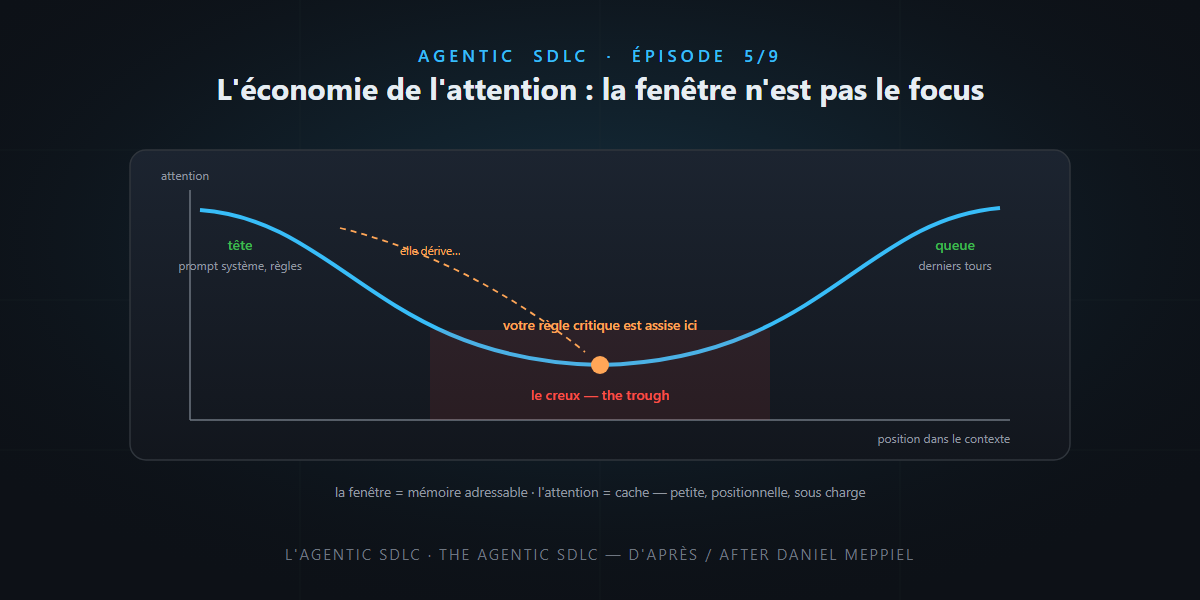
On the product page: “one-million-token context window”. In your session: an agent that, forty minutes in, ignores a rule that has been loaded since the start. Contradiction? No — a confusion between two quantities. The window is addressable memory; attention is the CPU cache: smaller, position-sensitive, and degrading under load. The vendor’s number never promised the model reasons uniformly over everything you pour into it.
Chapters 14 and 15 of Daniel Meppiel’s Agentic SDLC Handbook form the “physics” side of the method: how context reaches the model (the load lifecycle), and what the model actually does with it (the attention economy). After PROSE, here is why those constraints work. Not rocket science.
The U-curve: where is your rule sitting?
Long-context research converges on a U-shaped curve: attention is strong at the head of the context (system prompt, initial rules), strong at the tail (the latest turns), and weak in the middle — the trough. The vicious part: the middle is a conveyor belt. What starts at the head drifts into it as turns and tool outputs pile up.
Hence the chapter’s canonical failure: a team adds an 800-line architecture document hoping for better reviews. Opposite result — the slab pushes the critical rules into the degraded zone. The rule is in the window, but it no longer receives enough attention to influence the output. Re-read the context window and our dive into attention and the KV cache: same mechanics, seen from above.
The load lifecycle: four phases, three modes
Before asking what the model looks at, the content has to arrive. Chapter 14 describes your primitives’ full pipeline:
Resolve (dependency resolution, lockfile) → Materialize (files land where the harness expects them: .github/, .claude/…) → Bind (the harness classifies each file into a load mode) → Activate (the dispatcher picks what actually enters, based on the task and the remaining budget).
| Binding mode | When it loads | The price |
|---|---|---|
| Eager | every session, unconditionally | consumes budget, always |
| Lazy | description loads eagerly, body on activation | allows hundreds of skills at no per-session cost |
| Dispatcher-mediated | explicit invocation, sub-agent | the cost lands in the child’s context |
The sneakiest bug lives at the joint: a skill that is registered but never activates, because eager loads ate the budget and the dispatcher down-ranks it. Five determinants can be tested one by one: path globs, valid YAML frontmatter, lockfile closure, description matching (probabilistic!), and budget pressure. Your harness’s verbose logs show exactly which phase failed.
The three structural levers
- Progressive disclosure — load when needed, not in case: every primitive added eagerly degrades all the others.
- Subagent isolation — a child thread restarts with a fresh window, in the strong zones of the U-curve, instead of inheriting the parent’s mid-context swamp. That’s the theory behind our Copilot subagents.
- Plan-write-then-reload — in long sessions, write the plan to a file and re-read it at decision points: the re-read brings the plan back from the trough into the high-attention tail, exactly when it matters.
The cost/benefit matrix of context loads
| Content type | Cost | Recommended treatment |
|---|---|---|
| Base project rules | low | at the head, always loaded |
| Scoped rules | moderate | progressive disclosure |
| Source files | moderate to high | load selectively |
| Tool output from old turns | grows without bound | summarize into the plan, purge |
| Pasted stack traces | high, fast-melting value | after two pastes: reset the session |
| Web-fetched docs | very high | one-shot grounding, bounded scope |
Diagnosis fits in three questions: how many tokens were loaded at the failure point? where is the failing instruction sitting in the window? how many tool outputs have piled up since it was last reinforced? Per the handbook, these three questions solve most attention-starvation cases.
A word of honesty
- The U-curve is an empirical, moving result: recent models keep improving on long contexts. But the economics remain: attention is finite, position matters, and there is no free lunch — a design principle more durable than any benchmark.
- Don’t cargo-cult the reset: killing a session that was going fine has a cost too. The useful signal is observed degradation (forgotten conventions, answers getting longer), not a token counter for its own sake.
In short
- Window ≠ focus: the window is addressable, attention is small, positional, and degrades under load — a U-curve, with drift toward the trough.
- Context follows a pipeline: resolve → materialize → bind → activate, with three binding modes; a skill that “doesn’t work” is often a skill that never activated, down-ranked by budget pressure.
- Three levers: progressive disclosure, fresh-context subagents, plan-write-then-reload.
- Sort your loads with the cost/benefit matrix — and beware of piled-up stack traces.
Tomorrow, the uncomfortable question: what do we actually let the agent do? The deterministic/probabilistic boundary — the model proposes, the gate disposes. And that, honestly… is not rocket science.