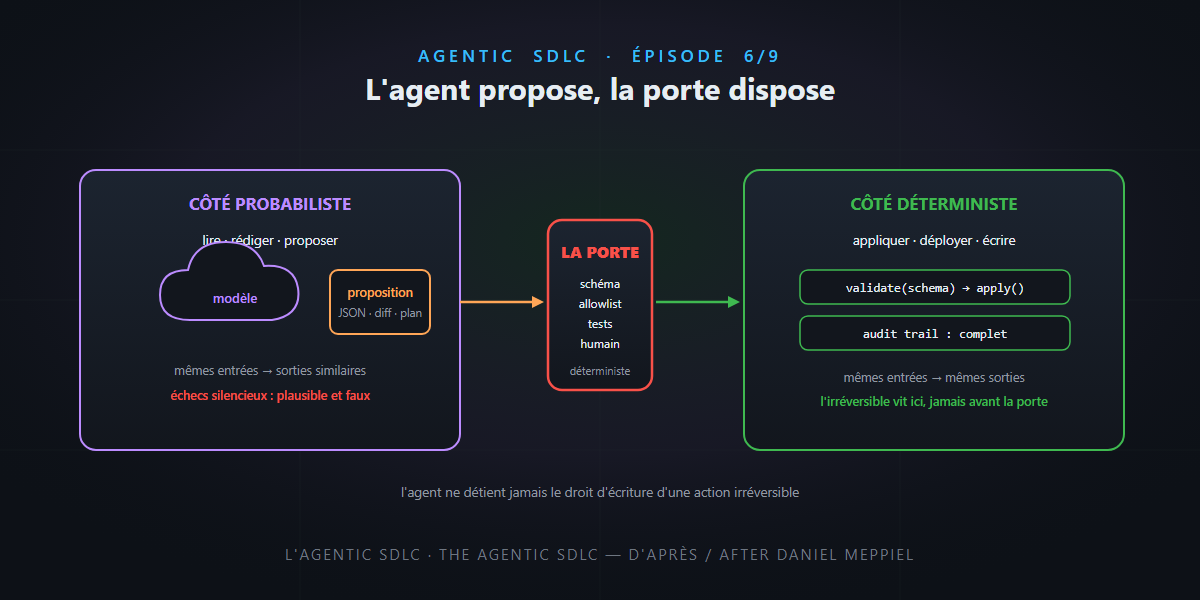
An agent opens an impeccable GitHub issue: clear title, structured description, the name of the affected customer. One detail: the customer doesn’t exist. The name was plausible, the API accepted it, the issue went out. Nobody had placed a deterministic check — “is this customer in the system?” — between the agent’s proposal and the API call. The lesson of chapter 16 of Daniel Meppiel’s Agentic SDLC Handbook fits in one sentence: the fix wasn’t a better model, it was a line to redraw on the architecture diagram.
After the attention economy, here is the design decision the handbook ranks as the most important in any agentic system: where the boundary between deterministic and probabilistic runs. Not rocket science.
Two computers in the same machine
Every agentic system runs two computers side by side:
| Deterministic side | Probabilistic side | |
|---|---|---|
| Who | file I/O, tool calls, schema validation, tests, audit trails | the model: reading, drafting, proposing |
| Behavior | same inputs → same outputs | same inputs → similar outputs |
| Failures | loud and traceable | silent: “confident, plausible, wrong” |
Nothing derogatory about the probabilistic side: that’s where all the creative value comes from. But you don’t hand consequential operations to the component whose failures are undetectable to the naked eye.
The rule: the model proposes, the gate disposes
Any consequential side effect — and a fortiori any irreversible one: writing to production, creating a customer-facing artifact, modifying a canonical table, deploying — executes on the deterministic side, behind a validation gate the agent cannot bypass.
The strictest form is called supervised execution: the agent holds no write capability at all. It produces a buffered artifact (a JSON, a diff, a plan), and a separate deterministic process validates it against a schema and an allowlist before applying it. The principle matches what we wrote about the GitHub coding agent and one branch per agent: a PR is exactly that — a buffer zone before the irreversible.
Two disciplines against hallucination
The chapter refuses to treat hallucination as a prompt problem. It’s a system problem, managed by two complementary disciplines:
- Grounding: load specific, justified context per decision — not ambient vibes — to reduce the incidence of hallucinations.
- Verification: assume a hallucination survived grounding, and catch it before externalization with deterministic checks against systems of record — to reduce the blast radius.
Both, always. Grounding without verification lets things through; verification without grounding wastes effort.
The quality gate matrix
Four gate types, along two axes — programmatic/judgement and internal/external:
| Programmatic | Judgement | |
|---|---|---|
| Internal | types, lint, schema validation → catches structural defects | the agent re-reads against original intent → catches goal drift |
| External | cold review, fresh context, with a rubric → catches structural defects at scale | human checkpoint before the irreversible → catches scope decisions |
The handbook’s matching rule: pick the gate that catches your failure mode — not the one that’s easiest to set up. A JSON schema will never catch goal drift; a tired human will not catch a schema violation.
In real life
The chapter catalogs concrete implementations of the seam: GitHub agentic workflows’ safe-outputs blocks (the agent emits JSON, a post-stage validates and applies via API); the sandboxed CI job without write permissions, paired with a separate process under a different IAM role that applies validated changes; the approval node in a workflow DAG between “propose” and “apply”. Every time, the same geometry: the seam is reified in infrastructure, not promised in a prompt.
And three habits to adopt: draw the boundary on the diagram before coding; pick your gates before picking your model; and never hand out a write token without documenting why.
A word of honesty
- Gates have a cost: on low-risk work, over-gating kills velocity. The handbook embraces proportionality — aggressive autonomy in reversible zones, hard gates in front of the irreversible. We’ll come back to this on the governance side in episode 9.
- Watch the “judgement-internal” cell: an agent reviewing itself is still probabilistic. It’s a useful layer, not a guarantee — never count it as one in a compliance file.
In short
- Every agentic system = two computers: a deterministic one (loud failures) and a probabilistic one (silent failures, “confident, plausible, wrong”).
- The golden rule: the model proposes, the gate disposes — the irreversible executes on the deterministic side, behind an unbypassable validation.
- Against hallucination: grounding (reduce incidence) + verification (reduce blast radius).
- Four quality gates (programmatic/judgement × internal/external): choose by the failure mode you need to catch.
- The placement of the seam is the number-one architecture decision — before model choice, before window size.
Tomorrow we scale up: multiple agents, waves, checkpoints — and the meta-process that let the handbook itself be written by a fleet of eleven agents. And that, honestly… is not rocket science.