In the final episode of the CLI series, one magic character — & — shipped a task “to the cloud”. Time to meet who receives it: the Copilot coding agent, Copilot’s third face. The IDE assists, the CLI lives in your terminal… and the coding agent works on GitHub.com while you do something else.
Its user manual fits in one sentence: assign it an issue, it comes back with a pull request. The rest — where it works, how to brief it, how to fence it — is today’s program. You’ll see: it’s not rocket science.
The flow: an issue goes in, a PR comes out
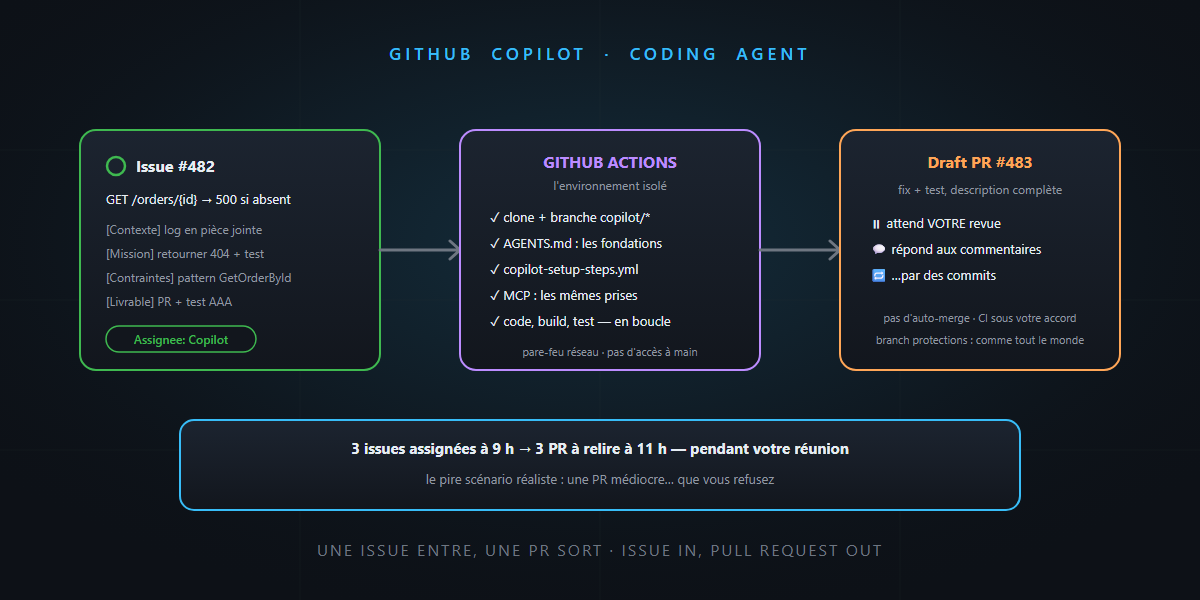
The basic gesture is disarmingly ordinary: on GitHub, open an issue and assign it to Copilot — just like you’d assign a colleague (the CLI’s & and github.com’s Agents interface lead to the same place). Then:
- The agent starts in an isolated environment on GitHub Actions infrastructure: it clones the repo, creates its branch, sets up its workstation.
- It works: explores the code, edits, compiles, tests — the harness loop, fully autonomous.
- It opens a draft pull request, describing what it did — and asks for your review.
- You comment on the PR; it answers comments with commits, like a remote colleague.
The point that changes the nature of the work: it’s asynchronous and parallel. Three issues assigned at 9 a.m., three PRs to review at 11 — while you were in a meeting. That’s no longer assistance; that’s delegation.
The brief: a good issue is a work order
You already learned everything in the subagents article: the coding agent knows only what the issue tells it — a well-written issue IS the brief. The same anatomy applies, word for word:
[Context] The
GET /orders/{id}endpoint returns 500 when the id doesn’t exist (log attached). [Mission] Return 404 with a ProblemDetails, and cover the case with a test. [Constraints] Follow theGetOrderByIdslice pattern; don’t touch the other endpoints. [Deliverable] PR with the fix + an AAA test that fails before / passes after.
What it does well: reproducible bugs, targeted debt, coverage improvements, the clean tasks of a vertical slice — the bounded perimeter, once again. What you don’t hand it: architecture decisions (those are made with you, and recorded as ADRs), vagueness (“improve perf”), and anything whose success criterion doesn’t fit in the issue.
Its workstation is customizable (and that’s where everything plays out)
The coding agent starts in a bare container. Three levers make it your employee:
AGENTS.md— your foundations, once more: conventions, architecture, build and test commands. The same file that briefs the IDE and the CLI briefs the cloud agent. The prompt expresses, the repo remembers — never has a formula worked this hard..github/workflows/copilot-setup-steps.yml— workstation preparation: preinstall the .NET SDK, restore packages, provision what’s needed before the agent starts, so it doesn’t lose twenty (billed) minutes guessing how to build.- MCP servers — configurable for the agent too: your stock server, internal tools… the cloud agent gets the same sockets as the team.
The guardrails: fenced by construction
This is the most reassuring part of the file — the essentials are structural, not optional:
- It works on its own branch, never on
main; its pushes are confined tocopilot/*. - The PR remains a draft that requires your review — and CI workflows only run with your approval: no auto-merge, no wild deployment.
- A network firewall bounds what the environment can reach (and widening it is an admin decision).
- Your repo’s branch protections apply to it like to everyone — the company policy knows no exceptions.
In other words: the worst realistic scenario is a mediocre PR you decline. That’s the bounded blast radius, organizational edition. Your reflexes from the security article still apply — the PR review is the checkpoint; treat it as such.
The word of honesty, meter-side: every session consumes premium requests and GitHub Actions minutes. A well-fenced issue that lands on the first try is profitable; ten comment round-trips on a vague brief cost more than doing it yourself. Brief quality isn’t just hygiene — it’s economics.
In summary
- The coding agent = the third Copilot: assigned issue → work in an isolated environment (Actions) → draft pull request → iteration through comments.
- A well-written issue is the brief: context, mission, constraints, deliverable — the subagent rules, applied at GitHub scale.
- Its workstation gets prepared: AGENTS.md (the foundations), copilot-setup-steps.yml (the environment), MCP (the sockets).
- Fenced by construction: dedicated branch, mandatory review, firewall, branch protections — worst realistic case: a declined PR.
- And the meter runs (premium requests + Actions minutes): a careful brief is also an economic decision.
The series’ loop closes: the same AI employee, briefed by the same foundations, assists you in the IDE, lives in your terminal — and now takes tickets while you sleep. And that, honestly… is not rocket science.