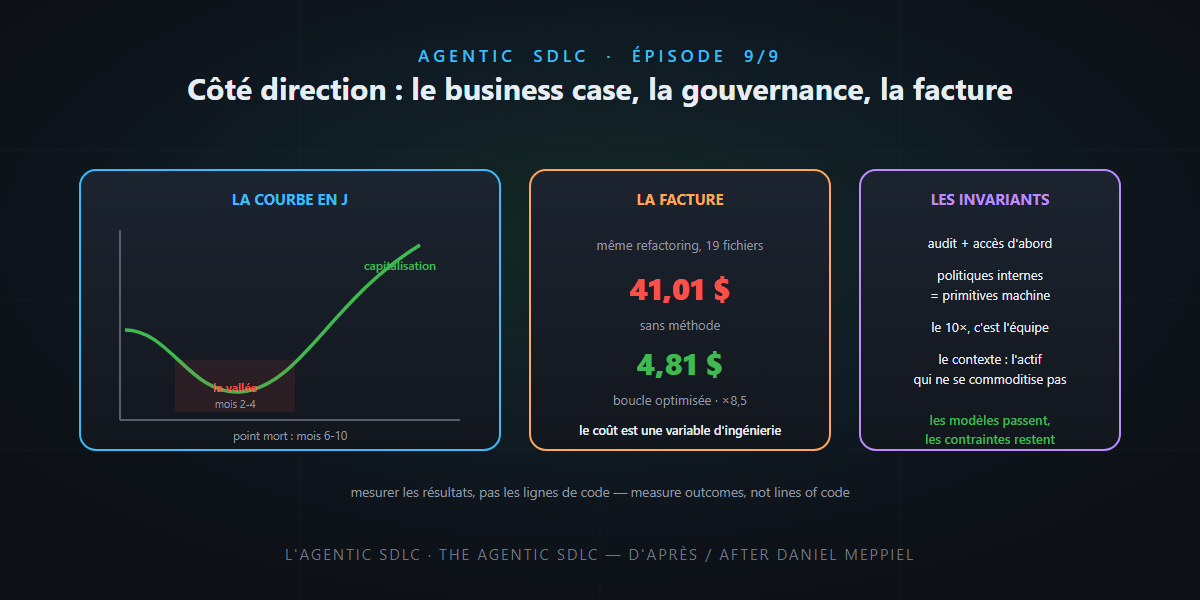
Two numbers to close the series. The same nineteen-file refactoring: $41.01 executed without a method, $4.81 with an optimized loop — an 8.5× spread, identical output. And a statistic you’ve met before: coding is only 20 to 35% of a developer’s time — even an agent that codes twice as fast will never deliver “10×” on total productivity. The bill, like the promise, depends on one thing: architecture, not token prices or model magic.
Final episode of our reading of Daniel Meppiel’s Agentic SDLC Handbook: the leaders’ part (chapters 2 to 8) and the book’s conclusion. After eight episodes inside the engine, we ride up to the executive floor — budget, governance, teams. Still not rocket science.
The honest business case
Chapter 3 dismantles the vendor narrative before rebuilding a defensible file. Three measurement flaws: the denominator problem (speeding up 30% of the work doesn’t transform the whole), the quality discount (30 to 60% of agent code reworked on complex tasks — measuring speed without measuring returns is measuring revenue without refunds), and the attribution problem (what share of the final code came from AI? undecidable). The bottom line: code is an intermediate artifact — what counts is shipped software.
Instead of generated lines of code, the handbook proposes tracking: the issue → production cycle time, the review rejection rate, post-deploy defect density, and above all the human intervention rate — its best proxy for context quality. And it owns a J-shaped trajectory: two months of setup, then “the valley” (months 2-4, where rework disappoints and projects get abandoned), the inflection around months 4-6, compounding afterwards. Its worked example — 50 developers — lands at a value-to-cost ratio of 2.3 to 7.6× and break-even between months 6 and 10. Returns that are real but moderate: 20 to 40% shorter cycles on well-specified tasks, not a miracle.
The chapter’s strategic reversal: licenses commoditize, context does not. Two organizations with identical tools diverge radically based on their investment in the context layer — that layer is the differentiating asset, and every month of delay is context your competitor is accumulating.
The reference architecture: standardize below the tool
Chapter 4 targets the classic procurement mistake: standardizing on a tool when you should standardize on the architecture below the tool. Its five-layer map — platform, context & capabilities, governance & distribution, harness, SDLC phases — has one key property: capabilities flow through it like software dependencies, declared, resolved, versioned. Tools change every quarter; capabilities compound over years. The recommended rollout is incremental: one team and one phase (Code) in month 1, Review in month 3, Test in month 6 — each expansion justified by measurements, not ambition.
Governance: the gap models will never fill
Traditional governance assumes a human at every decision point; agents break that assumption. Where to start, per chapter 5: audit trails (who generated what, with what context, reviewed how?) and dedicated access controls (per-task scoped tokens, not the developer’s credentials) — those two unblock everything else. The iron rule matches our episode 6: the agent never holds the write capability for an irreversible action.
The chapter’s most valuable anecdote: fifteen specialist personas, seven expert panels… and one internal compliance constraint missed, which a human spotted in thirty seconds. Normal, and permanent: organizational policies are internal, privileged, ever-moving — they will never be in the training data. Conclusion: encode them as machine-readable primitives, put executable gates in CI, and keep human review as the escape valve, not the primary mechanism. And flip the heaviness objection: clear governance accelerates — the way a test suite lets you deploy more often, crisp trust boundaries allow more autonomy in low-risk zones.
Teams: the 10× is the team
Chapter 6 quantifies the shift in work: code writing drops from ~30-35% to 10-15% of time, review rises to 20-25%, specification to 20-25%, and context engineering appears (10-15%). Seniors become context architects, juniors learn through review and specs, tech leads arbitrate what goes to agents. Three roles emerge: domain specialist (the what of a skill), agentic workflow engineer (the how), agent operations specialist (costs, eval drift, at scale only).
What fails, according to the field: the centralized “AI team” that becomes a bottleneck, the “human code / agent code” split, and the headcount-reduction bet. What works: stream-aligned teams with context engineering embedded — smaller, more senior. The formula that sums it up: a competent developer with excellent team context beats a brilliant developer with poor context. The leverage is systemic, not individual.
The bill: an engineering variable
Back to $41 versus $4.81. Chapter 7 turns it into an operating model: asking every developer to optimize costs doesn’t work (specialized knowledge, unsustainable vigilance) — the solution must be resident in the tool. Hence the “loop factory”: a small central team explores at frontier cost, freezes the optimized workflows (model routing, cache-aware prompts, tool subsets) and publishes them as versioned artifacts in a governed catalog. Exploration is paid once; consumption runs on cost-effective models.
What comes next — and where to start Monday
Chapter 27 closes the book with tiered predictions (multi-agent orchestration going mainstream near-term, specification becoming as rigorous a discipline as implementation mid-term, and on the horizon the “dark software factory” where verification replaces observation) — but above all with what won’t change: finite context, probabilistic output, explicit beating implicit, human judgment as the bottleneck, composition as a necessity. Five properties, five PROSE constraints: the loop from episode 1 closes.
It also lists when not to use any of this — changes under 50 lines, domains with entirely implicit knowledge, throwaway work, pure creative judgment. And it offers a one-week ramp, which I gladly pass along as homework: day 1, audit the implicit conventions of your most-changed module; day 2, write three instruction files; day 3, run the same real task with and without; day 4, measure and revise; day 5, share with the team.
A word of honesty
- Every number in this episode is the handbook’s — constructed ranges owned as such, not multi-year controlled studies. The author flags his estimates and himself calls for independent validation. That honesty is precisely what makes the file credible in a boardroom.
- Nine episodes don’t replace 27 chapters: the case studies, the Genesis worked example and the cross-harness porting appendix are worth the detour. The book is free and online — give it a weekend.
In short — the series in one lesson
- The business case holds if you measure outcomes (cycle time, defects, intervention rate) and cross the valley of months 2-4 without panicking.
- Standardize the architecture below the tool; start governance with audit + access; encode your internal policies as primitives — that gap is permanent.
- The 10× is a property of the team: excellent context, strong review, disciplined specs — and the bill is an engineering variable (up to an 8.5× spread).
- Beneath it all, one idea, repeated from the first episode to the last: models pass, constraints remain. You don’t cross the vibe coding cliff with a better model, but with a method.
Thank you for following this series — the full map is in episode 1, and the full text is at Daniel Meppiel’s. The agentic era has begun; we might as well show up equipped. And that, honestly… is not rocket science.