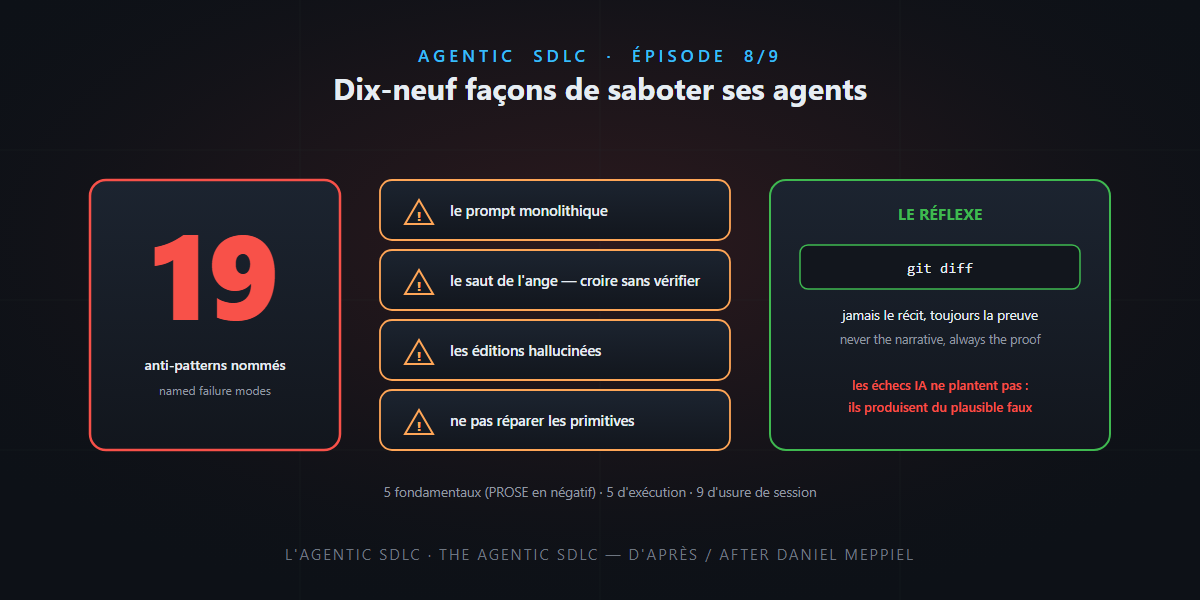
“Done — all three files modified and the tests pass.” You run git diff: nothing. The edit failed silently, the agent narrated its success with total confidence, and you just lived through anti-pattern #12 of the catalog. Chapter 20 of Daniel Meppiel’s Agentic SDLC Handbook documents nineteen failure modes of agentic development — named, diagnosed, treated. Its key line deserves a spot on the wall: AI failures don’t crash, they produce plausible wrong output.
After orchestration, the penultimate episode plays the blooper reel — except you’ll recognize yourself in every line. So did I. Not rocket science, but humbling.
The five foundational ones: PROSE in negative
The first five you already know — they are the direct violations of the PROSE constraints: the monolithic prompt (everything interacts with everything, each added rule destabilizes the others — models interpret context probabilistically, not sequentially), context dumping (the whole codebase in the window, the agent fixates on irrelevant details), the unbounded agent (no file restrictions), flat instructions (rules from different domains contradict each other), and scope creep (the task swells mid-session, quality melts along the way).
The five execution ones: where fleets crash
| Anti-pattern | The symptom | The remedy |
|---|---|---|
| The solo hero | one agent, one whole feature, one giant unreadable diff | one file per agent per wave, checkpoints |
| The trust fall | taking the agent’s word for it (“done!”) | git diff, never the narrative — deterministic verification |
| Same-file parallel edits | the second agent fails silently | one file, one agent; sequence across waves |
| Skipping checkpoints | three waves in a row untested, root cause unrecoverable | test and commit every wave — 2 minutes vs 3 hours |
| Not fixing the primitives | the same mistake every session, hand-corrected every time | trace back to the faulty config file: fix the system, not the output |
The last one is my favorite: it’s episode 3’s feedback loop run in reverse. Correcting the output without correcting the primitive is bailing water without plugging the hull.
The nine session ones: wear, cost, trust
The rest of the catalog covers everyday session life: context window exhaustion (quality degrades midway — stop, commit, restart fresh, see episode 5); hallucinated edits (our opening git diff); stale context between waves (the agent references the interface from two days ago — re-read committed state after every checkpoint); cost runaway (fifteen retries for marginal progress — set a budget: after two failures, re-slice or change approach); the “almost done” trap (the last 10% resists, sunk cost holds you hostage — commit what works, isolate the hard part); session state loss (mid-task crash, inconsistent codebase — commit every wave); persona drift (your backend specialist starts refactoring CSS — shorter sessions, role reasserted in the task prompt); cross-wave merge conflicts (each wave passes alone, the combination breaks — integration tests at every wave); and prompt injection via dependencies (a library README or code comment hijacks the agent — external content = untrusted, allowlists, pre-scanning; we devoted a whole episode to defense in depth).
Detecting the silent
Since nothing “crashes”, detection has to be planned. The chapter proposes a checklist by granularity: per dispatch (does the diff match the task?), per wave (tests + convention scan), per PR (review of the sensitive spots), weekly (trends: churn, intervention rate). The cross-cutting reflex: never accept a success narrative without deterministic proof — green tests, inspected diff, re-read file.
The recovery playbook
When it breaks anyway, six steps: assess and diagnose → snapshot what works → revert the broken sections → decompose the problem → update the faulty primitive → re-execute under constraints. Note step 5: every incident must leave a trace in your configuration — or you will relive it.
A word of honesty
- Nineteen is a catalog, not an anxiety checklist. Most teams accumulate three or four of these patterns, not nineteen. Spot yours, fix them in order of cost.
- Some remedies seem to contradict each other (commit often vs don’t over-persist). The referee is always the same: is the committed state tested and consistent? If yes, move forward; if not, step back.
In short
- Agent failures are silent: plausible, confident, wrong — detection is designed, it doesn’t happen by itself.
- Five foundational anti-patterns = the PROSE violations; five execution ones for fleets; nine of session wear.
- The reflexes that save you:
git diffover the narrative, test and commit every wave, a retry budget, and fix the primitive, not the output. - Six recovery steps, one non-negotiable: the incident must improve your configuration.
Tomorrow, the finale: we ride up to the executive floor — the honest business case, governance, the teams that change, and the bill that varies 8.5× depending on architecture. And that, honestly… is not rocket science.