Pull request review, Tuesday morning. Nineteen comments, fourteen of which boil down to: “use var here”, “unused using”, “interface without the I prefix — we agreed on this”. The new developer takes it politely, fixes, pushes again. Next week, same remarks — on code written by an AI agent this time. Nobody actually reviewed the meaning of the PR: the entire attention budget went into form.
Yesterday, schemas and contracts introduced a powerful idea: the rule the machine enforces itself. Today, same family, applied to your coding conventions: linters and analyzers. The best convention is the one you no longer need to explain — not to the newcomer, not to the agent. You’ll see: it’s not rocket science.
Guardrails
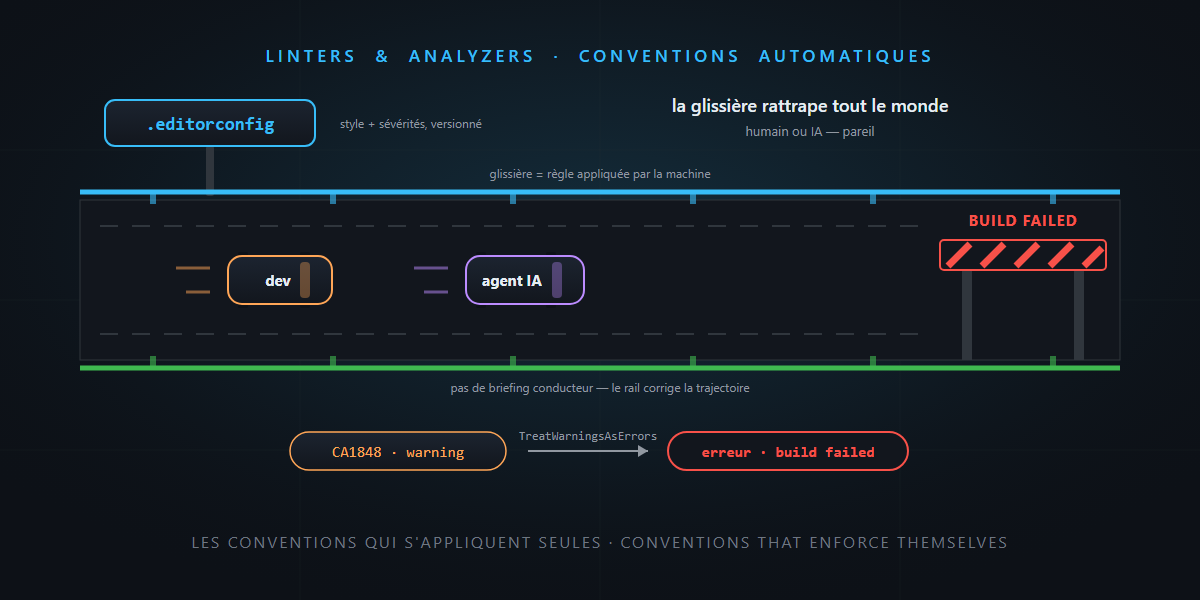
You don’t brief every driver on the layout of the road. You don’t stick a post-it saying “careful, left turn at mile 12” on every windshield. You install a guardrail: it’s there, all the time, for everyone, and it catches the seasoned driver, the Sunday driver — and the self-driving car — exactly the same way.
Your coding conventions deserve the same treatment. There’s a ladder, and each rung is worth ten times the previous one:
- The oral convention — “we agreed in that meeting that…”. It dies with turnover, and the AI agent never heard it.
- The written convention — a wiki page, a line in AGENTS.md. Better: it can be read. But nothing forces anyone to follow it.
- The enforced convention — a tool checks it on every build. No more explaining: the guardrail catches everyone the same, human or AI.
In the complete map of vibe coding artifacts, this is the most profitable family: the one you configure once and that works on every commit.
The .NET arsenal
Good news for .NET devs: everything is already in the box. Five tools, five moments where the guardrail catches you:
| Tool | What it does | Where it catches you |
|---|---|---|
.editorconfig |
declares the style and each rule’s severity | in the IDE, as you type |
| Roslyn analyzers | CAxxxx rules + package analyzers (xUnit, EF Core…) |
at compile time |
dotnet format |
doesn’t report: fixes | before the commit |
TreatWarningsAsErrors |
turns the warning into a wall | at build time |
| Pre-commit hook + CI | the last net, non-negotiable | before the merge |
The key point: since .NET 5, Roslyn analyzers ship with the SDK, and the .editorconfig drives their severity. A single file, versioned at the root of the repo, reviewed in PRs like everything else.
A concrete example, in full
A realistic .editorconfig excerpt — each rule is a review comment that will never exist again:
root = true

[*.cs]
# var when the type is apparent — the review debate is over
csharp_style_var_when_type_is_apparent = true:warning

# An unused using does not pass the build
dotnet_diagnostic.IDE0005.severity = error

# System.* first in usings, always
dotnet_sort_system_directives_first = true

# Interface without the I prefix = build error, not a post-it
dotnet_naming_rule.interfaces_prefixed.symbols  = interface_group
dotnet_naming_rule.interfaces_prefixed.style    = prefix_i
dotnet_naming_rule.interfaces_prefixed.severity = error
dotnet_naming_symbols.interface_group.applicable_kinds = interface
dotnet_naming_style.prefix_i.required_prefix    = I
dotnet_naming_style.prefix_i.capitalization     = pascal_case

# Nullable doesn't forgive: possible dereference = error
dotnet_diagnostic.CS8602.severity = error
dotnet_diagnostic.CS8618.severity = error
And the project-side lock, three lines in the .csproj (or better, a Directory.Build.props for the whole solution):
<PropertyGroup>
  <TreatWarningsAsErrors>true</TreatWarningsAsErrors>
  <EnforceCodeStyleInBuild>true</EnforceCodeStyleInBuild>
  <AnalysisLevel>latest-recommended</AnalysisLevel>
</PropertyGroup>
From there, the math is simple: every automated rule is one line less in your AGENTS.md and one comment less in review. The instructions file keeps what requires judgment; the guardrail handles the rest.
Why it’s worth double in the AI agent era
Three reasons, and the first one is the most beautiful:
- The feedback loop corrects the agent without a single token. The agent generates code, compiles, reads the warning-turned-error (
CS8602: possible null dereference), and fixes itself — alone, in the same session, without you writing a word. A build error message is the most efficient prompt in the world: precise, contextual, free. - The agent respects the
.editorconfigit detects. Modern agents read that file the way they read your code: they see your style preferences in it and adopt them from the very first generation. An enforced convention is also a readable convention — machine-verifiable and machine-understandable, just like yesterday’s contracts. - Human review is freed from form to judge substance. When the agent produces in an hour what a dev used to write in a week, fourteen style comments become untenable. The linter absorbs all of them; the human keeps the five that talk about architecture and meaning. The series formula, pushed one notch further: the AI proposes, the rule decides, the human only arbitrates what’s worth arbitrating.
The honesty moment
- The linter checks form, never meaning. Perfectly formatted code can be perfectly wrong. Zero warnings says nothing about the business logic — that’s the job of tests, reviews and specs. The guardrail keeps you from leaving the road; it doesn’t tell you whether you’re driving in the right direction.
- 2,000 ignored warnings = noise that drowns everyone. A build that spits out two thousand “usual” warnings teaches humans to stop reading — and drowns the agent in useless context where the important warning becomes invisible. The only sustainable policy: zero warnings, or nothing. Hence
TreatWarningsAsErrors. - Turning on 200 rules at once on a legacy codebase = guaranteed pain. The build goes red for three days and the team hates the tool before ever seeing its value. Go in waves: a handful of rules as
error, the rest assuggestion, then raise the severity wave after wave — withdotnet formatmopping up the existing code at each step.
In summary
- The convention ladder: oral < written < enforced — the best one no longer needs explaining, because a guardrail enforces it, for the human and the agent alike.
- The .NET arsenal is already in the SDK:
.editorconfig+ Roslyn analyzers +dotnet format+TreatWarningsAsErrors+ a CI that blocks. - Every automated rule = one line less in AGENTS.md, one comment less in review — the docs keep the judgment, the tool keeps the form.
- With agents: the build-error-fix loop steers the AI without a single token, and human review finally focuses on meaning — critical when the volume of generated code explodes.
A guardrail doesn’t make small talk, doesn’t get tired, doesn’t let anything slide on a Friday at 5 pm. Configure it once, and your conventions enforce themselves — on the sprint-24 dev and on tonight’s agent alike. And that, honestly… is not rocket science.