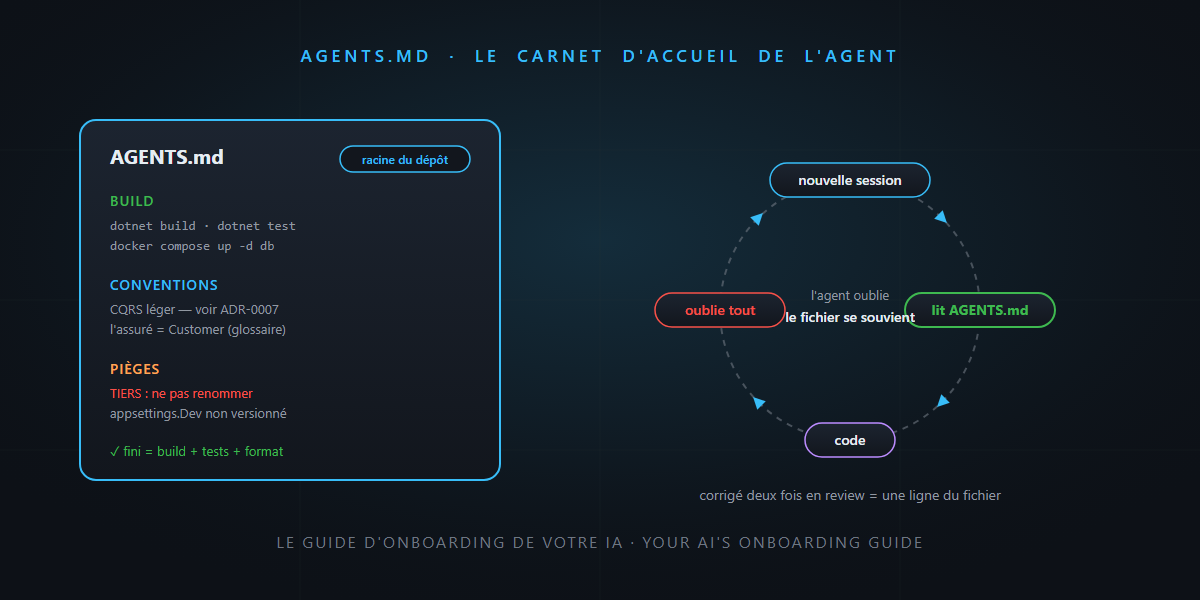
Monday, 9 a.m. The new hire arrives. You show them everything: the build command, the house conventions, the one table you must never rename. They’re brilliant, they code fast, the day goes great. Tuesday, 9 a.m. They come back… remembering nothing. Not the build, not the conventions, not the table. You explain it all again. Wednesday? Same thing. This colleague exists: it’s your AI agent, amnesiac every morning.
Yesterday, the complete map of vibe coding artifacts set the scene. First stop on the map, and not by accident: the agent instructions file — the onboarding booklet your amnesiac colleague re-reads at every session. You’ll see: it’s not rocket science.
The colleague who starts from zero every morning
An AI agent keeps nothing from one session to the next. Yesterday’s conversation — where you explained three times that the integration tests require Docker — is gone. Every session starts from a blank page: same questions, same guesses, same mistakes, same corrections. You remember; it doesn’t.
With humans, we solved this long ago: the onboarding guide. You write it once, the newcomer reads it, and you stop re-explaining. The only difference with AI is that your newcomer has to re-read the guide every single morning. Good news: re-reading without ever getting bored is precisely what an agent does better than anyone.
The onboarding booklet: AGENTS.md and its cousins
The cure fits in one Markdown file at the root of the repository, which the agent reads automatically at the start of every session. The emerging standard is called AGENTS.md (described at agents.md) — “a README for agents”, adopted by many tools. Its cousins do the same job under other names: CLAUDE.md for Claude Code, .github/copilot-instructions.md for GitHub Copilot.
The exact name matters little; the idea is the same everywhere: everything you keep repeating to the agent at the start of a session belongs in this file — and never needs repeating again.
A complete example: twenty lines for a .NET project
# MyShop — agent instructions

## Build & tests
- Build: `dotnet build MyShop.sln` (repo root, .NET 9).
- Local tests: `dotnet test --filter Category!=Integration`.
  Integration tests require Docker: `docker compose up -d db`.
- Before any commit: `dotnet format --verify-no-changes`.

## Conventions
- Light CQRS: one command OR one query per feature, dedicated
  handler in `src/Features/<Domain>/` (see ADR-0007).
- Business naming: follow `docs/glossary.md` — the insured is
  `Customer`, never `Client`.
- No `DateTime.Now`: inject `TimeProvider`.

## Known traps
- The `TIERS` table is ERP legacy: never rename it.
- `appsettings.Development.json` is not versioned: start from
  `appsettings.Template.json`.

## Definition of "done"
Green build, green tests, format verified — and if the decision
is structural, an ADR in `docs/adr/`.
Twenty lines, four sections: the exact commands (the ones that actually work, prerequisites included), the conventions you can’t deduce from the code, the known traps, and the definition of “done”. Notice the cross-references: the file duplicates neither the ADRs nor the glossary — it points to them.
What to put in — and above all what to leave out
Every line of this file is re-read at every session and costs tokens every time. A line that doesn’t prevent a mistake is a line that dilutes the others. The test:
| In the onboarding booklet? | Verdict |
|---|---|
| The exact build and test commands, prerequisites included | ✅ yes |
Conventions not deducible from the code (“no DateTime.Now”) |
✅ yes |
Known traps (“TIERS, never rename”) |
✅ yes |
| The definition of “done” (build, tests, format, ADR) | ✅ yes |
| What the code already says (the folder tree, the project list) | ❌ no |
| Ambient prose (“we value quality”) | ❌ no |
The rule from the other artifacts applies here more than anywhere: ten important instructions beat a hundred bureaucratic ones.
Root + folders: instructions as nesting dolls
One single file for a whole monolith eventually overflows. The fix: hierarchy. One AGENTS.md at the root for the global stuff (build, definition of “done”), and one per folder for the local stuff — src/Features/AGENTS.md for the CQRS conventions, tests/AGENTS.md for the testing conventions. The agent applies the file closest to the code it’s touching. Simple rule: the general at the root, the specific as close to the code as possible.
Why it’s worth double in the AI agent era
Three reasons — and here, “double” is almost an understatement:
- It’s the most directly read artifact on the whole map. ADRs, the glossary, the diagrams: the agent reads them if it finds them. The instructions file, though, is loaded by default at the start of every session. That makes it the gateway to everything else: one line saying “check
docs/adr/before touching the architecture” is enough to plug in the long-term memory. For the precise mechanics on the Copilot side — instructions, skills, agents — see the dedicated article. - The golden rule: corrected twice = one line. Every remark you repeat a second time when reviewing an agent’s PR must become a line in the file. Review stops being a recurring chore and becomes an investment: the AI proposes, the human decides, the repository remembers — and the same mistake doesn’t come back a third time.
- It turns amnesia into an asset. A human re-reading the onboarding guide every morning would be a waste. An agent applies the booklet to the letter from the first minute, every session, without fatigue or personal interpretation. The same onboarding, perfectly reproducible — for the second agent as for the two-hundredth.
The honesty moment
- The file drifts. Nobody re-reads it spontaneously, and a build command that changed makes it silently wrong. The reflex: when the agent gets something wrong, re-read the file first — the missing or stale instruction is often hiding there.
- Too long = diluted. A three-hundred-line file drowns the three vital instructions in noise — and the agent, like a hurried reader, retains the middle poorly. Pruning is maintenance, not sacrilege.
- It’s not magic. An instruction is not a constraint: the agent can ignore it, especially when it’s buried. The truly non-negotiable conventions deserve an executable guardrail on top — an analyzer, a failing test.
In summary
- Your AI agent is a colleague who is amnesiac every morning: the instructions file is the onboarding booklet it re-reads at every session.
- AGENTS.md (and its cousins
CLAUDE.md,copilot-instructions.md) holds the exact commands, the non-deducible conventions, the known traps and the definition of “done” — not what the code already says, since every line costs tokens at every session. - Hierarchical: the general at the root, the specific in one file per folder, as close to the code as possible.
- The golden rule: every correction repeated twice in review becomes a line in the file — the AI proposes, the human decides, the repository remembers.
Twenty lines of Markdown, re-read every morning without complaint by the most diligent colleague on the team. And that, honestly… is not rocket science.