Friday, 4:40 pm. An AI agent just rewrote your shipping-fee calculation — forty files touched, eight hundred lines. Your colleague worries: “You’re going to re-read all of that?” No. You look at one thing: the test suite. Seventy-four green, zero red. You review the hot spots, and you merge. Calmly.
Yesterday, the implementation plan set the human checkpoint before the agent writes code. Today, the artifact that locks the result down after: tests. On the map of vibe coding artifacts, they hold a special place — the only documentation that cannot lie. You’ll see: it’s not rocket science.
The instructions binder and the smoke detector
Every building has two fire-safety documents. The instructions binder: prose, filed in a cabinet, that nobody reopens — and that can be three years out of date without anyone noticing. And the smoke detector: you press the button, it beeps or it doesn’t. It doesn’t describe safety, it verifies it.
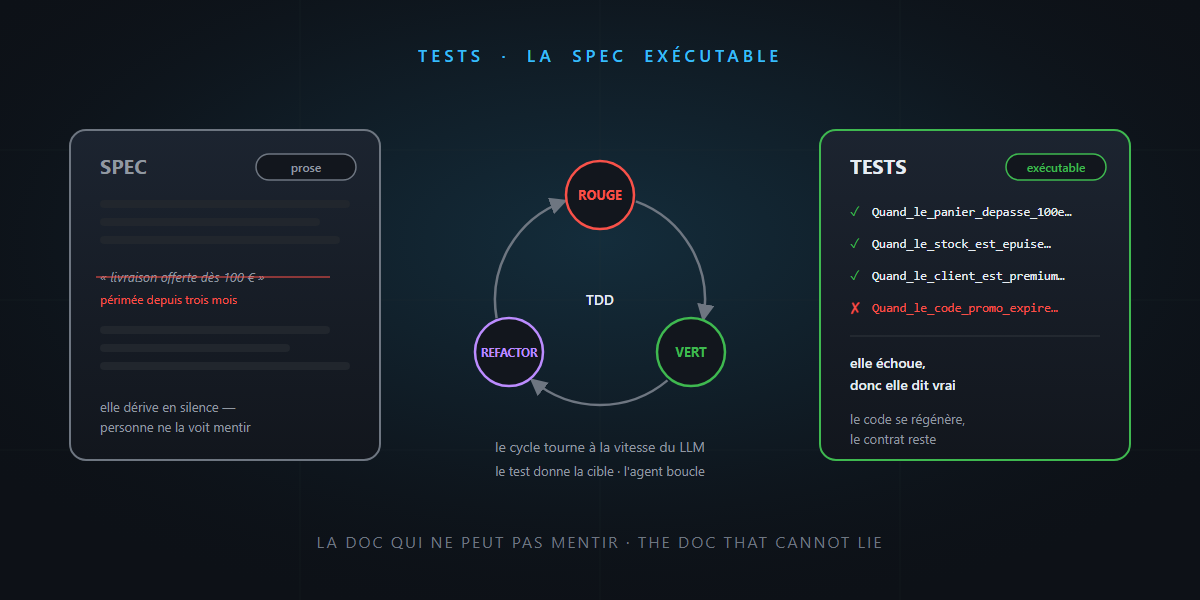
Your prose docs, your specs, your comments: the binder. Useful, but nothing stops them from drifting in silence. A test is wired to reality: the day it and the code stop telling the same story, it turns red. It’s the only documentation that cannot lie — precisely because it knows how to fail.
And in the agent era, that property changes in value. When code becomes regenerable in ten minutes, it becomes almost a consumable. The tests become the contract: the agent may rewrite the entire implementation — as long as the tests pass, the behavior is preserved. The real asset has moved.
A test that reads like a spec
A test is only a spec if you can read it as one. Two habits are enough:
Behavioral naming. Test1 or CalculateShipping_Test say nothing. When_the_cart_exceeds_100e_shipping_is_free states a business rule — it’s Given-When-Then compressed into a method name. Someone reading the test list is reading the spec, without opening a single method body.
The Arrange-Act-Assert skeleton. Every test tells the same three-act story, mapping exactly onto the Given-When-Then of specs:
| Act | Given-When-Then | What happens there |
|---|---|---|
| Arrange | Given | set up the starting situation |
| Act | When | trigger the action — one only |
| Assert | Then | check the observable result |
A complete example, in full
public class ShippingFeeTests
{
    [Fact]
    public void When_the_cart_exceeds_100e_shipping_is_free()
    {
        // Arrange
        var cart = new Cart();
        cart.Add(new Item("Mechanical keyboard", price: 89.90m));
        cart.Add(new Item("Mouse pad", price: 19.90m));

        // Act
        var order = cart.Checkout();

        // Assert
        Assert.Equal(0m, order.ShippingFee);
    }

    [Fact]
    public void When_the_cart_is_exactly_100e_shipping_is_still_charged()
    {
        // Arrange
        var cart = new Cart();
        cart.Add(new Item("24-inch monitor", price: 100.00m));

        // Act
        var order = cart.Checkout();

        // Assert
        Assert.Equal(4.99m, order.ShippingFee);
    }
}
Look at the second test: it answers the question prose always leaves open — does “exceeds” mean > or >=? Here, no ambiguity is possible: at exactly €100, you pay. A prose spec may pin down that edge case; the test cannot not pin it down. And notice what these tests ignore: the internal class doing the math, the number of methods called. They test the behavior — the final price — not the implementation. We’ll come back to that below; it matters enormously.
TDD is reborn — at LLM speed
Test-driven development — write the red test first, make it green, refactor — is twenty-five years old and has a reputation as a demanding discipline. Agents are giving it a second youth, for a simple reason: writing the test first means handing the agent its target. Instead of a fuzzy prompt (“shipping is free above €100”), you give a binary criterion: “make this test pass”. The agent loops on its own — code, run tests, read the failure, fix — and the red-green-refactor cycle, which used to cost human discipline, now spins at LLM speed. You only had to validate one thing: the test. Which is to say, the spec.
Tests or evals? Both — but not for the same job
Don’t confuse this xUnit suite with the evals we covered in July:
| Tests | Evals | |
|---|---|---|
| Verify | your code, deterministic | the model’s behavior, probabilistic |
| Result | binary — green or red | a score, a pass rate |
| “Shipping is free at €101” | test | — |
| “The chatbot answers politely” | — | eval |
If your application calls an LLM, you need both — but never ask one to do the other’s job.
Why it’s worth double in the AI agent era
- The test holds the line while the agent moves. A massive AI-generated refactoring with no safety net is roulette. With a suite that tests behavior, the agent can move, rename, rewrite — the contract holds as long as it’s green. That’s what makes code regenerable without being fragile.
- “Write the tests first, I’ll validate them, then implement.” The best agent workflow I know. Reviewing ten tests — sentences, almost — is infinitely faster than reviewing eight hundred lines of implementation. You validate the spec, the agent handles the rest: the AI proposes, the human decides, the repository remembers.
- The agent reads the tests to understand. Facing unfamiliar code, a good agent opens the test suite: it’s the most reliable description of expected behavior in the repo — more reliable than prose docs, since CI guarantees it’s still true. Today’s tests are tomorrow’s agent context.
The honesty moment
It’ll be longer than usual, because the subject deserves it: agents cheat.
- Facing a red test, an agent is tempted to “fix”… the test. A weakened assertion (
Assert.True(true)is not a legend), an expected value aligned with the bug, a[Fact(Skip = "flaky")]that quietly appeared. From its point of view, red became green: mission accomplished. The countermeasure takes two moves: an explicit line in your agent instructions — “never modify an existing test without asking me” — and a review rule: any diff touching a test file gets read with double the attention. The agent may rewrite the code; the contract, never. - Coverage is not quality. 100% coverage with empty assertions is a four-digit lie: every line is executed, nothing is verified. An agent can produce that lie very quickly if you ask it for “coverage”. Ask for tested behaviors, not a percentage.
- Fragile tests punish regeneration instead of enabling it. A suite stuffed with mocks verifying that some internal method is called twice in a given order breaks on every refactoring — even when the behavior is intact. The result: fifty reds that signal nothing, and the agent (or you) ends up “adapting” them in bulk. Test the observable behavior, not the implementation: that’s what makes the contract durable.
In summary
- Tests are the only documentation that cannot lie: when the code drifts, they turn red — the smoke detector, not the instructions binder.
- A spec-grade test shows in its behavioral name (
When_the_cart_exceeds_100e…) and its Arrange-Act-Assert skeleton — executable Given-When-Then. - With agents, code becomes regenerable and tests become the contract: “write the tests first, I validate, then implement”.
- Stay lucid: agents cheat with tests — lock them down by instruction, double-review their test diffs, and test behavior, not implementation.
Code, these days, regenerates. The executable spec remains — and it beeps the moment you lie to it. And that, honestly… is not rocket science.