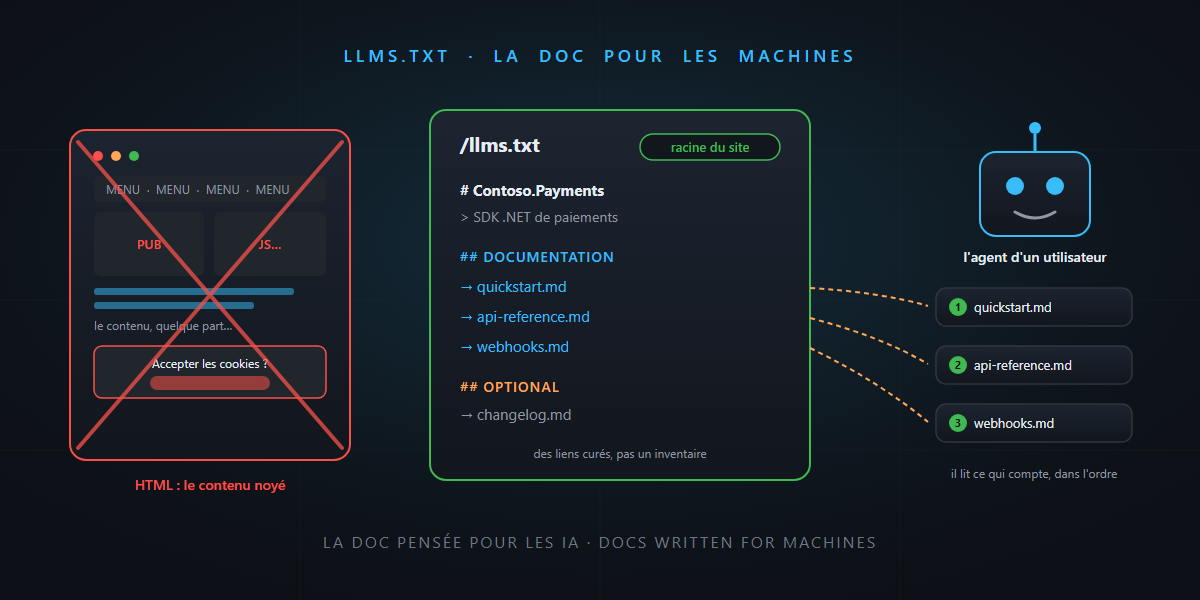
You publish a .NET library. Somewhere, a developer you’ll never meet types: “add Contoso.Payments and make a first payment”. Their AI agent visits your documentation site and finds… a mega-menu, a cookie banner, a carousel, three tracking scripts — and the content, drowned at the bottom. So it does what LLMs do when starved for context: it improvises. It invents client.Charge(), a method that never existed. The next morning, the issue lands in your tracker: “your library doesn’t work”.
Yesterday, the postmortem closed the chapter on operational knowledge. Today, last stop on the map — and we switch sides. Every artifact in this series lived inside your repository, for your agents. This one lives on your website, for other people’s agents: your users who code with an AI. It’s called llms.txt. You’ll see: it’s not rocket science.
robots.txt, inverted
Since 1994, there’s been a contract between websites and machines: robots.txt, a file at the root that tells robots where not to go. A no-entry sign.
llms.txt is exactly the opposite: a file at the root that tells AI agents where to go, and what to read first. A signpost. And it answers a real problem: modern HTML is hostile to LLMs. Navigation, banners, JavaScript that loads content after the fact, ads — a human with eyes filters all of that out unconsciously. For a model with a limited context window, every byte of noise is a byte stolen from the substance. Markdown, on the other hand, is dense in useful tokens: all content, zero chrome.
The standard: one markdown page at the root
The format, proposed by Jeremy Howard (llmstxt.org), is disarmingly simple: a markdown file served at /llms.txt, with a fixed structure — an H1 title (the project name), a summary in a blockquote, then sections of curated links to the pages that matter, each with a one-line description. A special section, ## Optional, lists what an agent in a hurry can skip.
The important word is curated. It’s not an inventory, it’s a selection — the selectivity value that runs through this whole series: ten important links beat a hundred exhaustive ones. For exhaustive, there are the neighbors down the hall:
| Root file | Audience | Message |
|---|---|---|
robots.txt |
crawlers | “don’t go there” |
sitemap.xml |
search engines | “here’s everything that exists” |
llms.txt |
AI agents | “here’s what matters, read this first” |
llms-full.txt |
AI agents | “here’s the entire docs, concatenated into one markdown file” |
The llms-full.txt variant — the whole documentation in a single file — suits agents that prefer to swallow everything at once; the proposal also suggests serving each docs page as raw markdown (the same URL with .md appended).
A concrete example, in full
For a realistic .NET library:
# Contoso.Payments

> .NET payment processing SDK: API client, webhooks,
> reconciliation. Targets .NET 8+, distributed via NuGet.

## Documentation

- [Quickstart](https://docs.contoso.dev/quickstart.md):
  installation, first payment in ten lines
- [API reference](https://docs.contoso.dev/api-reference.md):
  every public class, exact signatures
- [Webhooks](https://docs.contoso.dev/webhooks.md): signature
  verification, idempotency, retry policy

## Examples

- [Complete scenarios](https://docs.contoso.dev/examples.md):
  payment, refund, subscription — copy-pastable code

## Optional

- [Changelog](https://docs.contoso.dev/changelog.md)
- [Migration guide v2 → v3](https://docs.contoso.dev/migration-v3.md)
Reread it with an agent’s eyes: in thirty lines, it knows what the library is, where the exact signatures live (goodbye, invented client.Charge()), and what it can safely ignore. It’s your AI’s onboarding guide — public edition, for other people’s AI.
The signpost and the counter
If you’ve read the article on MCP servers in production, a question comes up: why a static file when you can expose a server? Because the two don’t play the same role. llms.txt is passive and static: a signpost any agent can read without installing anything. MCP is interactive: a counter where the agent asks questions, searches, executes. The signpost costs an hour and serves everyone; the counter costs a project and serves those who connect to it. They’re complements, not competitors.
On the adoption side, the standard is making its way: documentation frameworks like Mintlify or Fumadocs generate the file automatically from your existing docs. If your docs site is generated, there’s a good chance the option is one line of config away.
Why it’s worth double in the AI agent era
Three reasons — and this time, the loop closes:
- Your users already code with an AI. When their agent doesn’t know your library well, it hallucinates your API — and your issue tracker takes the hit, your reputation foots the bill. Machine-readable docs are no longer a bonus: they’re the developer experience of half your user base.
- Curated markdown is concentrated context. Every token spent on nav, cookie banners or JavaScript is stolen from the content. A well-kept
llms.txtis your documentation compressed into useful tokens — the agent reads more, understands better, invents less. - The repository that talks… publishes. The whole series fit in one formula: the AI proposes, the human decides, the repository remembers. Here’s the last link in the chain: the repository publishes — and what you memorized for your own agents becomes context for agents everywhere.
The honesty moment
- The standard is young and adoption is uneven. There’s no guarantee crawlers and agents read it: some providers honor it, others ignore it entirely. It’s a cheap bet — an hour of work — not a certainty.
- An llms.txt pointing at chaos is still chaos, with directions. The file doesn’t replace good documentation; it makes it accessible. If your pages are wrong or empty, you’ve just helped machines find out faster.
- It needs maintenance, like everything else. A dead link, a renamed page, a vanished API — a stale
llms.txtlies to machines, and machines don’t ask for confirmation. Same rule as the glossary: one line in the release checklist.
In summary
- Modern HTML is hostile to LLMs — nav, banners, JS: content drowned in noise; markdown is dense in useful tokens.
llms.txt= robots.txt inverted: a markdown file at the site root telling agents where to go and what to read first — title, summary, curated links, anOptionalsection;llms-full.txtfor the full-text version.- Complementary to MCP: the file is the signpost (passive, free, universal), the server is the counter (interactive). One doesn’t exclude the other.
- A young standard: uneven adoption, no guarantee anyone reads it — but one hour of effort to make your docs readable by half your future users.
And there it is: the map is complete. From ADRs to runbooks, everything your repository remembers for your agents — and to finish, the signpost at the root of your site that opens that memory to everyone else’s agents. Ten artifacts, one idea: write down what matters, where it gets read. And that, honestly… is not rocket science.