Level 400, episode 4 — the article for those who sign the invoices. In June’s BYOK post, we freed the AI from billed tokens by self-hosting it. The question left open: from what point is it profitable? And above all: why a long context costs memory, not just computation.
The KV cache gave us the physical key; today we turn it into economics. VRAM, continuous batching, quantization, and the API vs self-host break-even calculation. You’ll see: it’s not rocket science.
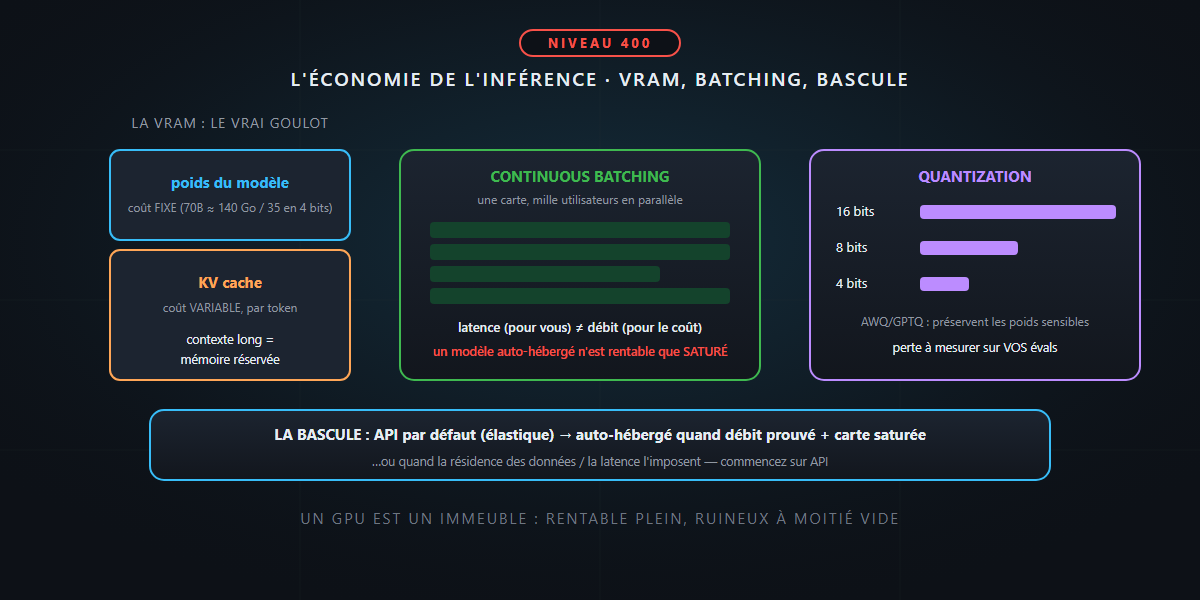
The real bottleneck isn’t compute, it’s memory
A wrong intuition to correct right away: “a GPU serves a model, so more requests = more compute”. In reality, at inference, the wall you hit first is VRAM — the GPU’s memory. It hosts two things:
- The model weights — fixed cost. A 70-billion-parameter model in 16 bits is ~140 GB just to exist; in 8 bits, ~70 GB. Constant, whatever the traffic.
- The KV cache — variable cost, per request and per token. Remember: every in-flight token keeps its Keys and Values in VRAM. An 8,000-token conversation thus reserves a slice of memory proportional to it — for its entire duration.
The financial consequence is counterintuitive and central: “long context” = “reserved GPU memory” = “fewer simultaneous conversations on the same card”. The real cost of a big context isn’t only the quadratic computation, it’s that it takes up a spot other users can no longer have. Your per-token bill is just a proxy for that.
Continuous batching: why total throughput rules
A GPU processes requests in batches: a thousand users share the same card, their tokens generated in parallel. Hence two metrics you must stop confusing:
- Latency — the time for your answer. Decomposed: the TTFT (time to first token, dominated by the quadratic prefill of your whole prompt) then the tokens/second of the decode.
- Throughput — the total tokens/second the card outputs, all users combined. It’s this that determines the cost per token.
Continuous batching (vLLM and the like) is the queen optimization: instead of waiting for a whole batch to finish, you inject a new request as soon as a spot frees up. The card stays saturated, throughput climbs, cost per token collapses. The architect’s lesson: a self-hosted model is only profitable when saturated. A card at 30% utilization costs almost as much as at 100% — but produces three times less.
Quantization: trading a little precision for a lot of memory
The lever that makes self-hosting practical. Weights are stored as floating-point numbers; quantization compresses them into fewer bits — 16 → 8 → 4 — dividing the VRAM footprint accordingly (and speeding things up, memory being the bottleneck).
| Precision | Footprint (70B model) | What you lose |
|---|---|---|
| 16 bits (bf16) | ~140 GB | reference |
| 8 bits (INT8) | ~70 GB | negligible in practice |
| 4 bits (AWQ/GPTQ) | ~35 GB | measurable, often acceptable |
Modern methods (AWQ, GPTQ) are smart: they finely preserve the weights most sensitive to rounding instead of dumbly rounding everything. 4-bit fits a 70B on a single big card — the difference between “rentable” and “out of reach”. The word of honesty: the loss is real and must be measured on your task — with your evals, not on a generic benchmark. Sometimes painless, sometimes disqualifying depending on your case’s sensitivity.
The break-even calculation: API or self-hosted?
The decision, stripped bare. The API is paid per token, no commitment, elastic; self-hosting is paid per GPU-hour, fixed, whether it runs or not.
- Below a certain volume → the API wins, always. A €20,000/year card idle at night never beats a meter that drops to zero when you don’t call it. That’s the overwhelming majority of projects.
- Above, with sustained and predictable throughput → self-hosted (saturated, quantized) pulls ahead: the fixed cost amortizes over a constant flow.
- The other criteria, often decisive before price: data residency (the real driver of the BYOK article — your data doesn’t leave), controlled latency, independence from a provider, and access to specialized open models.
The honest rule: start on API. Migrate to self-hosted when throughput is proven, predictable, and the card would be saturated — or when compliance requires it. Migrating too early means paying for a card to watch it sleep.
In summary
- The inference bottleneck is VRAM: weights (fixed) + KV cache (variable per token) — hence “long context = reserved memory = fewer simultaneous requests”.
- Two distinct metrics: latency (TTFT + tokens/s, for you) and throughput (for cost). Continuous batching saturates the card and collapses the per-token cost.
- Quantization (8/4 bits, AWQ/GPTQ) trades a little quality for a lot of VRAM — loss to be measured on your evals.
- Break-even: API by default (elastic); self-hosted when sustained throughput + saturated card, or when data residency/latency demand it.
A GPU is an office building: profitable full, ruinous half-empty — and the KV cache is the rent each conversation pays for the space it occupies. That’s the economics of inference, no mystery. And that, honestly… is not rocket science.