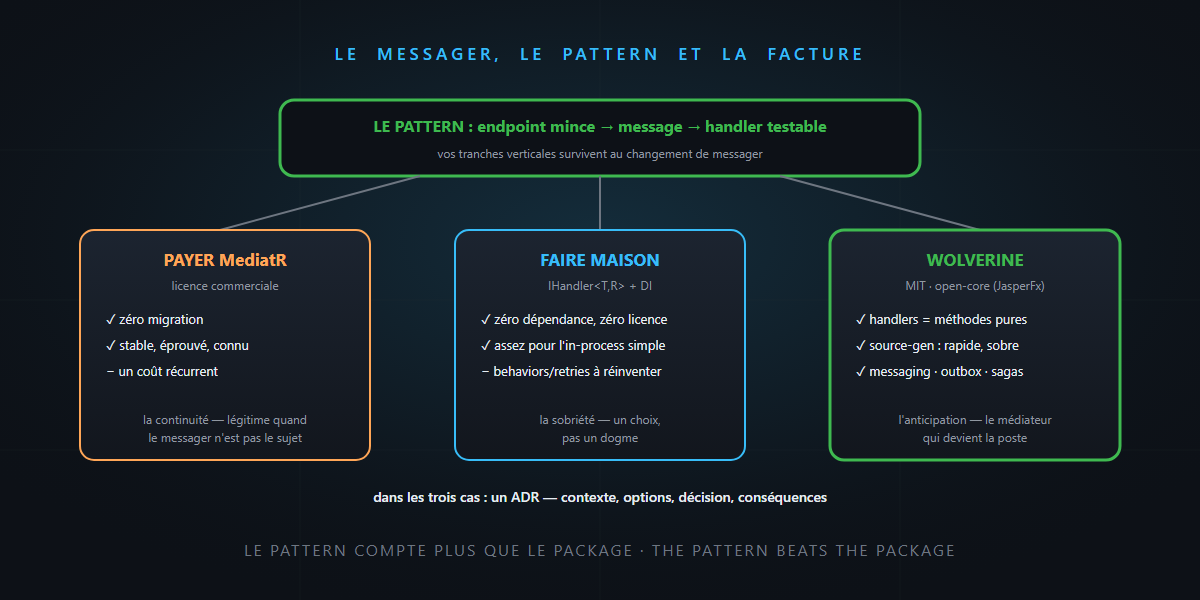
In the vibe engineering post, a “word of honesty” flagged that MediatR was moving to a commercial license, with this promise: the pattern matters more than the library. Several of you asked for the follow-up — so here it is: what do you actually do when your architecture’s messenger sets up a tollbooth?
Three honest options, one candidate worth the detour (Wolverine), and a golden reminder about what your slices owe to the pattern — not the package. You’ll see: it’s not rocket science.
The context, without drama
The facts: MediatR — like MassTransit and other ecosystem pillars — moved to a commercial model: free below a revenue threshold, paid above. And let’s say it against the ambient reflex: this is not a scandal. A maintainer wanting to make a living from a tool half the .NET ecosystem has used for free for ten years is rather the sign of a model seeking sustainability. Paying the license is a perfectly legitimate option — it’s even first in the comparison.
But it is an architecture decision being put to you — and a decision gets documented. Let’s build the file.
The reminder: what does the messenger actually do?
In our CQRS mold, the mediator does one thing: the endpoint hands over a message, the right handler receives it — without either knowing the other. Plus the cross-cutting behaviors (validation, logging) around the pipeline. It’s useful, it’s clean… and it’s remarkably little code. Keep that in mind: you’re not choosing a nuclear reactor, you’re choosing an internal switchboard.
Option 1: pay for MediatR — continuity
Your solution is full of it, the team knows it, it’s stable and battle-tested: paying and changing nothing is a rational choice. The avoided migration cost pays for years of licensing. It’s the option for the files where the messenger is not today’s topic.
Option 2: the homemade dispatch — sobriety
At the other extreme, for a simple in-process mediator, the pattern fits in one interface and a DI resolution:
public interface IHandler<TCommand, TResult>
{
    Task<TResult> Handle(TCommand command, CancellationToken ct);
}

// The Carter endpoint resolves the handler — that's the whole "mediator"
app.MapPost("/orders", (CreateOrder cmd, IHandler<CreateOrder, Guid> h, CancellationToken ct)
    => h.Handle(cmd, ct));
Zero dependencies, zero license, zero magic — and for many projects, that’s enough. The limit is known in advance: the day you need sophisticated behaviors, retries, messaging… you’ll be reinventing a library. Sobriety is a choice, not a dogma.
Option 3: Wolverine — the messenger that thinks bigger
The serious candidate of the moment: Wolverine, from JasperFx’s “Critter Stack”. Three things to know:
1. The model is open-core: the code is MIT and stays that way — JasperFx sells support and consulting, not the right to use the library. (Honesty requires: that’s today’s model; the MediatR story reminds us a model can evolve — hence the ADR.)
2. The philosophy is different — and will remind you of something. No IRequestHandler interface, no base class: a Wolverine handler is a pure C# method, discovered by convention and wired by compile-time code generation (fewer allocations, faster than reflection):
// MediatR: class + interface + IRequest<T>
public class CreateOrderHandler : IRequestHandler<CreateOrder, Guid> { /* … */ }

// Wolverine: a method. That's it.
public static class CreateOrderHandler
{
    public static async Task<Guid> Handle(CreateOrder command, IDocumentSession session)
    { /* … */ }
}
A bare method that the framework discovers and equips on its own… MCP server regulars will smile: same declarative philosophy.
3. It outgrows the mediator role. Where MediatR stops at in-process, Wolverine keeps going: distributed messaging (RabbitMQ, Azure Service Bus…), a durable outbox (the message leaves if and only if the transaction commits — the most underestimated problem in distributed systems), sagas, retries, scheduling. The switchboard that becomes the post office: if your trajectory leads to messaging, migrating to Wolverine isn’t a replacement — it’s an anticipation. A migration guide from MediatR exists, and temporary cohabitation is possible.
The verdict as a table
| Your situation | The right reflex |
|---|---|
| Solution full of MediatR, it does the job | Pay — migration would cost more than the license |
| Simple need, modest project, no messaging in sight | Homemade dispatch (or a free source-gen mediator) |
| New project, or a trajectory toward messaging/outbox/sagas | Wolverine — the pattern, plus what comes next |
And in all three cases: ADR-00XX, context, options, decision, consequences — you know the format.
The real lesson: your slices don’t care
Re-read the structure of a vertical slice: a thin endpoint, a message, a testable handler. That shape survives MediatR, Wolverine, the homemade dispatch — because the pattern structures, not the package. That’s exactly why the base prompt mandates “an endpoint delegates to a handler” rather than a library name. Well-laid foundations make tollbooths negotiable.
In summary
- Commercial MediatR: not a drama, a decision — paying maintainers is a healthy model, and a legitimate option.
- Three paths: pay (continuity), build your own (in-process sobriety), Wolverine (MIT open-core, handlers = pure methods, plus messaging/outbox/sagas).
- The criterion: your trajectory — simple in-process, or durable distributed?
- And the deeper lesson: the pattern matters more than the package — your slices survive a messenger change; that’s what foundations are.
The internal switchboard set up a tollbooth; the post office next door is open and free; and you still know how to wire two desks yourself. What matters: that the messages arrive. And that, honestly… is not rocket science.