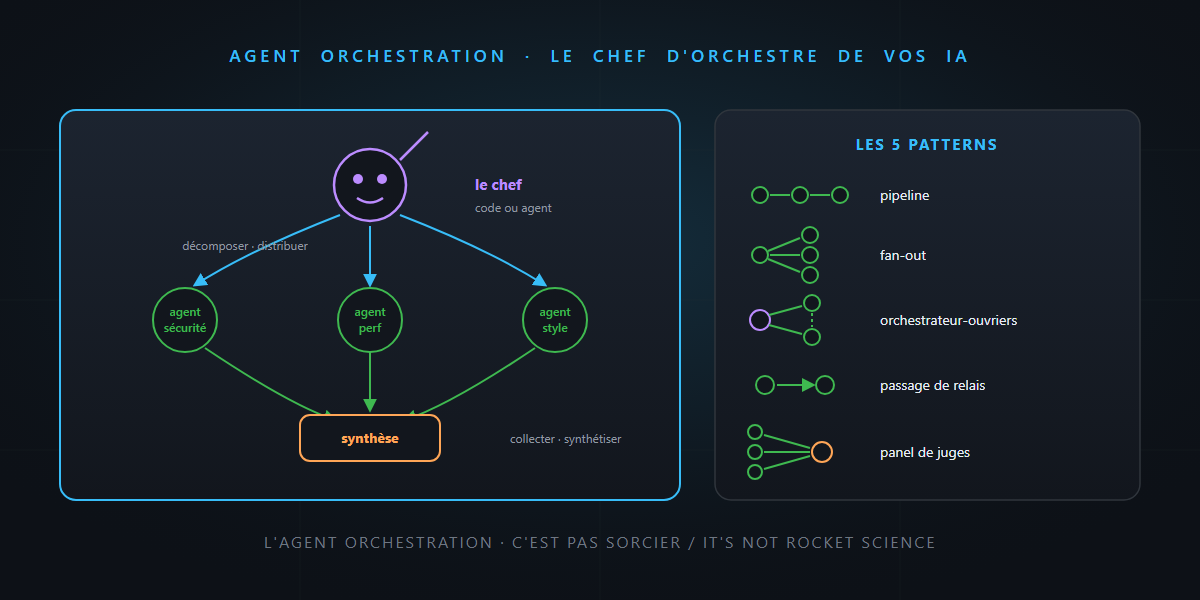
A virtuoso violinist can play a sonata. But a symphony? You need forty musicians — and above all a conductor: someone who plays no instrument, yet sets the tempo, cues the entrances, and turns forty talents into a single work.
This afternoon, we saw what one agent can do alone: loop until the goal. But what happens when the task is too big for a single agent — too long, too wide, too varied? You bring in several. And immediately, a question pops up: who coordinates? The answer is called agent orchestration. Take your seats — it’s not rocket science.
Why not one giant agent?
First legitimate objection: instead of ten agents, why not one agent ten times stronger? Three reasons, all met before in this series:
- The desk overflows. An agent works inside a context window: auditing forty files, reading all the docs and keeping the thread doesn’t fit on one desk — and whatever overflows gets diluted.
- The generalist spreads thin. An agent briefed “watch out for security, performance, style, tests and accessibility” skims everything. Five agents with one obsession each dig deep.
- Time flies. Ten independent tasks run by one agent = ten times the time. By ten agents = the time of the slowest one.
You don’t get a symphony by asking the violinist to play louder. You get it by adding sections — and a conductor.
The conductor, precisely
Orchestration is the role that produces nothing itself but makes everyone else produce:
- decompose the score into sections (the big task into subtasks);
- distribute — the right agent, the right brief, the right slice of context;
- collect the results as they come in;
- synthesize — make it a work, not a pile.
A detail that matters: the conductor can be code (a script chaining the steps — reliable, predictable, testable) or an agent itself (dynamically deciding what to delegate — flexible, but fallible). Good systems mix both: determinism for the structure, judgment for the content.
The five patterns to know
1. The pipeline — the chain of sections
Each agent takes the previous one’s output: draft → proofread → fix → lay out. Dev flavor: write the code → generate the tests → run the review. Simple, readable — entry-level orchestration, and it already covers a lot.
2. The fan-out — all bows at once
A task that splits into independent pieces, distributed in parallel. The canonical example: multi-dimensional code review — a security agent, a performance agent, a readability agent read the same diff at the same time, each with its own obsession. Another classic: migrating forty files, forty workers, each with its own workbench.
3. Orchestrator-workers — the conductor improvising the score
Here, the split isn’t known in advance: a lead agent explores first (“what is this repo made of?”), draws up the list of work sites, then distributes to workers — and adjusts based on what comes back. It’s the pattern of audits and research: the score gets written while playing.
4. The handoff — the soloist stepping aside
An agent recognizes the next part isn’t for them and passes the whole file to a specialist: triage hands off to billing, billing to engineering. Key difference from the pipeline: nobody orchestrates from above — the handoff is decided in the flow, file in hand.
5. The judge panel — playing the same score twice
Several agents tackle the same question independently, then a judge compares, votes, decides. Expensive but precious when mistakes are costly: three agents hunt for bugs, and every finding goes to an adversarial verifier tasked with refuting it. What survives is solid — the principle of evals, applied live.
And concretely, with what?
You already own the instruments. Microsoft Agent Framework turns multi-agent workflows into C# code objects — pipelines, fan-outs, handoffs. Claude Code orchestrates parallel subagents from a session. And GitHub Copilot has its subagents — as it happens, we dissect them tomorrow morning in the CLI series. Today’s vocabulary is the reading grid for everything that follows.
A word of honesty
The orchestra costs more than the soloist — and not just in fees:
- The bill is multiplied. Ten agents = ten contexts to fill, ten outputs to pay for in tokens. Comfort fan-out — parallelizing what one agent would do perfectly well alone — is the most common waste.
- Coordination is the real problem. Two agents editing the same file, one worker contradicting another, a result arriving too late: everything software engineering knows about distributed systems applies — with wrong notes on top.
- Debugging changes nature. When the symphony sounds off, which section do you blame? Without per-agent traces (who received what, who returned what), you’ll be debugging by ear.
The golden rule: start with one agent. Orchestrate when the task objectively overflows — the context, the clock, or the number of independent perspectives needed. A one-musician orchestra is a ridicule no demo forgives.
In short
| Pattern | The move | When | Example |
|---|---|---|---|
| Pipeline | one after another | dependent steps | draft → proofread → publish |
| Fan-out | all at once | independent pieces | multi-dimensional review |
| Orchestrator-workers | explore then distribute | split unknown upfront | repo audit |
| Handoff | the file changes hands | successive skills | triage → specialist |
| Judge panel | same question, N answers | mistakes are costly | bugs + adversarial check |
- Orchestrating = decompose, distribute, collect, synthesize — the conductor doesn’t play, they make others play.
- The conductor can be code (reliable structure) or an agent (flexibility) — good systems dose both.
- Multiplying agents multiplies the bill and the coordination problems: one agent first, the orchestra when it overflows.
- The five patterns cover the essentials — learn to recognize them: every current tool is a variation on them.
Tomorrow, double bill: in the morning, Copilot’s subagents — orchestration seen from inside a tool. And in the afternoon, we connect this week’s two worlds: what happens when the score becomes a graph? Hint: everything you read today fits into nodes and arrows. And that, honestly… is not rocket science.