This whole series has built your agent company: employees (Agent Framework), their tools (MCP), their procedures (workflows). But a company doesn’t live in a vacuum: it has suppliers, carriers, partners — who have their own agents too.
How does your logistics agent ask the carrier’s agent where the delivery stands? Answer: A2A — the Agent-to-Agent protocol — the open standard that makes agents from different systems, vendors and companies talk to each other. You’ll see: it’s not rocket science.
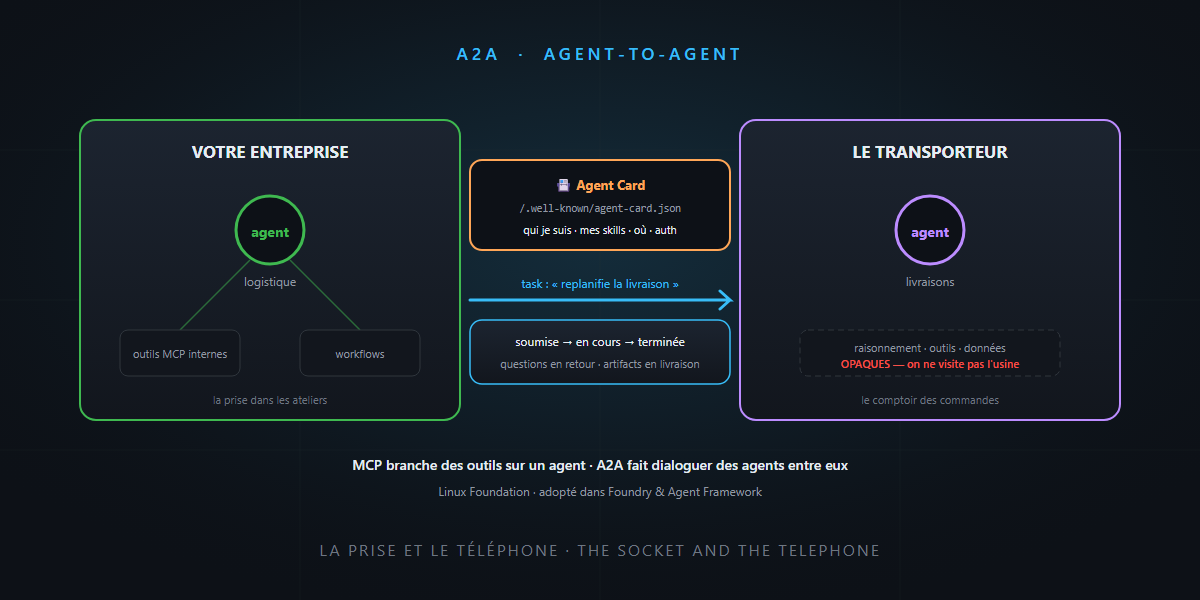
MCP plugs in tools; A2A makes agents converse
The classic confusion first, because the two protocols are cousins:
- MCP is the wall socket: it plugs tools — passive, deterministic — into your agent.
GetStockdoesn’t think: it answers. - A2A is the inter-company telephone: it connects two agents — two autonomous systems that reason, ask questions back, and take time to work.
The simple test: if the thing being called executes and returns (a function), it’s a tool → MCP. If it deliberates, asks for clarification and comes back later (an employee), it’s an agent → A2A. And the two compose naturally: the carrier’s agent you call over A2A uses, internally, its own MCP tools. The socket in the workshops, the telephone between headquarters.
The business card: the Agent Card
How does your agent discover what the agent across the street can do? Every A2A agent publishes an Agent Card — a JSON document at an agreed address (/.well-known/agent-card.json), literally its business card:
{
  "name": "TransExpress Delivery Agent",
  "description": "Tracking and rescheduling of TransExpress deliveries.",
  "url": "https://agents.transexpress.example/a2a",
  "skills": [
    { "id": "track-shipment", "description": "Locates a parcel and estimates arrival." },
    { "id": "reschedule-delivery", "description": "Reschedules a delivery." }
  ],
  "securitySchemes": { "...": "how to authenticate" }
}
Who I am, what I can do (my skills), where to reach me, how to identify yourself. Your agent reads the card, picks the skill, and starts the conversation — no custom integration. It’s exactly what MCP did for tools, applied one floor up.
The purchase order: the task
The second key concept solves the problem of time. An agent-to-agent question is not a function call that returns in 200 ms: “reschedule the delivery” may require checks, a human approval on the carrier’s side, hours. So A2A models the exchange as a task — a purchase order with a lifecycle:
submitted → working → (needs clarification?) → completed / failed
Your agent submits the task, then follows its state (notifications, streamed updates). The agent on the other side can ask for input (“which time slot do you prefer?”) before resuming. And the final result — text, structured data, documents — arrives as artifacts. You recognize the pattern: it’s the workflows’ RequestPort, extended across organizations — and the same philosophy as the subagents’ work orders: brief, mission, deliverable.
Opaque by design: you don’t tour your supplier’s factory
A crucial design choice, and a very “enterprise” one: A2A is opaque. The carrier’s agent reveals neither its reasoning, nor its internal tools, nor its data — only its advertised skills and its answers. You don’t tour your supplier’s factory: you place an order at the counter.
That’s what makes the protocol viable between companies (trade secrets, compliance, security)… and it’s also its most serious consequence: you’re trusting a black box. Hence the importance of the rest of the protocol — mutual authentication (the card’s security schemes) — and of your own reflexes: trace these exchanges like any outbound call, and verify what’s verifiable before acting on a third-party agent’s answer.
Where the ecosystem stands (and Microsoft in it)
A2A, initiated by Google then entrusted to the Linux Foundation, has rallied the big names — including Microsoft, which adopted it in Foundry and Agent Framework: your .NET agent can call a remote A2A agent, and your own agent can expose itself over A2A, business card included. The series’ Russian-doll loop closes: a workflow becomes an agent, the agent becomes an MCP server for your internal tools… and an A2A agent for your external partners.
The word of honesty, because it’s due: A2A is young. The protocol is stable and governed, but the directory of public agents remains embryonic, the inter-company trust models (who certifies the business card? who’s liable for a third-party agent’s damage?) are under construction, and your first uses will probably be… internal — between your own departments’ agents, where trust already exists. It’s the classic standards bet: get ready before you need it.
In summary
- MCP plugs tools into an agent; A2A makes agents converse — the socket and the telephone, complementary by construction.
- The Agent Card: the published JSON business card (identity, skills, address, authentication) — discovery without custom integration.
- The task: a purchase order with a lifecycle — long-running, questions back, artifacts on delivery.
- Opaque by design: no reasoning or tools exposed — viable between companies, but a black box to trace and verify.
- Governed by the Linux Foundation, adopted by Microsoft in Foundry/Agent Framework — young, but the standard to watch.
Your agents have business cards, purchase orders and a switchboard: the agent economy is starting to look like… an economy. And that, honestly… is not rocket science.