Level 400, episode 8 — the last of the series, and a rehabilitation. In the RAG article, I waved fine-tuning away: “expensive, slow, frozen — prefer context”. That was true at level 100, for the problem of the moment (giving fresh knowledge). But it was a half-truth, and an architect deserves the other half.
Today: when fine-tuning is the right answer — and it is, sometimes, honestly — without the heavy math. LoRA, SFT vs DPO, catastrophic forgetting, and the break-even calculation. You’ll see: it’s not rocket science.
The founding distinction: knowledge vs behavior
The misunderstanding that ruins everything. Fine-tuning gets misclassified because people ask it for the wrong thing. The rule in one line:
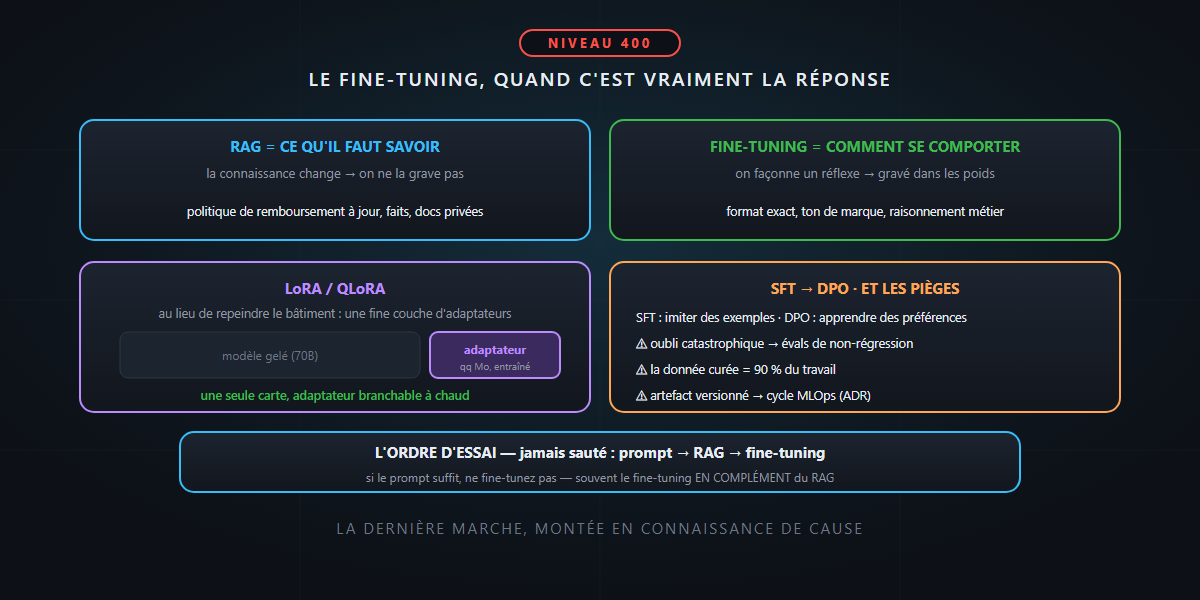
RAG teaches the model what to know. Fine-tuning teaches it how to behave.
You want it to know your up-to-date refund policy? RAG — the knowledge changes, you don’t carve it. You want it to always answer in your system’s exact JSON format, with your brand’s tone, following a specific business reasoning that three pages of prompt can’t reliably impose? There, fine-tuning wins. You don’t inject facts, you shape a reflex.
The signal that should make you consider it: your system prompt has swollen to two thousand tokens of examples and style rules, you pay for it on every turn, and it still “goes off the rails” one time in ten. That’s when moving the behavior from the prompt into the weights becomes profitable.
LoRA: fine-tuning without retraining the world
Why fine-tuning had its “expensive” reputation: retraining all the weights of a 70-billion-parameter model needs a GPU farm. The revolution is LoRA (Low-Rank Adaptation) and its variant QLoRA.
The idea, as an image: instead of repainting the whole building, you add a thin layer of adapters — small matrices grafted onto the model, representing a tiny fraction of the parameters. You freeze the original model, you train only those adapters. Decisive consequences:
- Accessible: a LoRA fine-tune often fits on a single card (QLoRA adds quantization to lower memory further). Not a farm, one GPU.
- Light to deploy: the adapter weighs a few megabytes, plugs onto the base model, swaps hot. You can have several (one per task) on the same model.
LoRA turned fine-tuning from an infrastructure project into a product-team operation. That’s what makes this article relevant in 2026 and not in 2022.
SFT and DPO: show, or make prefer
Two ways to teach a behavior, not to be confused:
- SFT (Supervised Fine-Tuning): you show examples of good answers. “Here are 500 tickets, here’s the ideal summary of each.” The model learns to imitate. It’s the main path, the one you start with.
- DPO (Direct Preference Optimization): you show pairs — “for this input, this answer is better than that one”. The model learns a preference, a quality judgment. Useful when “good” is easier to compare than to write — tone, diplomacy, avoiding a flaw.
The reflex: SFT to install the behavior, DPO to refine it on the nuances that examples alone capture poorly. And the quality of all this lives, as always, in the data.
The word of honesty: the three traps
- Catastrophic forgetting. In learning your task, the model can unlearn general capabilities — the price of too narrow a specialization. You watch it with evals that also cover the skills you want to preserve, not just the new task.
- The data is all the work. 90% of a successful fine-tune’s effort is curating the dataset: hundreds to thousands of clean, representative, consistent examples. A mediocre dataset carves flaws into the weights — far harder to fix than a bad prompt.
- Frozen, again. A fine-tuned model is a versioned artifact: new need, new training round, new eval, new deployment. An MLOps-style cycle, not a prompt edit. It’s an ADR in its own right.
The break-even calculation
The order to try, from least to most binding — never skip a step:
- Prompt engineering — free, instant, reversible. Exhaust it first, always.
- RAG — when fresh or private knowledge is missing.
- Fine-tuning — when behavior resists the prompt, at sufficient volume to amortize the MLOps cycle, and often alongside RAG (a model fine-tuned for format + RAG for facts: the winning combo).
The honest rule, symmetric with June’s: if the prompt is enough, don’t fine-tune. But when a behavior must be reliable, compact (out of the prompt paid on every turn) and repeatable, then carving it into the weights isn’t a luxury — it’s the right architecture.
In summary
- RAG = knowledge, fine-tuning = behavior. The wrong classification is the cause of 90% of disappointments.
- LoRA/QLoRA made fine-tuning accessible (one card, a few-MB adapter) — hence its rehabilitation in 2026.
- SFT (imitate examples) then DPO (learn preferences) — the curated data is 90% of the work.
- The traps: catastrophic forgetting (non-regression evals), frozen MLOps cycle (ADR), and the trial order prompt → RAG → fine-tuning, never skipped.
Fine-tuning isn’t level 100’s bogeyman: it’s the tool you bring out when behavior must be carved, not recited. Rehabilitated, framed, and in its right place — the last step, the one you climb knowingly. And that, honestly… is not rocket science.